

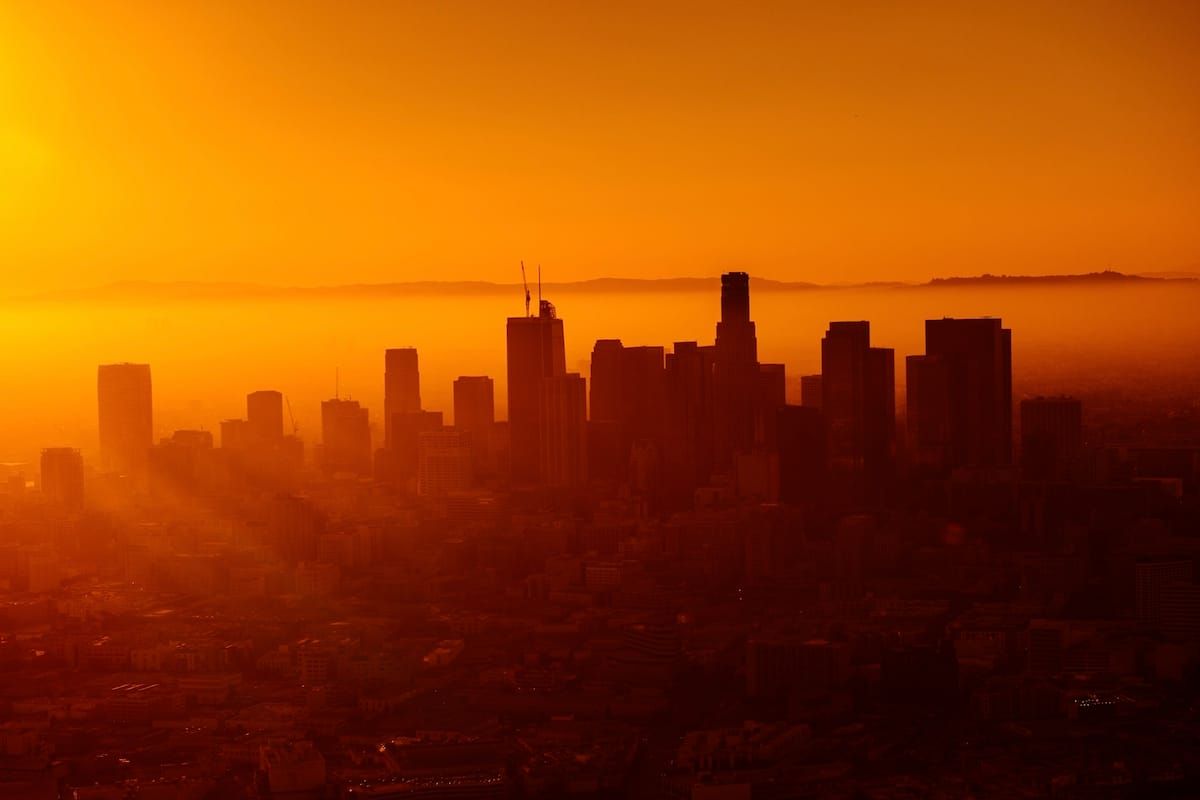
This week, those of us in the UK and much of Europe have been sweltering in a record-shattering heatwave. In London, on Wednesday, temperatures reached 35.1 degrees Celsius, smashing the previous May record—set just two days earlier—of 34.8 degrees, itself two degrees higher than the previous record high for the month. The historical average for this time of year? Just 18 degrees.
The extremes have spurred plenty of discussion about expectations of a “super” El Niño looming later this year: a particularly powerful phase in the recurring El Niño Southern Oscillation, which is driven by phasic changes in ocean temperatures in the Pacific.
But this week’s deadly temperatures are also inseparable from the steady march of a climate crisis that, despite its pace, has faded from the concerns of mainstream politics. Global average temperatures now stand at 1.4 degrees Celsius above pre-industrial levels. A super El Niño could raise them an additional 0.2 degrees. And while the effects are felt most acutely near the equator, nowhere is spared: Australia and Southeast Asia, for instance, face higher risk of drought and wildfire, while the southern United States and parts of South America face heavy rains and the potential for major floods.
In the past, particularly powerful El Niño events have in some cases driven catastrophic suffering and loss of life. In Late Victorian Holocausts, Mike Davis charts the effects of the 1877 El Niño event, which he estimates caused between 30 million and 60 million deaths in India, China and Brazil alone, with further widespread famine in Korea, Brazil, the Philippines and parts of Africa. But Davis is careful in articulating a critical element of these events: that weather is scarcely alone in bearing responsibility for the scale of harm. In Davis’s detailed account, populations whose traditional agricultural and water maintenance practices had been transformed by the machinery of empire were left suddenly exposed and unable to respond to extremes. It wasn’t merely weather patterns that caused the devastation across the Global South; it was the “malign interaction between climatic and economic processes.” Imperialism and economics dealt the fatal blows.
It's an insight that holds just as true today, and one that is important for understanding how the impacts of both this year’s super El Niño and a climate-changed future will unfold. In one of the first interviews for our podcast, I sat down with attribution scientist Dr. Friederike Otto, who explained how the severity of climate impacts is strongly shaped by factors like economic inequality and infrastructural neglect, which leave poorer communities more exposed and less able to adapt. It’s a conversation worth revisiting because, unfortunately, it’s a relationship that appears, for the time being, to be moving in exactly the wrong direction.
In the UK, for instance, where increasingly our infrastructure is built for a climate that no longer exists, we continue to radically underinvest in adaptation. A new report from the Climate Change Committee estimates says that, without adaptation measures being taken in the meantime, by 2050 the cost of climate change to public welfare spending will be between £60 and £260 billion per year—the equivalent of 1-5 per cent of UK GDP. And, as the governing party squabbles over its next leader, Reform—a party that has made opposition to climate policy one of its defining pledges—marches steadily toward power at the next general election.
What might that future look like? What might it mean for increasingly routine climate extremes and everything they imply—baking heatwaves in homes without AC; destructive flooding; surging food prices; rail delays as tracks grow too hot for service—to collide with political parties that deny them, and infrastructures and economic systems that, by design, are ill-equipped to handle them?

In many ways, this was the question that united our two panel discussions over the weekend at the How the Light Gets In festival in Hay-on-Wye: the first—with Joel Wainwright and Andreas Malm—on the prospect of solar geoengineering; and the second—with Lukas Slothuus, Richard Seymour and Peter Chappell—on the ecological politics of the far right.
In a sweltering tent over the scorching weekend on the Welsh-English border, we discussed two darkly plausible and interconnected visions of the future should we continue on the current path. Across much of the world—whether Reform and Restore in the UK, India’s BJP and Germany’s AfD, or France’s National Rally and the United States’ many new far-right factions—the fortunes of an “eco-fascist” or, to use Richard Seymour’s formulation, a “disaster nationalist” political project seem bright. For the climate crisis, however, the implications across the board are bleak.
This is true, of course, when it comes to mitigation denial and championing the fossil fuel economy, but those commitments are hardly novel or unique to the extreme fringes. Instead, what is particularly worrying about this turn is the marriage of an opposition to climate action with hardening perspectives on the border, alongside ethno-nationalism and a racist Malthusianism and exclusion as the foundation of ecological stability. None of this is new, but what is unique about this moment is the extent to which far-right narratives have moved the political “centre”, driving politics toward a future in which perceptions of scarcity, hardship and zero-sum competition draw sharp lines between those whose lives are worth protecting and those whose are not. Absent a major redirection, we’re looking squarely toward a future defined (to draw again on Mike Davis) by the “construction of green and gated oases...on an otherwise stricken planet.” It’s in this context that the prospect of geoengineering rears its head.
Faced with the continued failure to slow emissions, the idea that we might deploy forms of geoengineering at scale is creeping out of the policy fringes. The most globally decisive of these technologies, stratospheric aerosol injection (or “SAI”)—wherein reflective particulates are sprayed in the upper layers of the atmosphere to reflect incoming sunlight and cool the Earth—has moved from science fiction toward viable prospect with alarming speed.
For the past several months, I’ve been researching an in-depth podcast series on the subject with friend of The Break—Down, Geoff Mann. We have now spoken to dozens of experts who have assured us that the prospects of its deployment are both deeply concerning and concerningly plausible.
Just a few weeks ago, the sole private sector mover in the space, the US-Israeli startup Stardust Solutions, released a slate of documents outlining the features of its proprietary reflective particle and its suggestions for how further research and deployment might best be governed. Right-wing US think tanks, meanwhile, have published multiple reports in recent months on the urgency of “weather sovereignty” and the need for the US to be a first mover on the technology as a “national security imperative”. And, as both Malm and Wainwright asserted on our panel, there is really only one actor well placed to act first and decisively on SAI: the US military. As climate-related disruption bears down in the years ahead, the prospect of their doing so, in an effort to stabilize the United States’ position in the global economy, grows more likely.
There’s a lot more to say on this issue, but we’ll have to save that for the series (due out this summer: watch this space). For the time being I’ll try to summarise it as follows: the climate and ecological politics of the new and increasingly assertive right are driving us squarely toward a world that, in its desperation, might demand large scale climate interventions like SAI. In this context, it is hardly contradictory that parties or leaders who disavow the urgency of the climate crisis might develop and deploy these technologies in the interest of security or geopolitical dominance.
So where does this leave us? Admittedly this hasn’t been the cheeriest of notes. But if there was an overriding takeaway from both conversations this weekend at Hay, it was the urgency of reinvigorating the movement for climate action and economic transformation that existed not so long ago. That movement proved itself genuinely capable of moving the dial. An even greater and more innovative movement is needed now, not only pushing for decarbonisation, but also for equitable forms of adaptation. And, though I hope otherwise, it will be needed if, a decade or so from now, we find ourselves staring down the barrel of large-scale geoengineering—a technology whose deployment could unfold in radically different directions.
We feel far from such a movement right now, but there are green shoots. Last month, thousands of representatives, activists and scientists from more than 57 countries met in Colombia for the inaugural conference on phasing out fossil fuels. Among the outcomes was the initiation of a recurring process, like the COPs, of annual meetings to continue regular deliberations and build a collaborative strategy for fossil fuel phaseout focused, critically, on production. It’s a tall order, but tall orders are exactly what the moment calls for. And while the process is inherently vulnerable and not without shortcomings (see Joel Wainwright and Wim Carton’s reflections on the conference), among the many vital outcomes from Santa Marta is the scaffolding for a new, internationalist climate movement. It’s incumbent on all of us to build upon it.
Adrienne Buller is the editor of The BREAK–DOWN..