


The Great Biodiversity Bake Off
The last 30 years of biodiversity policy would have made for good(ish) TV. Each season, new project developers come on the scene, building excitement about their idea for how to turn biodiversity into an investible asset. The pilot episode could have been bioprospecting Costa Rica's genetic resources. Then biodiversity credits in the Amazon, followed by a bond linked to Rhino numbers or a satellite that tracks whales as carbon credits.
Some of these ideas have helped fund important conservation projects: the Yurok Tribe, for example, has leveraged forest-based carbon markets to buy back pieces of their territory in California and conduct ecological restoration. Other ideas have been speculative, unscientific or ludicrously ignorant of their social and ecological impacts. All have jostled for attention among NGOs, governments and the private sector, making the case for how they will create a market that can “unlock trillions” in capital for biodiversity conservation and restoration.
But the promised flood of capital has never arrived. Instead, viewers have tuned in to see the proliferation of pilot projects, boutique funds and voluntary efforts repeatedly demonstrate that profit-motivated biodiversity conservation remains a tough sell. Each time, the money mobilized has been small, inconsistent and dependent on public subsidies and philanthropic guarantees. The result is an outlook for biodiversity that resembles not a burgeoning capital market but something more like a bake sale.
“Bake sales”, for those who don’t live in the Anglosphere, became popular in the 19th and early 20th centuries when churches, schools and charitable groups would sell homemade cakes, pies and breads to raise money for various causes. Over time, bake sales became a staple of school fundraising—today, they are often used to support extracurricular activities like sports, music and field trips. Bake sales are voluntary, piecemeal and subsidized by concessional capital and labour (parents buying ingredients and making the cakes and cookies themselves), while the proceeds are unpredictable. They are not designed to support ongoing investment in essential infrastructure; they are stopgaps in weakened public systems.
As with bake sales, most biodiversity finance projects depend on subsidies: public money or philanthropic funds that absorb potential losses so private investors are motivated to participate. A whole range of public and NGO actors work behind the scenes to perform this market under the impression that such efforts are more efficient and scalable than funding conservation directly. And so, despite nature-related private finance consistently falling short of the lofty projections for market growth, the show is always renewed for another season.
Ecosystems, of course, are not the only public goods exposed to marketization efforts—health care, education, utilities and transportation systems in many parts of the world are under pressure to turn core infrastructure into profitable business models. But even in this context, biodiversity faces a unique set of constraints to privatization and profitability: put simply, there is no market for the type of global protection and restoration needed to stay within planetary boundaries. Lack of revenue, high transaction costs, low liquidity and the need to satisfy investors’ risk-return profiles all limit the scale and distributional reach of projects.
So, despite frequent projections that the market will scale, the lack of a true business case for investment in biodiversity has relegated “market-based conservation” to a never-ending bake sale.
Perverse Incentives
Why, then, spend so much energy trying to appeal to private finance when you don’t have the one thing it needs—profit?
Public funding remains, by a long shot, the largest force in biodiversity conservation. But with private capital increasingly concentrated and public finance increasingly scarce, those seeking funds for conservation work are frequently told they must develop return-generating ideas to tap into this abundant capital.
While raising money for protection and restoration is critical, a lack of conservation funding is not the primary driver of the ecological crisis. Most ecosystems are lost not because of insufficient funds but because the pressures to convert them to other uses are so strong. Up to 90 per cent of all biodiversity loss on land is estimated to be driven by extractive land use change, including mining, forestry and industrial agriculture. Much of this happens with the full-throated approval of the state, although informal or illegal practices drive these activities, too.
Finance follows a similar pattern: while some finance supports illicit activities, oftentimes shielded by tax havens, the majority of this destruction is entirely above-board. UNEP’s 2026 State of Finance for Nature estimates that in 2023, harmful subsidies, dominated by those for fossil fuels, agriculture and water use, reached about US$2.4 trillion, while private finance harmful to nature was US$4.9 trillion.[1]
Those pushing the business case for nature hope that one day the true value of ecosystem services will be reflected in economic activity and can therefore come to outweigh the pressure to convert to other uses. Report after report has proclaimed that the destruction of nature will soon come to hinder profits. One oft-cited figure, produced by consulting firm PricewaterhouseCoopers, suggests that $44 USD trillion of the world’s Gross Domestic Product (GDP) is dependent on nature; while the World Economic Forum consistently ranks biodiversity loss as one of the top global risks to GDP, population and natural resources. Yet little has changed in terms of the underlying economic drivers of this loss. Why?
At present, extraction is baked into the structure of the international financial and monetary system. Under the current arrangements of this system, forgoing extraction is not a dollar-for-dollar problem, as if all revenue streams or budget items are created equal. For many countries—and especially those in the Global South, where the majority of the world’s remaining biodiversity and tropical forests are found—revenue from the extractive activities that drive environmental destruction are critical for maintaining financial stability. Extractive industries and the raw materials they produce for export bring in the foreign currency that is necessary for managing balance of payments, making burdensome debt repayments and keeping investment flowing into the country. Without this influx of foreign currency (and the strong commitment to the sectors that generate it) governments face not simply lost revenue but a further deteriorating financial position in the form of capital flight, credit rating downgrades, currency runs and investor disputes.
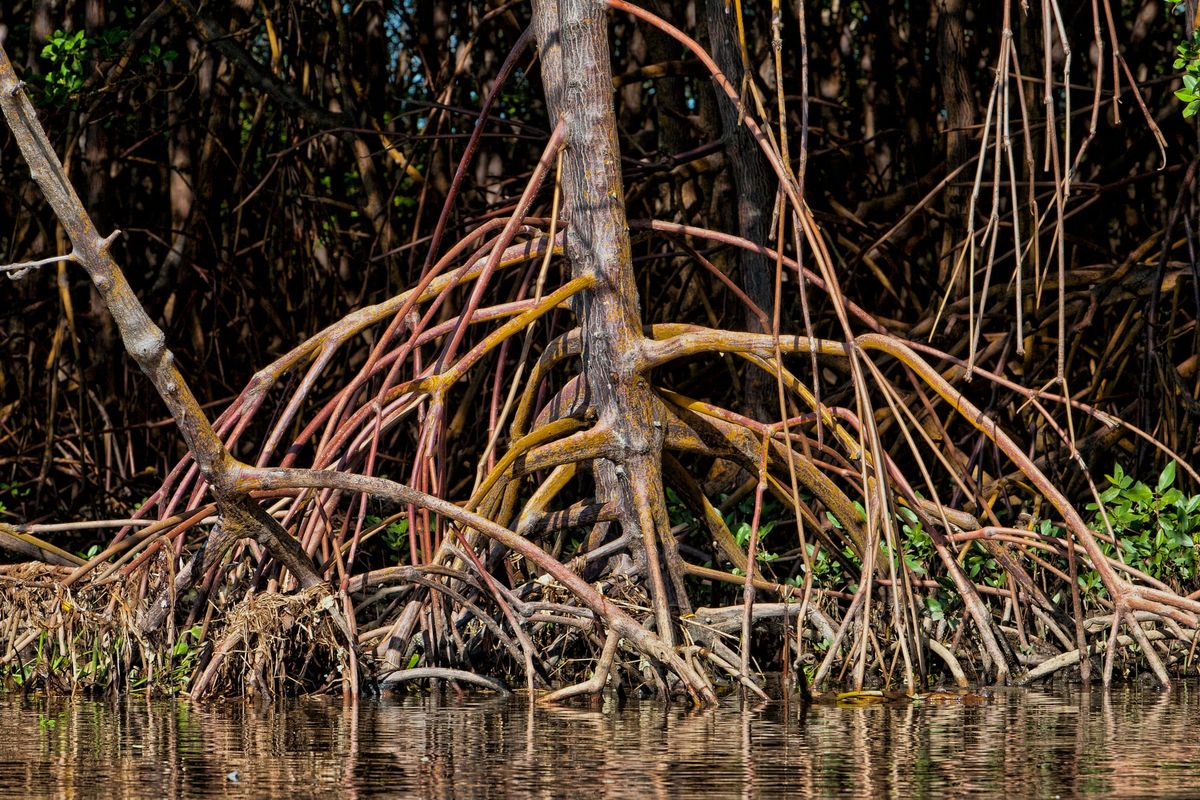
Under these conditions, ecosystems are often put up as collateral to regain stability in times of fiscal crisis. Mangrove ecosystems are one such example. Mangroves play a key infrastructural role in coastal areas: in addition to their function in the global carbon cycle, they protect against storms and sea level rise and provide critical habitat for wild fisheries. But mangroves have been destroyed at record pace in recent decades, making them one of the most threatened ecosystems in the world. The majority of this destruction took place following the 1980s debt crisis, when countries across Latin America and Southeast Asia were encouraged, funded and sometimes mandated to rapidly expand exports. The result was a boom in agricultural and aquaculture production, which accounted for nearly half of all mangrove loss, with intensive shrimp farming leading the charge.
Shrimp farming was implemented—with hefty support from development banks and international financial institutions—as a strategy for regaining financial stability amid external shocks in the global economy. While initially the scaling of intensive shrimp farming boosted yields, exports and local incomes, it also created long-term vulnerabilities to disease outbreaks and ecosystem collapse, as well as increased exposure to storms and flooding. Then, as production systems failed and companies relocated, communities were often left with degraded environments, reduced food security and mounting debt. The prioritization of short-term financial stabilization and creditor repayment imposed lasting social, economic and ecological vulnerabilities—including mangrove loss.
These vulnerabilities constitute the very conditions from which the bake sale now seeks to construct a market. For conservation efforts to provide marketable services, particularly in carbon and nature markets, projects must demonstrate “additionality”—that is, they must prove that things like mangrove protection or restoration would not have occurred without private finance. This means that governments must be scientifically verified as being unable or unwilling to carry out conservation or restoration, lest the market lose legitimacy. Lacking state capacity, therefore, supplies one counterfactual that makes this market legitimate, transforming the degradation of ecosystems and of public capacity for environmental management, into an opportunity. Austerity thus does not merely coexist with biodiversity markets, but forms a premise on which they claim to generate value.
Certainly, many states do lack the budget, staff or mandate to protect ecosystems at the scale needed. But responses to this austerity often entrench the conditions they seek to answer. In pursuing environmental markets in things like ecosystem carbon offsets, states can perceive perverse incentives against regulating the protection of ecosystems or funding their restoration, which would render them uninvestable. And as private finance is positioned as the only viable option for such investment, this consensus reinforces itself in market design. Given the poor outlook for raising sufficient finance from these markets, this is particularly concerning. The result is a landscape of “austerity natures”: proliferating ecosystems in need of repair alongside states understood as structurally incapable of providing it.
Austerity Natures vs. Abundance Extractivism
Against state austerity, the bake sale is often seen as better than nothing. If budgets cannot expand, then private finance seems pragmatic rather than ideological.
But bake sales are not simply an unproductive side show. They are a symptom of a deeper political settlement, one that relegates biodiversity and the communities that manage and depend on it to swim upstream against a waterfall of subsidized extraction. Meanwhile, as conservation groups hustle to raise millions through private schemes, governments mobilize billions of dollars, acting decisively and at scale, to expand pipelines, subsidize fossil fuels or underwrite industrial development.
In this context, state power is moving decisively towards what we might call “abundance extractivism.” As many proponents of the “Abundance” agenda, à la Ezra Klein and Derek Thompson, point out, many states are beset by bureaucratic intransigence and poorly coordinated regulations. Abundance extractivism shifts this focus, utilizing it most fervently to fast-track and streamline resource developments, including fossil fuels pipelines, mineral mines and monoculture plantations.[2] Such projects are viewed as essential, not only for financial stability, but also national security. The result is a ballooning of state financial support—taxes paid by you and us—used to de-risk extractive activities.
We don’t deny the reality that Klein and Thompson focus on, nor the urgent need to build stuff like affordable housing, transit and renewable electricity infrastructure. But alongside this must be an equally dramatic fast-tracking and financing of abundant and diverse forests, rangelands, wetlands and, yes, mangroves. Instead, what we see in many conversations about biodiversity conservation is inflated perceptions of private capital’s willingness or ability to solve environmental problems, all of which distracts from the need for public investment at scale, the protection of essential ecosystems and, at the international level, coordination to undo the hard wiring of rampant extraction into the political economy of financial stability.
These alternatives do not promise flashy innovation or win-win solutions. Instead, they involve compromise and planning, as well as the need to operate through democratic mechanisms of the kind that many have lost faith in. They require rebuilding policy space and public capacity to steward nature at scale and learning how to do this in a way that upholds rights and meets societal needs. They require sticks, not only carrots: habitat protections, meaningful penalties for failing to comply with environmental law and financial regulation.
If biodiversity is essential infrastructure, then its protection demands budgets, laws and political commitments commensurate with that status. We don’t need more bingeable TV or a Great Biodiversity Bake Off—we need stable, boring, sustained, large-scale public investment and planning which can protect the broad public benefits of intact ecological systems as well as the rights and tenure of Indigenous people and local communities.
Beyond the Bake Sale
As states spend more and more on their militaries, alongside rising inflation and pressure to cap public spending, supporting biodiversity as essential critical infrastructure, in collaboration with Indigenous rightsholders and local communities, can feel like a pipe dream: less possible than winning the Bake Off or finding a soulmate on Love Island. Reality is a sobering place to inhabit.
But we cannot hide from it, nor can we rely on elaborate workarounds. Threatened ecosystems will not be saved by rhino conservation bonds or by turning whales into carbon credits. We can’t assume that we can just plug a new dollar value into the column labelled “nature,” and keep the rest of the international financial system exactly as we found it. Entrepreneurs search for niche market innovations; political movements are the only ones capable of shifting the real-world constraints.
Taking biodiversity seriously as a political project means supporting the necessary (but often underfunded and marginalized) work of stewarding ecosystems to meet people's needs: managing forests to reduce wildfire risk, ensuring clean water and protecting wild fisheries. It would mean advancing an entirely different vision of stability, with a built-for-purpose political economy to support it. This vision must adhere to and advance implementation of the United Nations Declaration on the Rights of Indigenous Peoples.
But, as mangroves illustrate, the policy space to undertake this project is conditioned by powerful, international economic pressures. Bold environmental policy runs the risk of provoking capital flight, currency runs and financial instability. While these are far from the only pressures that states face in reforming harmful sectors, their grip on environmental policy remains firm. In many contexts, then, an ecological transition can only happen if we prevent quick-moving financial discipline based on short-term returns overtaking the longer-term structural planning needed for planetary stability.
To do so would mean shifting from appeals to concentrated private capital with return-generating ideas to paying attention to how this capital falls through the cracks of low corporate tax rates, tax evasion and subsidies for extractive sectors, all of which constrains governments budgets further. We must focus on closing these cracks, while expanding public budgets through progressive taxation, regulating harmful sectors at their source and directing investment towards life-sustaining infrastructure. Doing so means joining forces with movements trying to produce the political and economic conditions for a liveable and truly abundant, planet, including those focused on debt, tax and resource justice, and resetting the asymmetrical relation between governments and finance.
These are the kinds of reforms that every biodiversity advocate should take seriously. Rather than fighting for crumbs, we should be putting forward a bold vision of an international political economy that can deliver global ecological stability. This may seem like a departure from the usual conservation policy, but it is necessary for transforming the conditions that threaten life on Earth.
- This includes public finance flows that encourage unsustainable production or consumption and harm nature through resource depletion, ecosystem degradation or adverse planetary health impacts. Private finance is measured through bonds, loans and equity, flowing to high-impact sectors such as utilities, industrials, energy and basic materials.
- A recent extreme example, in West Papua, has seen the conversion of an expanse of forest roughly the size of Belgium into profitable monoculture. See: https://www.lrb.co.uk/blog/2025/august/the-world-s-largest-deforestation-project
Audrey Irvine-Broque is a PhD Candidate in the Department of Geography at the University of British Columbia and a Research Associate at the Climate and Community Institute.
Jessica Dempsey is a Professor of Geography at the University of British Columbia and a Senior Fellow at the Climate and Community Institute.