

Reading Marshall Berman for the Climate Crisis

Reading Marshall Berman for the Climate Crisis
Drunk, sleep deprived and furiously talking through the night, a gaggle of early 20th Century Italian men pile into a Fiat. Leaving behind Milan’s rickety tram, “feeble” canal and traditional architecture, they step on the gas and rush out of the city.
Accelerating at thrilling speed, they honk and holler like schoolboy drag racers. But the scene is interrupted as quickly and jarringly as it began. In their way appear two “wobbling” bicyclists, natural enemies of the progress and pace these men seek to harness through the emerging power of the automobile. Narrowly avoiding them, ringleader Filippo Tommaso Marinetti swerves the car into a ditch, drenching his men in muddy water. The slapstick sketch could have ended in horror but, to the readers’ shock, Marinetti is pleased. He “came up—torn, filthy and stinking—from the capsized car” and “felt the white-hot iron of joy deliciously pass through [his] heart.” Perversely gratified by the destruction, Marinetti goes on to introduce the eleven tenets of Futurism, the Italian avant-garde movement of which he was the leading member.
Marinetti’s Manifesto offers an apt, if chaotic—and, depending on the translation, occasionally racist—preface to this brief but ultimately influential movement, one that violently glorified speed, war, masculinity, the erasure of history and the congested industrial city. Central too, for the Futurists, was the image of an urban landscape always under construction; each generation, they suggested, should raze the buildings of their predecessors and build anew: a city wholly “untainted” by the architecture of the past.
The Futurist movement may have been short-lived, dying with many of its members on the battlefields of the First World War, but as the writer and urban theorist Marshall Berman recalled in his classic 1982 account of urban modernity, All That Is Solid Melts into Air, the movement's vision did not die with it. As Berman wrote, the movement’s “uncritical romance of machines, fused with their utter remoteness from people, would be reincarnated in modes ... less bizarre and longer-lived.”
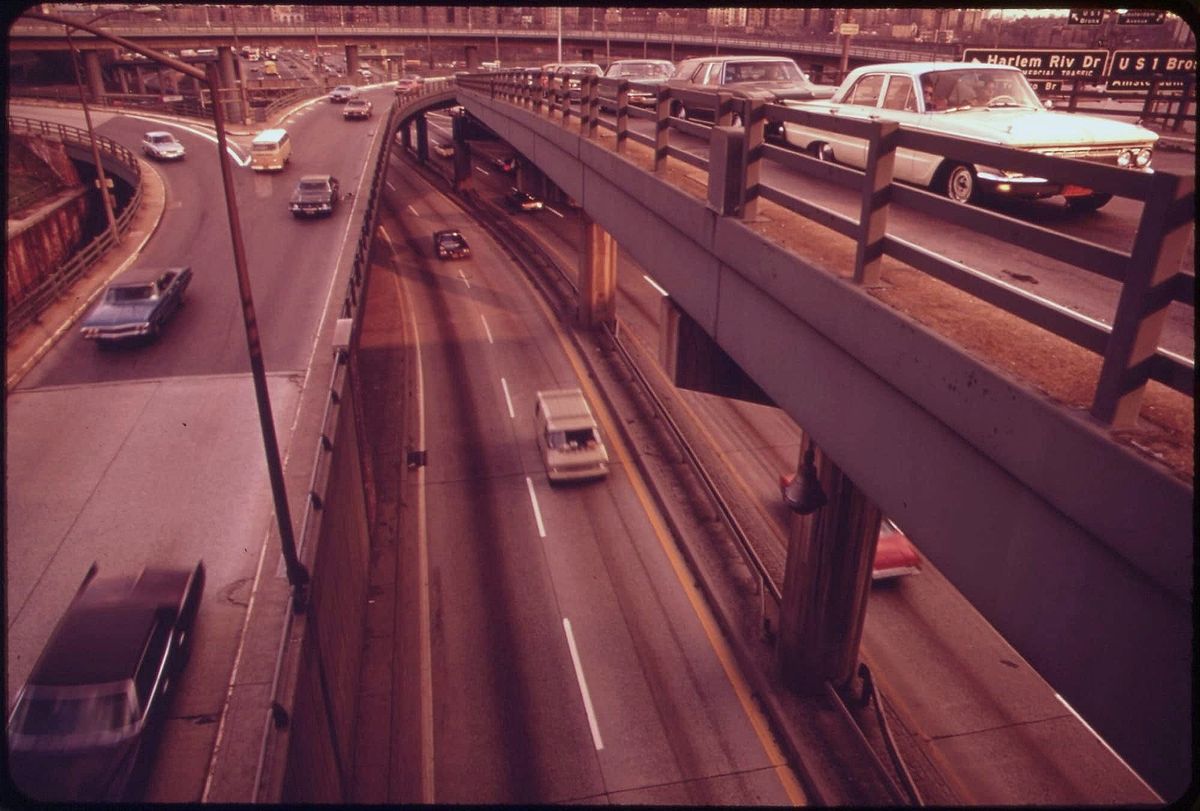
Chief among these is a now globally pervasive—and environmentally catastrophic—car culture. Beyond the immediate risk of accident-related casualty, much of the violence done by today's vehicles is ecological: polluting our air, land and water; generating some of the most toxic emissions to human health; encouraging sprawling, resource-intensive land use; and burdening vulnerable communities with the brunt of structural harms.
Of course, motordom wasn’t exclusively a product of modernism. An entire Fordist economy arose around automobile manufacturing, enabled by labour exploitation and predicated in the U.S. upon racial inequality. Still, Berman asks us to grasp that something more than capitalism shaped the car-flushed and congested urban landscapes many of us have inherited. His argument remains key to understanding the promises and risks of efforts to address them today.
“We come from ruin, but we are not ruined.”
In All That is Solid, Marshall Berman traverses many of the 20th Century’s landmark artistic, literary and physical construction feats, those material and cultural infrastructures with which we’re still contending. Berman guides us through the history of modernity to the emergence of the “machine aesthetic” in the twentieth century, with its concrete blocks, “rational” straight lines and celebration of the extractive mass production techniques enabled by industrialization. Throughout, Berman’s work seems to tell us not only that history repeats, but that we disservice our present and future selves when we fail to learn from the past.