

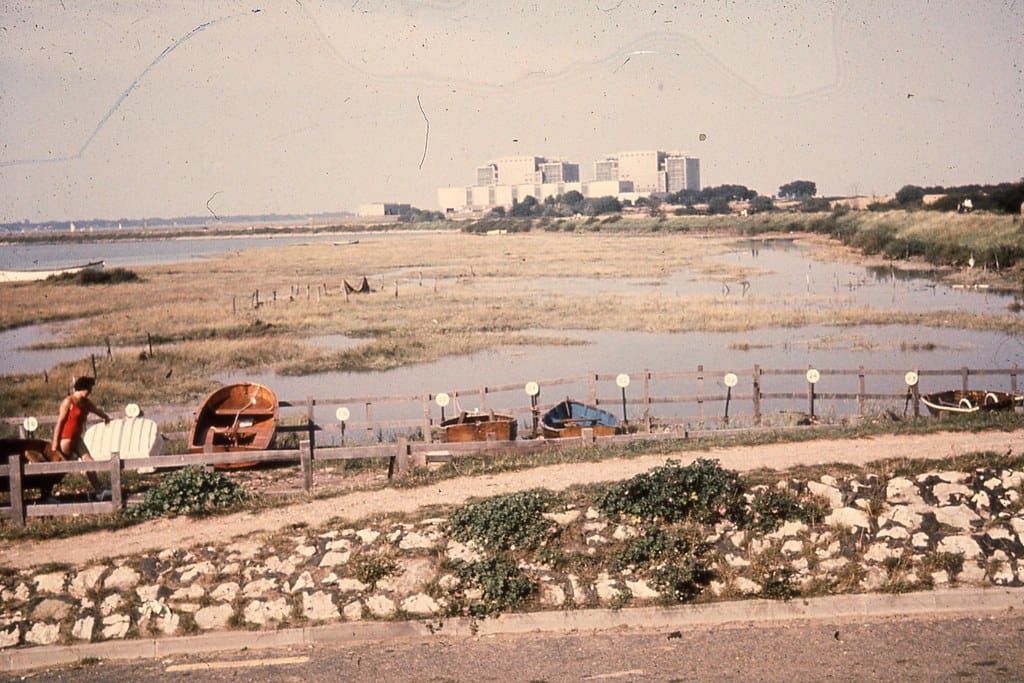
The Chapel and the Nuclear Plant
i

The Chapel and the Nuclear Plant
Robert Newton

At a remote Essex chapel shadowed by a dormant nuclear plant, a battle over a proposed new reactor reveals how Britain’s drive to decarbonise is reshaping old conflicts between conservation, community and state power.

For eighty years, a small religious collective called the Othona Community has worshipped by the chapel of St Peter-on-the-Wall, at the edge of a marsh on Essex's Dengie Peninsula. It’s a simple structure, more like a barn than a church, its sandstone walls patched with brickwork. In the seventh century, Saxon monks built it from the ruins of a Roman fort. Ever since, this compact form has stood in counterpoint to the broadening span of the mudflats, to the expansive sky.

In recent decades, this ancient place has stood in tension with a more recent force, one that arrived on the Essex coast in the mid-twentieth century: nuclear energy. Two miles to the chapel’s east, at the mouth of the River Blackwater, is a dormant atomic power plant called Bradwell A. In the 1950s, when plans for the power station were announced, local people and conservation organizations made the chapel a symbol of their opposition. For these campaigners, the contrast between the chapel and the power plant expressed a wider conflict in post-war Britain, in which centrally planned motorways, towns, and reservoirs intruded into quiet, hidden places. Decades later, those struggles seemed to have faded into history, while Bradwell A, retired in 2002, was encased in a metal sarcophagus to seal up its four thousand cubic metres of irradiated graphite.

Life by the marshes went on. Then, rumours of a new nuclear project reached the estuary, and the chapel once more became a focal point for debates about nature, history, and power.

In 2015, EDF (the French state-owned energy group) and CGN (a Chinese state-owned energy corporation) proposed the construction of a new atomic plant in Essex. Five years later, their joint enterprise BRB was claiming that nuclear energy was critical to the UK’s recently announced target of net zero emissions by 2050. Bradwell B, as it would be known, ‘would make a vital contribution to meeting the UK’s future need for low carbon, secure and affordable energy’, they declared, and would offer a stable source of electricity ‘when limited wind and solar power is produced’.[1] 

Locals baulked at the new project, which would be several times larger than Bradwell A. The Othona Community, in particular, voiced fears that the plant would devastate a sacred site, and questioned the need for nuclear power in the energy transition. Once again, the chapel and the nuclear plant became emblems of competing visions of this place: one channelled its distinct historical, ecological and spiritual qualities; while the other subordinated them to a grand industrial scheme. But now, a new tension was at play—a tension between a local form of environmentalism, and an emerging argument for nuclear power as a solution for the energy transition.

Since the Chernobyl disaster in 1986, atomic energy has in the popular imagination been associated with abandoned cities, toxic clouds and cancer. Despite its continued prominence in electricity systems, this association persists. Two decades into the twenty-first century, as activist movements drove the climate crisis up the political agenda, lobbyists spotted an opportunity to refresh their industry’s image, developing a potent new narrative: there can be no decarbonization without nuclear power. Protestors against Essex’s first nuclear plant saw themselves as protectors of the natural world, defending what they called “this half-land of mud and ooze and salted winds” from an “industrial invasion.” This time, though, to resist development was to find oneself an adversary of state climate policy. Local opposition to a nuclear plant was revealing a new faultline in British environmentalist culture, pitting conservation against an increasingly mainstream vision of decarbonisation.

***

By the time I arrive at the Othona Community, I am quietly asking myself whether it is wise to have come here. It is spring 2021, and under the oak rafters of a spacious modern hall, I am drinking tea with Pete, who has been with Othona for twenty-two years, and Richard, the new warden. Pete is telling me how he joined the group. “It’s great being part of a cult,” he declares with a grin.

 “My friend knew about Bradwell, and he knew about the chapel. And he says, ‘Would you like to go and see the oldest chapel in the country’. We came down, had lunch in the village, seen the chapel. And then we started walking along the sea wall.” He leans in conspiratorially. “We saw the sign for the Othona community, and thought, ‘Oh, what’s that?’ We walked in here, and it was kind of like…a strange place. There was nobody here, and I thought we were going to get chased away by some kind of mad cult thing. Which I soon found out it was.” I laugh nervously. “And I’m still here!”
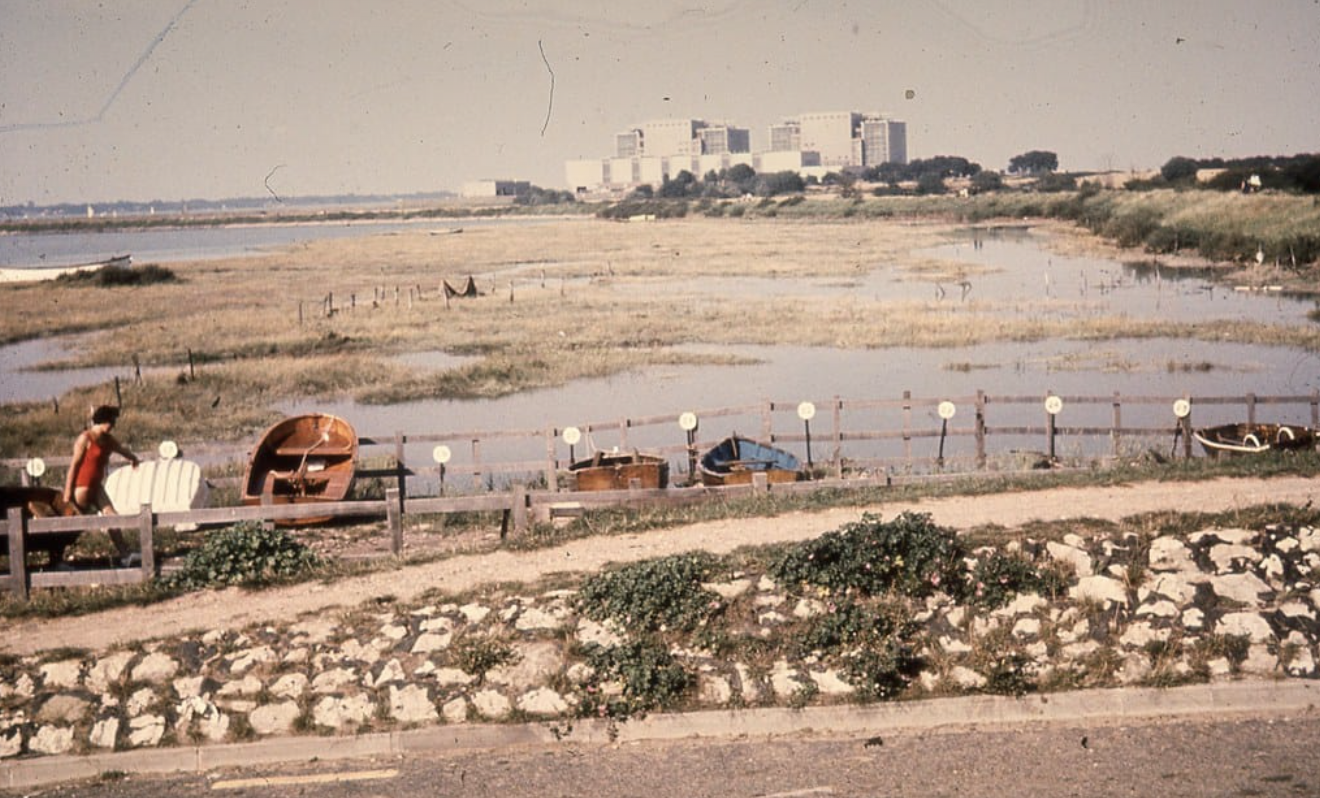
 “Which way did you come in, by the way?”, he asks. Images flit through my mind: the blank sandstone front of the chapel; an opening in a hawthorn hedge like a tunnel; yurts covered in algae, laminated images of medieval saints at their doors. I describe the route to Pete. “Ah yes,” he says. “Generally when you come in that way, you don’t leave. I will get the next pit ready!” I force a strangled laugh and look down at the teapot, which sports a crochet tea cosy in the form of a chicken.

I can only think to ask how the pair feel about the nuclear plant. Pete’s expression darkens. “I hope this thing doesn’t go ahead,” he mutters. “The destruction to this area is just going to be immense.”  

***

Norman Motley, the founder of the Othona Community, first came to the Blackwater Estuary in 1946 in search of a home for his new religious collective. Motley had investigated the island of Lindisfarne, which he found too remote, and a ruined mansion in Gloucestershire, which he found too expensive. Then, he found the chapel of St Peter-on-the-Wall and ‘came under the spell of that ancient building’:

There, one can breathe. The land on which we stood is almost a peninsula, with the mile wide estuary to the north and Bradwell Bay behind – and all round and curving to the south, the North Sea. The cry of the curlew was heard, and a variety of maritime flora and many sea birds were visible on the saltings; and withal, a great silence.

During the war, Motley had worked as a chaplain at an RAF training centre in Blackpool. Assigned to give religious lectures to trainees, he became frustrated by their didactic format. In response, he set up what he called “answer back meetings,” in which men and women of all military ranks, religions and political persuasions were encouraged to talk across social barriers about collective wartime suffering. The result, Motley wrote, was “a sense of belonging, of solidarity, and of caring.” When the war ended, some participants in these meetings, dispersed but still communicating, decided to regather and resume their discussions, this time alongside released German and Italian prisoners of war. In doing so, they hoped, Motley later said, to “meet the post-war world with some idea of a framework which would make a contribution to the inevitable uncertainties of the time.”

The Essex coast near Bradwell is a place of contradictions. In its offshore world of saltings, creeks and islands, religious dissidents and writers have long sought to escape from convention and surveillance. Planners, meanwhile, have found here a blank space on the map, a surface onto which to project large-scale infrastructural fantasies.

In the 1850s, speculative investors observed hungrily that Essex contained “waste lands of considerable extent,” resolving to claim its marshes from the sea. In their place, they envisaged tens of thousands of acres of prime farmland, or pools of London’s sewage pumped away from the capital in new pipelines. Their schemes failed, but not before excavators had uncovered some remnants of the Roman fort of Othona, along with a few spearheads, brooches and bones among the ruins. While the reclamation projects came to nothing, the power dynamics they expressed lived on, to re-emerge in a distinctive twentieth century form.

First came the power plant. In the 1950s, the Central Electricity Generating Board (CEGB) was looking for “isolated and undeveloped” places to build a new generation of nuclear power plants. They chose to build the first of these at Bradwell, despite considerable local protest. 

Then, the 1960s brought plans for a new airport on the mudflats of Foulness Island. Foulness was preferred to a location in Buckinghamshire, which, unlike the Essex marshes, had rolling hills, hedgerows and little woods, and was thus deemed “of interest” to the “open background of London.” One campaign slogan exclaimed: “Don’t foul Bucks, Foulness.” This doubled character of the Essex coast—in location, close to London and the urban zones of the southeast, and in landscape aesthetics, readily categorised  as a foul, undeveloped waste—has for two centuries made it a convenient, peripheral place to put ugly but necessary things. 

***

Bradwell A was built as part of the CEGB’s 1950s SuperGrid initiative: an ambitious programme to transform national electrical infrastructure. The social history of the SuperGrid—characterized by a volatile geopolitical background, tensions between the local and the national and the mutual incomprehension of conservationists and engineers—recalls in some respects the UK’s contemporary energy politics. In the late 1950s the CEGB, Britain’s newly formed state-owned electricity vehicle, was embarking on a wave of activity, marked by a strong commitment to nuclear power as “the energy of the future.”

At the time, nuclear power was salient in Britain. Reactors could create raw material for nuclear bombs, detonated in tests on Indigenous lands in Australia and the Pacific, spectacles deemed necessary by political leaders to project British strength as the empire diminished. With oil supply in doubt following the Suez Crisis, and with pessimistic projections of British coal production, nuclear electricity was also at the forefront of political consciousness. In 1957, the government announced its intention to build nineteen nuclear power stations—enough to supply a quarter of the nation’s electricity. A new fleet of British-designed reactors, they promised, would generate cheap power far into the future.[2] And although they did not yet know it, some isolated communities throughout the British Isles were about to become participants in this story of imperial decline, statist dynamism and atomic ambition.

Nuclear power plants require a specific set of geographical characteristics: deep water, to cool the hot uranium rods and keep the reaction stable; solid ground, to protect the plant from subsidence; and a sparse population, so that less people will die in the event of a catastrophic accident. In the 1950s, these requirements were new in the context of power generation. Coal-fired electrical plants, then the predominant form of generation, were located near mines or railways, and near population centres. This reduced the costs of transporting coal and building high-voltage lines. Nuclear plants, with their need for deep water and few people, would bring large-scale generation infrastructure to remote parts of the country hitherto sheltered from heavy industry. Furthermore, they would necessitate the construction of long transmission lines across the countryside to convey the electricity to factories, towns and cities.[3] This, as the CEGB anticipated, would be culturally convulsive and politically fractious. 

As the first of the new reactors, Bradwell A drew attention not only from locals, but also from national organizations. At a public inquiry held in a village hall, the Campaign for the Protection of Rural England exploited the contrast between the “modest, lonely and ancient chapel of St Peter-on-the-Wall,” and the “dominating bulk” of the proposed station. And no less than the future poet laureate John Betjeman showed up to defend Essex’s “unregarded beauty”, pronouncing that he “came here voluntarily because I regard the siting of power stations as something which is of national importance, and Bradwell station as a test case and a national thing.” 

To placate the forces they had raised from the land, the CEGB used a surprising means: landscape architecture. If the visual impact of power stations and transmission cables could somehow be softened, they reasoned, people might be more willing to accept these new arrivals. At its height, the CEGB’s landscape architecture section employed thirty-two people, and the organization even declared itself “the modern patron of landscaping.” Its architects saw themselves as working to create a “social landscape”, and where conservatives like Betjeman identified an irreconcilable opposition between power generation and the countryside, they imagined the possibility of integrating ancient places with the aims of a modern state.

Image from Sylvia Crowe, The Landscape of Power

The landscape architect assigned to Bradwell A was Sylvia Crowe. With a background was in garden design, she was both a pragmatic participant in and an imaginative theorist of the changes underway in Britain. As she wrote in her 1958 book The Landscape of Power, there was “no tradition of design to deal with” an “influx of gigantic constructions and power lines.” Crowe’s work on atomic energy—not only at Bradwell, but also on her masterpieces at Wylfa and Transfynydd—represents a resourceful, intelligent and subtle endeavour to create such a tradition. 

For Crowe, the most reliable “treatment” for huge structures was to build them in places that could “take the new scale”. If built among mountains, for example, a nuclear plant would be placed into dialogue with vast volumes of even greater size. But in Essex there were no mountains. The only thing for such places, Crowe concluded, was what she called the “tactful blending method”. The “scale and majesty of the reactors and turbine houses,” she decided, “should be accepted; nothing can humanize them or relate them to a small-scale landscape.” But the extraneous features of the plant—the car parks, fences, and electrical gear—could be concealed.

To absorb transformers into farmland, Crowe conceived of earthworks that would “have the clean architectural quality of giant lynchets”—stepped earthen structures used in ancient British field systems. The “spirit of the flat landscape”, Crowe declared, would be “echoed in the horizontal terraces of the spoil banks,” just as the “open landscape of grey sea and sky, of flat marshland and clouds,” would be “reflected in the grey and glass of the reactor’s cladding.” From “the old chapel of St Peter-on-the-Wall,” she observed with satisfaction, “the whole of the reactor will be hidden.”

Sixty years later, Bradwell A has been absorbed into the everyday life of the estuary. Its reactors have been dormant since 2002, and peregrine falcons nest above their quiescent shells. The armed night-time convoys transporting spent fuel rods to Sellafield are a thing of the past. People employed to clear the rest of the plant—a process that will last into the 2080s—go down the pub, where they spread rumours that the old uranium rods were hotter than anticipated. Pete tells me that fishermen used to cast their lines into the thermal plume created by the outfall of the cooling water, which was warmer than the river upstream and preferred by certain breeds of fish. “Fairly popular place for swimming as well I think,” adds Richard. “Yeah”, Pete deadpans. “And you come out green.”

“We’ve kind of accepted it’s there,” says Pete.” With the decommissioning they spent two or three years re-cladding the whole thing, because before it did look like something out of the USSR in the 1960s. That softened it a little bit.”

“The only advantage this area has for a new nuclear power station,” says Richard, “is that there’s an old one there, and there aren’t many people to complain.” I ask whether other residents, having got used to one nuclear plant, might be more willing to accept a second. “When you look back to when the first Bradwell was built,” says Pete, pointing over my shoulder in the direction of the dormant plant, “there were huge protests around here. Roads closed, people marching up and down. This time, it’s much more hush-hush, more quiet.”

I point out that on my way to the chapel, I passed through neat villages hung with banners reading “Leave Bradwell Be”. A few houses had posters in their windows, with images of gas masks and radiation symbols. “I think generally people were fairly relaxed,” says Richard, “until the first consultation came out and they saw the scale of it.”

The village of Bradwell lies at the northeastern point of the Dengie Peninsula, a low-slung landform shaped, seen from above, like an axehead. Bordered by rivers to its north and south, its sharp edge broadens into the sea. The proposed site for Bradwell B occupies the top of the axehead, an area of about two square miles. This zone does not contain the new town to be built nearby, to accommodate three thousand employees. “As Richard says”, exclaims Pete, “the scale of it! At the peak of construction, they’ll be moving something like ten thousand workers.” “The population of the village is only about eight hundred and fifty,” adds Richard. “We’d be swamped”.

Then Pete points south, towards the chapel. “This thing here,” he says, “hasn’t done a lot of environmental damage. But this thing will. You could destroy the whole area and the whole history of this place by having this power station here.”

Image from Sylvia Crowe, The Landscape of Power

In its consultation document, BRB is at pains to assure readers that the new power station will be sensitive to its context. “Our vision”, it reads, “is for the design of Bradwell B to take account of its distinctive local landscape and seascape setting as far as possible.” The company pledges to use “planting and landform to better integrate the development,” and stresses the importance of “avoiding a ‘cluttered’ appearance.” There is something here of Crowe’s commitment to the “pattern of landscape”. In its overall tone, though, this document expresses the corporate agendas and focus-grouped messaging that underpin so much contemporary political language.

The BRB consultation begins by framing Bradwell B as a new chapter in “the long-established history of nuclear power in the area.” Then, the document celebrates the proposed use of a new type of cooling tower, praising its small scale and height relative to alternative designs, and the low frequency of its vapour discharges. Superb engineering this may be, but BRB does little to discuss how these huge structures, each of which would stand sixty metres tall and one hundred and sixty in circumference, might affect how people actually experience this place—that is, through their senses, memories and emotions. 

Image from Sylvia Crowe, The Landscape of Power

Though they appear in a consultation document, these historical and technical narratives function like campaigning materials, amplifying stories that justify development, while eliding those that do not. To a public mistrustful of distant and impersonal institutions, this transparently strategic style of communication can make the energy transition seem just another manifestation of a wider phenomenon afoot in the UK, in which familiar places are transformed on behalf of distant investors while local communities look on. Read between the lines, and it’s clear that BRB is interested in preparing the way for development by emphasising just one dimension of Essex’s “distinctive local landscape”. Alluding to Bradwell A and a wind farm, they observe that “existing energy infrastructure dominates the skyline from a number of views.”

***

Through their long intimacy with Bradwell A, the Othona Community have learned the stories the nuclear lobby prefers not to tell. “I think one of the differences between a project like this and a project like the first one,” Richard says, “is that people see how long the decommissioning effort has to be, because the decommissioning effort here went on much, much longer than was proposed.” Nuclear plants create radioactive waste. This waste imposes heavy economic, as well as environmental, costs onto society, and historically, the public has paid. Richard leans toward me and his slow, deliberate gestures become more animated as he warms to his theme.  “If you’ve got, as these firms did, a contract to decommission, you can milk that so easily, can’t you. You know, ‘we need another couple of million to deal with that.’ It’s very easy to just drag that decommissioning on. And that makes such a difference to the economics of nuclear power.”

Nuclear energy consumes public money not just through the hidden price of decommissioning old plants, but also through the runaway costs of building new ones. “Considering the economic gains which atomic energy will presumably bring,” wrote Crowe, it is only reasonable that “any steps which will make these buildings more acceptable as part of the nation’s landscape, should be considered.” In the 1950s, nuclear generation had no record against which to assess the case for such gains—but, from the present day, we can look back along a trail of mounting bills and dragging delays. In 1960, four years after they set the nineteen-plant target, the Government found that their reactors would take forty per cent longer than anticipated to build, and that their electricity was twenty-five per cent more expensive than coal’s. Soon afterwards, the CEGB placed the cost of nuclear as double that of coal (though they did not price in coal’s climate and health damages).

Since then, this pattern of ballooning costs and delays has recurred internationally, from South Korea, to the USA, to China, to France.[4] In the UK, the story is repeating itself. The Government has approved a new nuclear project, Sizewell C in Suffolk, initially predicted to cost thirty-eight billion pounds. Under Sizewell C’s financing model, if costs exceed forty-seven billion, the Government will have two options: find the missing money, or abandon the project and compensate investors. Recent modelling found Sizewell C could cost up to one hundred billion pounds.

As Richard discusses nuclear economics, Pete interjects: “I just don’t understand how they make any money!” The explanation: he pays the nuclear industry’s bills, along with the rest of the public.

In 1960, CEGB chairman Christopher Hinton observed that “it is perhaps fortunate that this great and serious national problem [of nuclear landscape politics] finds its focus in an industry which is nationally owned.” Such an industry, he implied, would be directly accountable to voters and taxpayers, and so would do its best to respect them. While the democratic responsiveness of the CEGB may be contestable, questions of ownership and accountability remain central to energy politics. 

As the historian and strategist Arthur Downing has identified, the governance structures through which the British state is currently seeking to execute a decades-long energy transition are historically untested. These can best be described, he writes, as a “centrally planned system designed around private sector companies and financial institutions and their returns, with the state liberally de-risking investments.” In search of a name for this baroque neoliberal configuration, he proposes the “Central Return Generating Board.” And just as Labour’s recent reforms to infrastructure planning laws seem to have been implemented with investors, more than communities, in mind, the nuclear industry, perhaps more than any other, depends on returns guaranteed by the state.

In the context of the 2020s, to bet on new nuclear is to bet that this expensive, delay-prone source of electricity is necessary for secure, decarbonized power. Its advocates often deploy the word “baseload”, which has an authoritatively weighty and technical ring to it. Baseload means nuclear reactors are always on, compared to wind turbines and solar panels, which make electrons out of weather. Intuitively, it might make sense that to compensate for intermittent flows of electricity from renewables, the grid should have a constant block of atomic generation.

The government is planning for exactly this, aiming to hit twenty-four gigawatts of nuclear by 2050: enough to meet a quarter of national electricity demand. An emerging school of thought, though, is questioning the need for this much nuclear in decarbonized systems. In grids dominated by renewables, the argument goes, the economic need is less for monolithic juggernauts like nuclear power plants, and more for nimble, responsive, and flexible energy storage technologies that can adjust to the rippling flow of electrical current.[5] 

Richard, unsurprisingly, is across this discourse. “One of the disadvantages of nuclear,” he says, “is that it’s not dispatchable. If you’ve got solar and wind that’s coming in and out, you want something else that’s coming in and out. And you can’t do that with nuclear. It can’t counteract the fluctuations of the wind.” In the quadrant of sky framed by the courtyard, a buzzard glides into view, slowly spiralling up, her outstretched wings carried by a thermal of rising air.

***

As of 2026, the future of Bradwell B is uncertain. The project has faltered: ministers are wary of inviting a company owned by the Chinese state to construct nuclear reactors of their own design on British territory. Meanwhile, through gas price crises triggered by wars, electricity is politically visible in a way it has not been for decades. The vast majority of the public want more renewable energy. However, fossil-funded right-wing populists are spreading climate disinformation, exploiting distrust of institutions, and fomenting local tensions to fuel an insidious narrative: that decarbonization is a ruinous scheme foisted onto disempowered communities by elite technocrats.

In some ways, Pete was right in his prediction that I would not leave Othona. The flat, endless planes of land and sea, perforated by the arrowhead shape of the chapel, stayed with me. Places like this touch people, and that can be a powerful motivator of climate action. Before I left, Richard showed me around the Othona site, and explained how the community had built its own self-contained renewable energy system. On the roof of the hall in which we had chatted was an array of solar panels. Beyond stood a small wind turbine, and the fast revolution of its blades blurred the sky.

  1. Alan Raymant, ‘Foreword’, in Bradwell B Stage One Consultation Document (CGN/EDF/BRB: 2020), p. 2.
  2. Their other objective—to make plutonium for bombs—was not publicly emphasized.
  3. It should be noted that coal plants (24.6 deaths per terawatt hour) kill considerably more people than nuclear plants (0.07 deaths per terawatt hour). Nuclear accidents are rare, while coal plants kill consistently through the slow violence of air pollution.
  4. See M.V. Ramana, Nuclear Is Not the Solution: The Folly of Atomic Power in the Age of Climate Change (London: Verso, 2024), pp. 67-70.
  5. On the reduced economic need for baseload plant in systems dominated by wind and solar, see Lion Hirth, Falko Ueckerdt, and Ottmar Edenhofer, ‘Integration costs revisited: An economic framework for wind and solar variability’, Renewable Energy, 74.15 (2015),. On the case for limited new nuclear in the UK, see Chaitanya Kumar, ‘Closing the clean power gap’, Green Alliance, 13 September 2017. For a more general case against new nuclear but for keeping existing nuclear, see Michael Liebreich, ‘We Need to Talk About Nuclear Power’, BloombergNEF, 3 July 2019. For a succinct argument that nuclear power will play a limited role in the energy transition, see Brett Christophers, The Price Is Wrong: Why Capitalism Won’t Save the Planet (London: Verso, 2024), pp. 19-21. On clean flexibility and fossil gas, see Liam Hardy, ‘How building clean flexible power can reduce the need for a strategic reserve of gas power’, Green Alliance, 31 July 2024.

Robert Newton is a writer and energy policy researcher. He teaches at the New School of the Anthropocene.