

Reading Marshall Berman for the Climate Crisis
Reading Marshall Berman for the Climate Crisis
Drunk, sleep deprived and furiously talking through the night, a gaggle of early 20th Century Italian men pile into a Fiat. Leaving behind Milan’s rickety tram, “feeble” canal and traditional architecture, they step on the gas and rush out of the city.
Accelerating at thrilling speed, they honk and holler like schoolboy drag racers. But the scene is interrupted as quickly and jarringly as it began. In their way appear two “wobbling” bicyclists, natural enemies of the progress and pace these men seek to harness through the emerging power of the automobile. Narrowly avoiding them, ringleader Filippo Tommaso Marinetti swerves the car into a ditch, drenching his men in muddy water. The slapstick sketch could have ended in horror but, to the readers’ shock, Marinetti is pleased. He “came up—torn, filthy and stinking—from the capsized car” and “felt the white-hot iron of joy deliciously pass through [his] heart.” Perversely gratified by the destruction, Marinetti goes on to introduce the eleven tenets of Futurism, the Italian avant-garde movement of which he was the leading member.
Marinetti’s Manifesto offers an apt, if chaotic—and, depending on the translation, occasionally racist—preface to this brief but ultimately influential movement, one that violently glorified speed, war, masculinity, the erasure of history and the congested industrial city. Central too, for the Futurists, was the image of an urban landscape always under construction; each generation, they suggested, should raze the buildings of their predecessors and build anew: a city wholly “untainted” by the architecture of the past.
The Futurist movement may have been short-lived, dying with many of its members on the battlefields of the First World War, but as the writer and urban theorist Marshall Berman recalled in his classic 1982 account of urban modernity, All That Is Solid Melts into Air, the movement's vision did not die with it. As Berman wrote, the movement’s “uncritical romance of machines, fused with their utter remoteness from people, would be reincarnated in modes ... less bizarre and longer-lived.”
Chief among these is a now globally pervasive—and environmentally catastrophic—car culture. Beyond the immediate risk of accident-related casualty, much of the violence done by today's vehicles is ecological: polluting our air, land and water; generating some of the most toxic emissions to human health; encouraging sprawling, resource-intensive land use; and burdening vulnerable communities with the brunt of structural harms.
Of course, motordom wasn’t exclusively a product of modernism. An entire Fordist economy arose around automobile manufacturing, enabled by labour exploitation and predicated in the U.S. upon racial inequality. Still, Berman asks us to grasp that something more than capitalism shaped the car-flushed and congested urban landscapes many of us have inherited. His argument remains key to understanding the promises and risks of efforts to address them today.
“We come from ruin, but we are not ruined.”
In All That is Solid, Marshall Berman traverses many of the 20th Century’s landmark artistic, literary and physical construction feats, those material and cultural infrastructures with which we’re still contending. Berman guides us through the history of modernity to the emergence of the “machine aesthetic” in the twentieth century, with its concrete blocks, “rational” straight lines and celebration of the extractive mass production techniques enabled by industrialization. Throughout, Berman’s work seems to tell us not only that history repeats, but that we disservice our present and future selves when we fail to learn from the past.
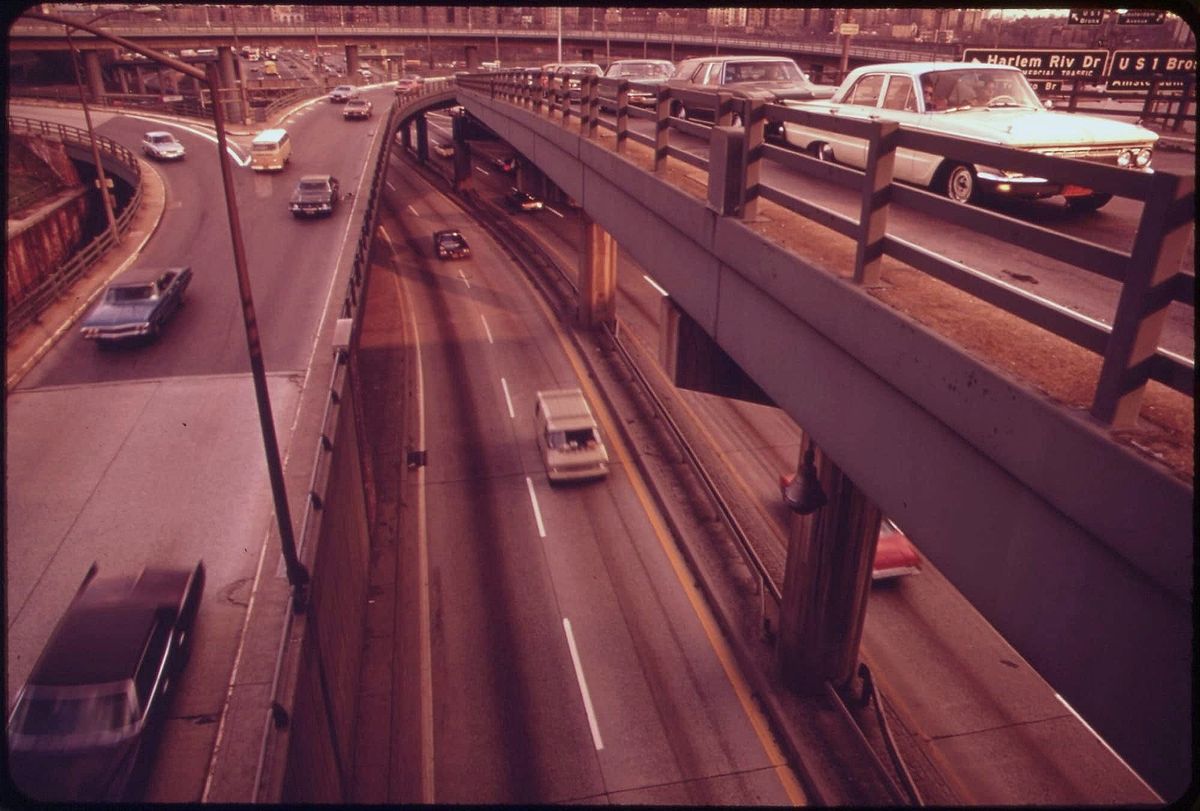
Two of the book’s “tragic heroes” are Parisian master-builder Georges-Eugène Haussmann, whose rapid steamrolling of new boulevards city-wide began in 1853, and his New York correlate, Robert Moses, the master-wrecker of Berman’s native Bronx a century later. The blocks of Berman’s youth were, he wrote, “transformed into garbage- and brick-strewn wilderness” when the Cross-Bronx Expressway, one of many highways in Moses’s dizzying construction portfolio, blasted through them.
Both Haussmann and Moses, famous czars of public works, harnessed strategic alliances with a state hell-bent on “modernizing” and a capitalist class keen to accelerate the movement of cars and commodities through these networks. Echoing the Futurist call to arms, the French and American road plans were each tied to strategic defense interests: planes could be landed on them in wartime, and they could rapidly transport weapons if needed while conveniently quelling other “undesirable” uses of a street left to people, like the ability to protest.
The master-builders’ easy partnership with institutional forces—alongside their racial and class backgrounds, and apparent tendencies toward megalomania—helped them realize massive public works programmes at proportionately substantial human cost. The Cross-Bronx Expressway, for instance, has among the highest collision rates among US interstates, and residents surrounding the corridor have among the worst health outcomes in the city.
Like other artefacts of modernity, something more than capitalism powered these urban transformations. It required human will aligned with political and cultural interests to fundamentally reconstruct urban life. Berman was particularly attuned to Moses’s “destructive and disastrous” construction that, for nearly 25 years, tore through his beloved borough, where he was born in 1940. Yet he was impatient with the defeatism that he found in other writers who theorized the darkside of modernity. In particular, he called out prominent sociologists like Max Weber and Michel Foucault, who saw the dominant power structures as totalizing, prophetic prisons. Under these grand narratives, Berman thought, any compelling theory of change, compassion or human agency was impossible.
After all, the “urbicide” (a term Berman claimed to have coined) wrought by the Cross-Bronx Expressway, as well as the exploitative, insurance-industry-backed arson wave that singed the South Bronx in the 1970s and ’80s, happened at the same time that the borough was emerging as an explosive cultural force. As the Bronx burned, it was home to humanist photographers like Mel Rosenthal and Camilo Jose Vergara, subway-graffitists-turned-gallerists, iconic art spaces like Fashion Moda, sculptors like Rigoberto Torres (longtime collaborator of John Ahearn) and genre-defining hip-hop artists. Founding DJs like Kool Herc, Afrika Bambaataa and Grandmaster Flash all rap-battled on the very streets they wrote and sang of, asserting, Berman argues, that “we come from ruins, but we are not ruined.”
Berman focuses in particular on Grandmaster Flash and the Furious Five’s ubiquitously sampled hit, “The Message,” which he reads as a dialectal artwork: both a testament to human resilience and a warning against reducing the borough’s story to the crush of political economy. In the song, a girl pushed in front of a train survives and repairs her broken arm, while a man stabbed through the heart gets a transplant and a “brand new start.” Amid intense physical and emotional trauma, the spirit persists and creates anew.
If Berman were still alive, he might let out a chuckle if he learned that this Message is already being embraced once more in key sites of his analysis: Paris and New York, cities again at the centre of contemporary environmental transformations. In Paris, Socialist 15-Minute City champion Anne Hidalgo, who stepped down as mayor earlier this year, declared that the “car city is over.” Under her leadership, Haussmann’s boulevards were retrofitted with over 1,300 kilometres of bike lanes, with some city-centre routes reporting over 840,000 cyclists a day; an air-cleaning army to foil Marinetti. Meanwhile, in the New York of newly elected Democratic-Socialist Zohran Mamdani, Moses’s expressways have become sites of “reimagination” targeted by energetic, savvy environmental justice campaigns. Creative partnerships between community organisations, urban designers, academic institutions and even local and federal government have been forged in a collaborative attempt to lobby homegrown visions into serious contenders for prospective capital works.
Revolutionising the urban process
Berman’s titular phrase is drawn from another manifesto, The Communist Manifesto, and it embodies the classical Marxist understanding of capitalism as a constant dance between the creative and destabilising forces of crises. The moment that profit rates drop and finance stops circulating, new products, technological innovations or places “in need” of development must be found from which to extract a surplus. In the process, new types of relationship are continually formed, not only between the workers and capitalists, but also between individuals and their understandings of themselves. Per the Manifesto:
All fixed, fast-frozen relations...are swept away, all new-formed ones become antiquated before they can ossify. All that is solid melts into air, all that is holy is profaned, and men at last are forced to face ... the real conditions of their lives and their relations with their fellow men.
What “melts into air,” for Berman, is any promise of social or psychological stability under capitalism. “To say our system is in crisis,” he writes, “is to say it is alive and well.” But, in the same breath, he argued this disorientating state of constant crisis also offers the chance, however fleeting, for new actors to take command of the turmoil, and even leverage it to build something new.
In 2008, Marxist geographer David Harvey drew upon Henri Lefebvre to offer an exciting new language for this aspiration: “the right to the city,” or the “right to change ourselves by changing the city.” Here was one of these rare, emotive academic concepts that took root beyond the academy, frequently invoked by activist campaigns in celebration of important grassroots insurgencies. Community-run gardens on disused lots, expressive murals, gonzo or tactical urbanism, highway lane reductions, campaigns for or against individual development projects: all endeavours, by individuals and civic groups, to claim their “right to the city.”
But Harvey also meant something bigger than these seemingly small-scale enterprises, and this is where he offers us a challenge both daunting and inspiring. Like Berman, Harvey invoked the Haussmann-Moses mash-up, which he thought had transformed the scale of thinking about the urban process. For Harvey, one of the key problems for capitalism is what to do with the endlessly produced surplus of capital and product. If there is a block in the system, and any “of the … barriers to continuous capital circulation and expansion becomes impossible to circumvent, then capital accumulation is blocked and capitalists face a crisis.” In the post-war era, one of the resolutions for this, what Harvey calls the “capital-surplus absorption problem”, was Moses’ public works portfolio; and, when expanded nationwide, such works played a crucial role in stabilizing global capitalism after 1945.
That is a stunning amount of power for cities, and for urban planners, to leverage. It would be hard to imagine a works programme—especially a benevolent one—happening today at this scale; major infrastructure projects like expressway reclamations are characteristically difficult to finance, lobby political approvals for and construct without serious delay. Often spanning beyond the terms of any one elected official, they get lost in the electoral volley and killed when budgets run dry. Taken in the right context, however, Harvey’s analysis can charge us with a far-reaching ambition, proportionate to the scale of the problem that climate change and environmental injustice present to urban life. Invoking the Paris Commune, Harvey said that “the right to the city had to mean the right to command the whole urban process”: a willingness to think just as big, and to act just as mightily, as the forces we seek to challenge.
A "green" urban future
From the Paris Commune and the Futurists to the master-builders, one common characteristic of power is the ability to articulate—and then action—a coherent, systematic vision for an ideal future. Urban planning theorists have long pointed out that the field has a unique relationship with future-making: city development visions always come “in between” an ongoing past and distant tomorrow, seeking to “design out” threats or, more optimistically, “design in” the principles we hope to someday achieve.
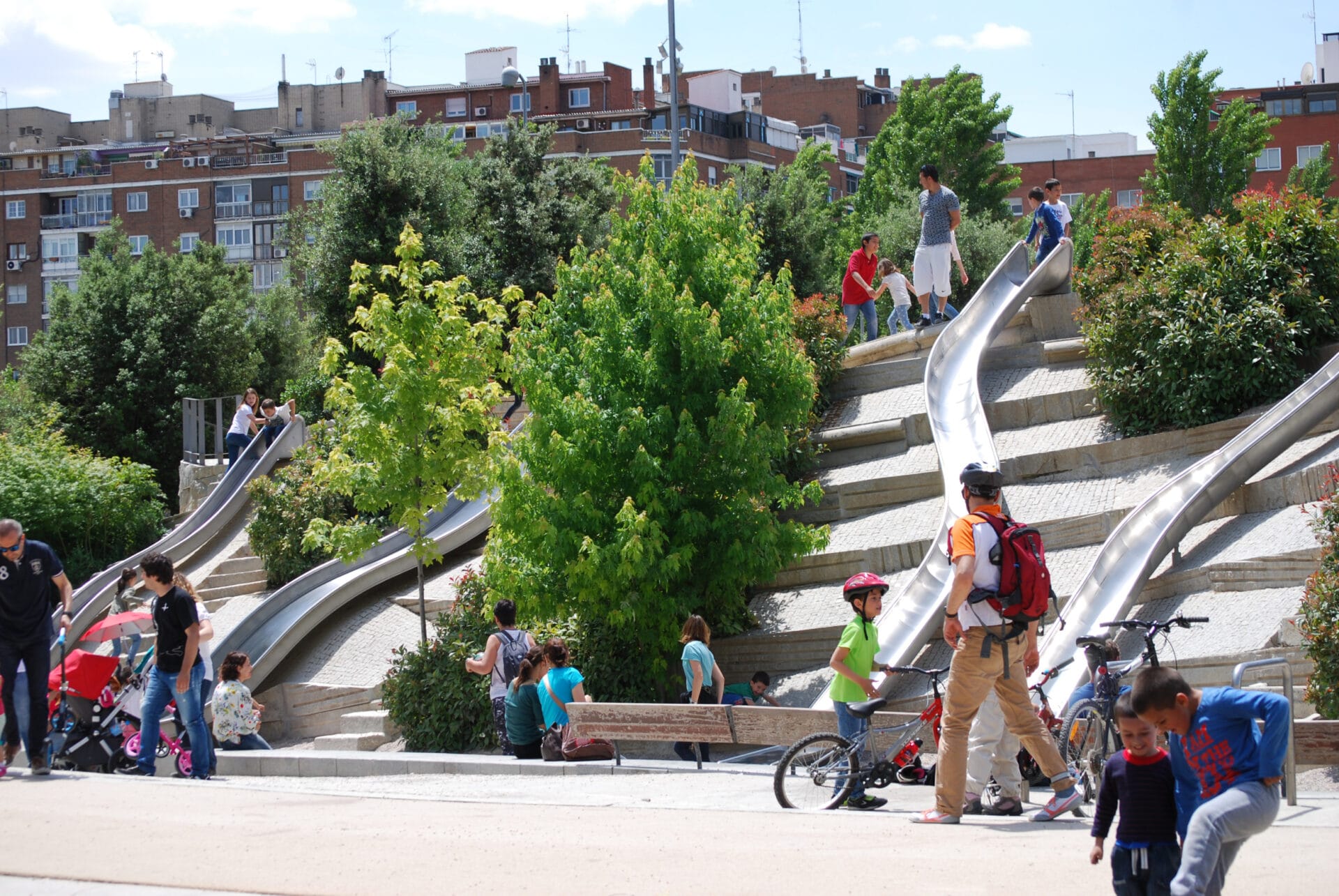
The modernist cities we’ve inherited were certainly founded upon one particular, linear narrative: a sense of constant, rapid change; an optimism about techno-fixes to social problems; a belief in the industrial-capitalist promise; a paean to the politics of construction. Today, we can begin to discern a counter-movement taking shape based on alternative value systems. Cities as diverse as Madrid, Seoul, Beirut, Antwerp and Utrecht are all experimenting with schemes to “un-plan” and “de-engineer” the polluting motorways synonymous with modernism. In doing so, and in an inversion of the Futurist utopia, cities are seeking new ways to address the harm that vehicle emissions inflict on human and environmental health. Interestingly, many articulate a green, civic future as antidotes to an extractive, dictatorial past. Projects often adopt the language of healing, re-wilding and restoration: highways are turned into parks and rivers, and traffic corridors into public spaces, ecological flourishing presented as a “balm” for historic social wounds.
This paradigm shift tells us as much about our cities as it does about ourselves. As Berman wrote: “we come from ruins, but we are not ruined.” Communities across the world have long been forced to endure the pernicious effects of major urban expressways. They’ve weathered economic underdevelopment; the social and spatial fracturing of their neighbourhoods; hours of time lost navigating nonsensical routes to visit friends, family and local businesses “on the other side”; and, of course, the toxic impacts of traffic congestion. Especially in long-disenfranchised areas, carbon emissions, air pollution and the irreversible health effects of prolonged exposure all compound, as Adam Almeida documented for Issue #3 of The BREAK–DOWN in today’s Bronx.
When driven by those closest to the problem, these “green” highway reclamations promise material and symbolic significance. From a practical perspective, they offer an immediate pathway to address air quality, reduce accident rates, mitigate the unequally experienced urban heat island effect, deliver new public space and socially reconnect neighbourhoods that expressways once severed. Perhaps even more valuably, from a cultural and ideological perspective, they allow long-harmed communities to take stock of the past, reckon with history and articulate a new vision for tomorrow that reflects their values and demands today.
Of course, as with any infrastructural feat, they’re not without their complications. Much like the modernist city that came before, the new green urbanism relies on immense triumphs of social and political organization, requiring strategic collaboration between a range of public and private sector actors. Structurally intensive and fiscally expensive, these are, ultimately, major capital works. As critical academics and community groups have acknowledged, they therefore present a new set of risks. Without genuine resident involvement or understanding of the real estate landscape, boosterist development projects could prompt a form of green gentrification, whereby parks erected in the name of justice outprice and displace the very communities they pledge to benefit. At their worst, they can echo the glossy “resilience” initiatives that so often emerge in the wake of extreme weather events, a disaster capitalism that further entrenches, rather than challenges, structural inequality.
But critique is always easier than action, and action in cities is always messy. Crying “greenwashing”, as many are apt to do, is, I think, too fatalistic. While these highway reimaginations might not be “anti-capitalist” per se, they aren’t pretending to be. Their greatest promise might be what they mean to the local residents backing them: getting at the softer, soulful, different ways of living and organising life that Berman's work can help us to take seriously.
Rediscovering the myth of construction
In one of Berman’s greatest essays, “Buildings Are Judgement, or, ‘What Man Can Build,’” first published in Ramparts in 1975, he described a “new cultural consensus” that had emerged on the Left throughout the 1970s. This, he wrote, was distinct from the attitudes of a generation before, not least in its wholesale hatred of construction. “How have we come to condemn the process and products of construction”, he writes, “as emblems of everything we find most destructive: massive ugliness, sordid venality, outrageous windfalls of wealth, endless storms of dirt and noise, big plans laying waste people’s lives, organized viciousness without redeeming social value?” While watching Moses raze his neighbourhood, Berman admits that he felt some of this himself. But he struggled to shake the feeling that Moses was “miles and years ahead of us”. Unlike him, “we never learned how to ‘think big’”; the “myth of construction” was something that all of us badly needed to rediscover.
Even while invoking Marx, with his at times substantial awe for the very bourgeoisie whose destruction he ardently criticised, Berman makes clear where he stood. Moses, he writes, was like a colonial official: an apt simile for a British-educated elite who sat at the helm of New York’s imperial 1964 World’s Fair. But Berman nonetheless had the humility to acknowledge—and here it is hard to disagree—that “what made Robert Moses so special was the largeness of his visions and ideas, his intellectual and organizational power to grasp the whole.” Against this he chided his fellow New Leftists, with their “strange slogan THINK SMALL”. “Between our visions and our plans fell a very large shadow.” He writes,
We were acutely sensitive to human feelings and needs—indeed, the New Left might be called, to its credit, a politics of sensitivity—and we understood how American institutions trampled on these feelings and needs. But although we knew what things needed to be stopped, and how to stop them, we had no idea how to start things. We had very little capacity to even imagine, let alone plan and organise and build, structures that could put our sensitivity into effect.
Structures that could put our sensitivity into effect. Perhaps that is the greatest promise of contemporary reimaginings of roadways in the name of community healing and environmental care. They give us somewhere to quell our existential dread, something new to believe in, a much-needed antidote to the resignation of capitalist realism. In this vein, they might even echo Mamdani’s renewed sewer socialism, delivering tangible improvements to issues in the built environment that the city possesses skill and capacity to resolve. In the process, we can see the knock-on effects of such thoughtful action: renewed faith in city government; the clean sweep of other Democratic-Socialist candidates running on platforms of affordability (with some, as a result, dubbing Mamdani the “new power broker” in another historic irony); and, as the Knicks celebrations attest, a reinvigorated urban pride and civic energy bolstered by someone with the capacity to pour care into our streets.
If “thinking small” was a direct answer to the emerging environmental movement of the 1970s, then decades of failure to genuinely rewire the system have underscored the need to change tack. As Mike Davis wrote, invoking the biblical figure of Noah, “since most of history’s giant trees have already been cut down, a new Ark will have to be constructed [emphasis added] out of the materials that a desperate humanity finds at hand in insurgent communities, pirate technologies, bootlegged media, rebel science and forgotten utopias.”
While some critics warn against responding to a top-down problem with top-down solutions, and others, just as totalizingly, argue that a new “grand vision” is exactly what’s needed to “heal” the wounds of the old, my attention veers toward who is saying what, from where, and how they stand to benefit or lose from these landmark green transitions. I think about the impassioned Bronx residents who handed out home air purifiers beneath the Major Deegan Expressway at a lively community Earth Day event earlier this year, coupled with a swap meet, ample rice and beans, breakdance circle and healing activities like massage. “While we fight for root cause solutions,” they assert, “we’re also delivering immediate relief.” I think about Berman and his willingness, unlike many of the academy’s staunch idealists, to meet Marxism with humility. And I think about my father, another late resident of a bygone neighbourhood, who was there when the Cross-Bronx went up. All, I imagine, would be touched by plans to undo parts of the road, reconnecting the blocks it once spliced with new parks.
In the New York of the ‘90s, Berman said, a new slang emerged, born equally from hip-hop and the confusion and tumult facing residents of all kinds: caught up in the mix. “She’s all caught up in the mix,” he said. “I got myself caught up in the mix.” Berman thought the image stuck because it captured the unseen forces narrating so many people’s lives. “I think Marx understood better than anybody else how modern life is a mix,” Berman wrote. “How, although there are immense variations in it, deep down it’s one mix – ‘the mix’; how we are all caught up in it; and how easy, how normal it is for the mix to go awry.” And, he continued: “He also showed how, once we grasped the way we were thrown together, we could fight for the power to remix.”
In bold attempts to turn the modernist project back on itself, to imagine transformations as grand as the ones that produced historical pain, destructive legacies are being taken on by communities asserting alternative visions of of the future. At a cultural and spiritual level, we are watching civic movements around the most compelling of these expressway reclamations assert their power to remix.
As residents of the Bronx and elsewhere seize the moment, the Message, to try and design cities anew, to think big, to take back power from where it’s been denied, to meet the threat of climate collapse head-on—indeed, to fight for the power to remix—we’d be silly not to learn from history.
Katie Mulkowsky is an urban planner, writer and researcher specialised in the link between polluting infrastructure and community health. She is the Director of Research and Urban Health at Future Places Studio. Her first book, The Expressway, is forthcoming with Verso.

