

Producing the Climate
“You are in danger and need to act immediately to survive. The safest option is to take shelter indoors immediately.
It is too late to leave.”
—New South Wales Rural Fire Service Emergency Warning
In the early months of the pandemic, while many of us wearily logged onto Zoom or donned protective gear, a group of scientists and engineers were on a boat stationed off the coast of Queensland, conducting a world-first experiment. Using a prototype constructed from a repurposed snow machine, the team sprayed ultra-fine particles of sea salt into the air from their research vessel. Their goal was to brighten the clouds over the Great Barrier Reef.
The experiment, part of a larger Australian government-funded programme called the Reef Restoration and Adaptation Program (RRAP), was designed to help the Great Barrier Reef survive the rapidly warming ocean temperatures. As the largest coral reef system in the world and the Earth’s largest living structure, the Reef is a dazzling archipelago made up of 2,500 individual reefs: a sprawling turquoise lacework constructed from trillions of tiny coral polyps on top of a series of older reef systems that formed and died off the north-east coast of Australia over hundreds of thousands of years. It is visible from space against the deep blue of the Coral Sea.
In the late 1990s, an escalating pattern of mass bleaching events, with further extensive bleaching in 2016 and 2017, threatened the future survival of the reef, prompting public outcry about the impacts of climate change. In response, both the federal government and industry promoted adaptation measures (even if much of their effort was concentrated on lobbying UNESCO to not list the world heritage site as “in danger”). As part of the RRAP, hundreds of scientists were tasked with finding novel ways to help the reef adapt to the impacts of climate change, including coral spawning, cryopreservation and Marine Cloud Brightening. The latter technique, first trialled in 2020, aims to increase the reflectiveness of marine stratocumulus clouds which, in theory at least, would temporarily cool the waters during summer heatwaves when the risk of coral bleaching is at its highest.
During the second year of my PhD, I told my supervisors I wanted to change the direction of my research to interview the people working on RRAP. My plan was to try to understand how they viewed their work in relation to climate mitigation, and what, if anything, was novel about humans willingly filling the atmosphere with pollutants or changing the reflectivity of clouds. I found the common critique of “geoengineering” (an umbrella term, covering a range of practices) as a mere “technofix” to be unsatisfying, and thought it required further elaboration. Technologies are always artefacts of labour; the working conditions of the people tasked with creating these solutions interested me more than the machines themselves. The scientists I spoke to were clear that cloud brightening, if successful, could only ever buy time for the reef. It would not replace the urgent need to cut emissions. Rather than being driven by a hubristic desire to control the weather or dominate nature with technology, the cloud brightening being tested by RRAP is something else: a multi-disciplinary research programme designed to defend an ecosystem uniquely favoured by legislation, regulation and funding due to the cultural and economic significance of the Reef.
Fixing the Climate
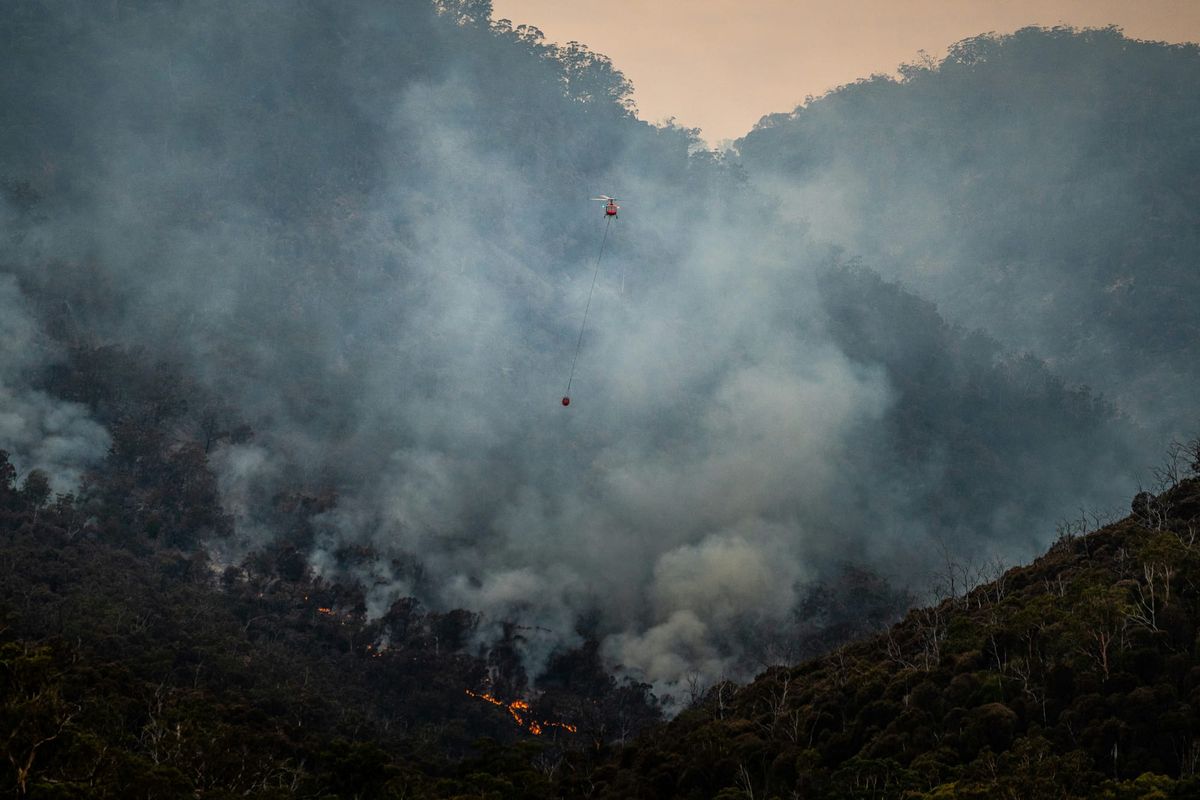
Nine months before the RRAP trials began, the federal government approved the long-disputed Carmichael coal mine in Queensland’s Galilee Basin, a project that would substantially increase the country’s already record-high per capita emissions. That same year, in what is now referred to as the Black Summer, a catastrophic bushfire season burned through an area of the Australian continent roughly the size of the United Kingdom, including ancient Gondwanan rainforest normally considered too wet to burn.
That the Australian government can provide funding to a programme like RRAP while approving new fossil fuel infrastructure reveals something crucial about climate politics today. We find ourselves in what many have called an “overshoot conjuncture”, in which ongoing deferral of or refusal to pursue adequate mitigation is creating a new rationale for an array of strategies to stabilize the conditions of capitalist production.[1] Not all of these proposals come from well-meaning scientists attempting to shepherd a critical ecosystem through the worst impacts of climate change, of course. Venture capitalists promising to “undo” carbon and “fix” the climate also proliferate, touting technologies spanning everything from covering the Earth in mirrors to dumping seaweed in the ocean as a form of carbon sequestration.[2] Many of these are spurious technofixes—attempts to divert the crisis and delay the politically difficult work of cutting carbon. But while the hype machine of Silicon Valley has little grounding in reality, start-ups with deep pockets—brimming with Promethean hubris—are ready and willing to solve the problem of climate change, for a fee.
Take Luke Iseman and Andrew Song, the duo behind Make Sunsets, a solar geoengineering start-up that began launching balloons containing sulphate aerosols from Iseman’s backyard in 2022. Neither Iseman nor Song have a background in atmospheric science, as both hail from the tech sector. They describe coming up with the tagline for their stunt, “sunscreen for the Earth”, by asking ChatGPT to explain solar geoengineering to a five-year-old. Despite their launches being unauthorized, Make Sunsets managed to raise USD$750,000 in venture capital by promising to help “cool the Earth”.
The existence of this and other VC-backed projects appears to confirm what opponents of solar geoengineering have long cautioned against: that relatively cheap and easily deployed technologies could become fodder for rogue, do-it-yourself geoengineers, in this case putting a highly risky and uncertain climate engineering technique in the hands of people who appear to have little interest in even tracking the impact of their experiments.[3] But a reckless desire to disrupt the climate and capitalize on the painfully slow progress of climate mitigation is not inherent to the technologies that sit under the broad umbrella of “geoengineering”. Iseman and Song’s actions were enabled not by decades-old developments in atmospheric science so much as by the ideology of planet-saving innovation espoused by “cleantech” entrepreneurs—an ideology perfectly suited to the steadfast refusal of major emitters to scale down highly profitable activities, even if it means risking the stability of Earth’s systems and the security of its inhabitants.[4]
A Fatal Climate
In early December I received a phone call from my partner’s Mum. Don’t panic, she said, but there’s a big fire near your place. We had been inside all morning, sheltering from the scorching 41-degree heat and high winds. Immediately, we divided up the tasks in our fire safety plan. Buckets were filled with water and the roof sprayed down, anything irreplaceable gathered in a bag (including 70 rolls of unprocessed film). Neighbours were called and the radio turned on. We live in a cedar-clad pole home that sits high on the wall of a narrow valley. The house is flanked by a national park, perched among a canopy of red gum, spotted silky oak and lilly pilly. It has the highest fire vulnerability rating a dwelling can have, aptly called the “Flame Zone”. That day, a fire had started about 2km south of us, and soon our phones were flooded with alerts and anxious messages from friends. By nightfall it had consumed 16 homes, spreading across 120 hectares of suburbia and bushland. It is hard to comprehend how quickly fire can move uphill until you see it.