

Economies of Breath
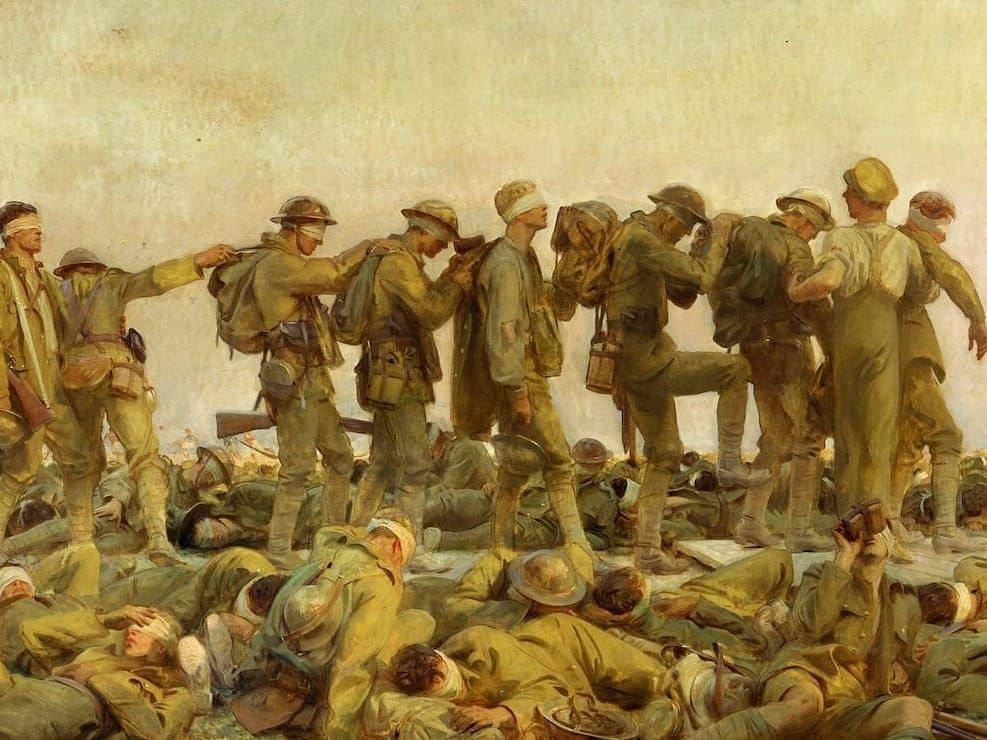
According to German philosopher Peter Sloterdijk, the environment was discovered at 6pm on 22 April 1915. This was the moment a German regiment launched the first full-scale chemical attack against French-Canadian troops at Ypres. It was also, as Sloterdijk writes in Terror from the Air, the moment the twentieth century began:
‘Discharging’ the liquefied substance released approximately 150 tons of chlorine into the air, billowing into a gas cloud nearly 6 kilometers wide and 600 to 900 meters deep … A favorable wind blew the cloud toward the French positions at a rate of two to three meters per second with a reported toxic concentration of about 0.5 per cent—a concentration high enough to ensure severe damage to the lungs and respiratory tracts after long periods of exposure.
Sloterdijk’s date is both earlier and later than we might expect. Surely, the environment was already known about before the twentieth century? Weren’t efforts already being made in the nineteenth to combat pollution or to alleviate the impacts of environmental deterioration? Or, if we’re talking about environmental thinking as we know it today, didn’t this really take shape in the post-war years? All of the above may be true, but for Sloterdijk the introduction of airborne chemical weapons onto the battlefield marked a seismic change in agency: we no longer simply existed with, or within, the environment—we had learned to control it. From the moment mustard gas was deployed, the atmosphere ceased to exist as an invisible backdrop; a neutral scenery that propped up our daily lives. The environment became a manipulable territory, a great big global weapon that could be turned against the many by the few. Sloterdijk names this shift a “caesura”, a historical rift that rewrote our sense of being in the world:
In the evening hours of that day, a hand jumped on the clock of ages, marking the end of the vitalistic, late-Romantic modernist phase and the beginning of atmoterrorist objectivity. No caesura of equal profundity has occurred on this terrain since.
On Discovery and Death
Since the start of the Early Modern period, many things have been “discovered”: the Americas, antibodies, crude oil. But there is also something fundamentally misleading in this valiant language of discovery; each of these had existed long before they were “discovered”. Guanahani already had a history before Columbus washed up on its shore and christened it “San Salvador”, while Indigenous peoples across North America had been making medicinal use of oil seeps for centuries prior to the first industrial drilling programmes in the 1880s. What the language of discovery offered was a way of converting past ignorance into celebrated new knowledge, while creating opportunities for colonial prospecting. Whatever Europeans—and, later, European Americans—“discovered”, they could also lay territorial claim to.
As the Age of Discovery morphed into the Age of Enlightenment, the language of discovery shifted towards scientific inquiry. To discover was now to invent—or to manipulate that which was already out there, inertly waiting to be harnessed by rational thinking. By the time modernity arrived, scientific breakthrough had replaced colonial conquest as the badge of national progress, but the old imperial assumptions of territorial claim, control and conditioning remained very much in place. When a nation made a scientific breakthrough, it also owned that discovery, and assumed the right to wield it against the rest of the world.
Like so many imperial discoveries, the revelation of the environment was brought into light through conquest, aggression and control. This is why, according to Sloterdijk, environmental thinking emerged alongside the “practice of terrorism” and the “concept of product design”, an unholy trinity that yokes together militarism, functionalism and ecologism. For Sloterdijk, all forms of modern terrorism must be understood in terms of their “atmoterrorist” means. And if every act of terrorism in some way harnesses the environment, then every terrorist act must also be an assault on the environment. In effect, the atmosphere becomes both the means and the target of terrorism.
The deployment of chlorine as a chemical weapon in 1915 may have marked the discovery of the environment, but the history of the entwined emergence of environmental consciousness and atmoterrorism didn’t end with gas attacks in the trenches. The contours of what Sloterdijk calls this “special climatology” would be shaped as much by the events of the Second World War as by the First.
After 1918—and despite the Treaty of Versailles’s explicit prohibition of the production of chemical agents in Germany—chemists in Berlin continued to develop the toxic concentrations that had been inaugurated by Professor Fritz Haber while working for the War Ministry’s department for poison gas studies.
By 1924, Hamburg-based company Tesch & Stabenow (also known as Testa) had patented a new, concentrated hydrogen cyanide product: Zyklon B. This gas would, by the late 1920s, become a “household name”, widely recommended for the disinfestation of insect-contaminated living areas. There can be little doubt, as Sloterdijk grimly reflects, as to the equation of pest control with the genocide of the Jewish people: “after 1941, it was through the metaphors of ‘pests’ and ‘vermin’ that the most extreme exterminist intensification of German ‘Jewish policy’ was propagated.”
This tightly woven web of chemical weaponry, corporate interests and terrorist practice would come to characterize the post-war period. After the dropping of the atomic bomb on Japan—still the most spectacular example of airborne terror ever committed—it would be America’s sense of supremacy that would shape not only geopolitics but the scope and direction of scientific investigation. As Jacob Darwin Hamblin discusses in Arming Mother Nature, investigations into environmental warfare ramped up during the Cold War, funded largely by the US military. “Scientists in the decades after World War II worked on radiological contamination, biological weapons, weather control, and several other projects”, Hamblin writes, “that united scientific knowledge of the natural environment with the strategic goal of killing large numbers of people.”
The examples he offers are breathtaking. The US tampered with the weather in Vietnam; they proposed dumping radioactive waste along the boundary separating North and South Korea; they considered detonating nuclear weapons to melt the polar ice caps to create artificial tsunamis, or to flood coastal cities, or simply to facilitate smoother naval passages; and they explored means of altering local climates, like targeting key links in ecological chains by deploying biological agents. The goal was no longer simply to win battles, but to maximize human death.