


Air Travels
In 1936, the New York-born poet Muriel Rukeyser travelled to Gauley Bridge, West Virginia, the site of what was then America’s worst industrial disaster.[1] Beginning in 1927, the rural Appalachian town had been home to a vast hydroelectric project which saw the fast-flowing New River diverted through the Gauley Mountain, with the power generated used by a nearby metallurgical plant. Nearly 5000 workers were contracted to dig a tunnel through the mountain, whose rock was rich in silica, essential for the alloy used in the steel plant. To extract more of it, the tunnel was widened, becoming a mine.
Searching for work during the early years of the Great Depression, thousands of migrant workers from the Southern US, most of whom were Black, had arrived in West Virginia to work on the project by mid-1930s. Under pressure to complete the tunnel within two years, and facing financial penalties if they failed to meet the deadline, the contractors, a company named Rinehart and Dennis, decided to save time and money by drilling through the mountain without the use of water to suppress the dust and without providing workers with protective respirators or ventilation. The consequences were devastating. Hundreds died from inhaling clouds of fine silica dust before the tunnel was even finished. We still do not know exactly how many workers died of silicosis due to their work on the Hawks Nest Tunnel, but contemporary estimates put the number at more than 750, with a further 1,500 afflicted by long-term lung disease.
“What do you want—a cliff over a city? / A foreland, sloped to sea and overgrown with roses? / These people live here,” Rukeyser wrote in the work she produced in the disaster’s aftermath, the documentary poems published in The Book of the Dead. Insisting that this disease caused by dust was a proper subject for literature and the poetic imagination, she combined worker narratives, courtroom statements and evocative descriptions of the Appalachian landscape. The work is a vivid testament to the horrors of silicosis. The poems also emphasize the lasting consequences wrought by corporate irresponsibility, linking the deaths of workers in West Virginia to the flows of money in the country’s urban centres. “Blasted, and stocks went up; / insured the base, / and limousines / wrote their own graphs upon roadbed and lifeline. […] ‘A corporation is a body without a soul.’”
For years after reading The Book of the Dead I was haunted by the Gauley Bridge disaster. The poems are lyrical, dramatizing the contrast between the cold, factual way the disease is apprehended by medical and legal systems, and the slow scarring that blocks the breath of workers, stealing their ability to speak. Reading the accounts of North American workers physically consumed by dust, and knowing that these mass deaths were never fully accounted for or remembered as a defining national moment, I was profoundly moved. It wasn’t simply the power of Rukeyser’s verse that disturbed me, but the links the disaster formed to a global chain of toxic air. The corporation that stood behind the hydroelectric power project, the steel plant, and the tunnelling in West Virginia was none other than Union Carbide and Carbon Company, a company now mainly famous for its part in another disaster that took place in India some fifty years later.
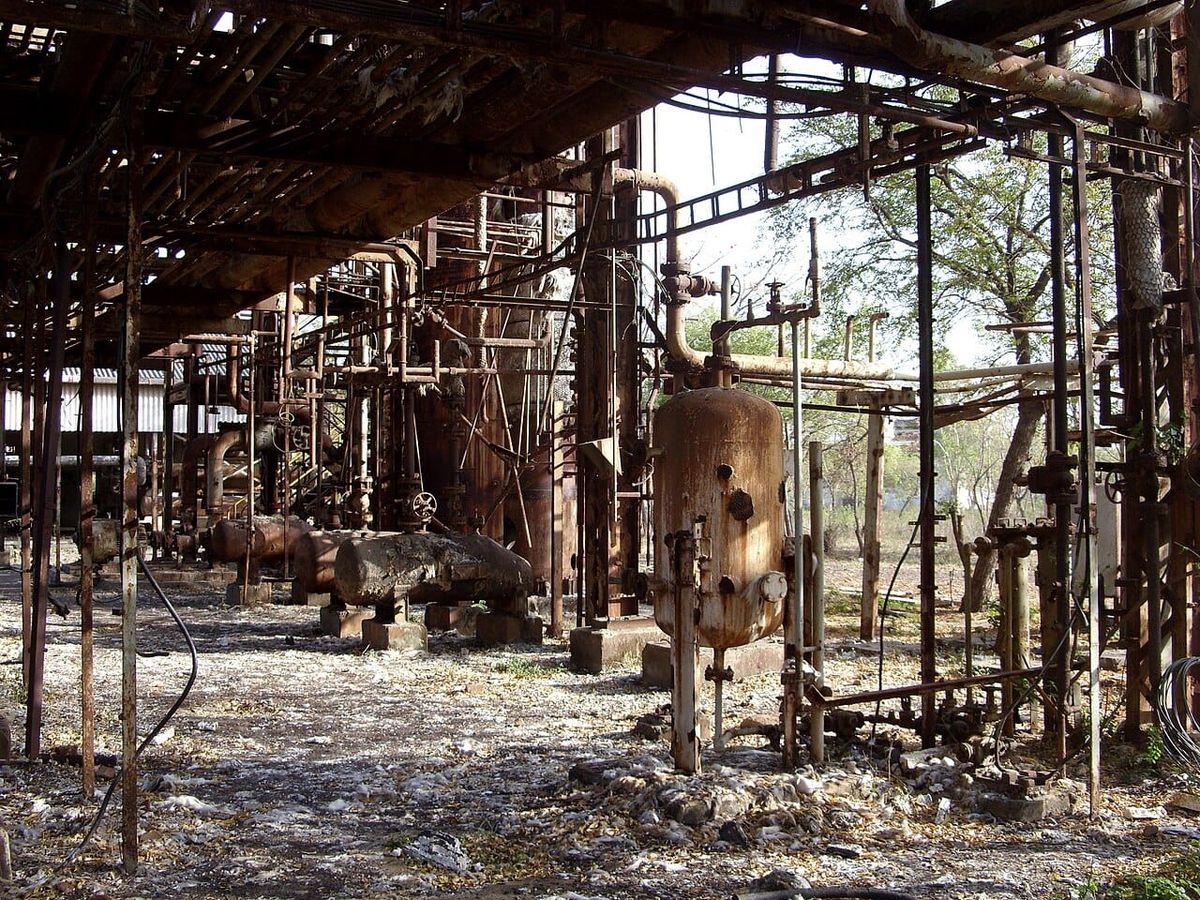
On the night of 2 December 1984, over 500,000 residents of the central Indian city of Bhopal were exposed to methyl isocyanate, which had leaked from a nearby pesticide plant. Thousands choked to death in their beds from inhaling the toxic gas, and many thousands more continue to live disabled by its effects. One of the many causes of the disaster is that Union Carbide were able to operate with far lower safety standards than would ever have been permitted in the Western world. As the Indian journalist Hartosh Singh Bal has written, Union Carbide held “the belief that they need not follow the same standards for their business in India that they do in Western democracies. The belief that, for profit, they can cut corners in what were earlier ‘the colonies’ and preach the liberalism that works for their consumers in the West.”[2]