

“The day promised to be hot”, begins Mollie Panter Downes’s 1946 novel One Fine Day, a line full of the smell of British summer, of lawns before the sun comes up and the promise of long evenings, bare feet and sun cream. Our associations of summer and of heat are often still in this vein: positive, precious and rare. But as the Economist argued last year, Britain is “an increasingly hot country” which “pretends it is anything but”.
The kind of summer that a person was likely to experience in the 1940s was quite different to that which they can expect to experience today. Our coldest days are behind us; our hottest days are now and ever after. But at the level of cultural understanding, do we really care? Do we even notice?
If it is the proverbial journalist’s job to look outside and tell you it’s raining (or, perhaps, that it hasn’t rained in months), it is the pollster’s job to tell you how many people are bothering to look outside.
At Persuasion, where we investigate UK public opinion, we can see that climate denial of the old, outright form is a niche pursuit in contemporary Britain. But a lack of consideration is not. In other words, the issue is not what answers people give when asked directly, but whether they are paying attention.
Speaking in the broadest terms, the picture this century is one of rising climate awareness. But one has to speak in broad terms to encompass the strange and fluctuating realities therein. YouGov’s tracker on how much of a political priority people consider climate and environment shows that in 2011, the tracker’s first year in operation, 7 per cent of people listed environment as the most important policy area when asked. Between 2019 and 2021, that shot up to around 30 per cent, after which the numbers have crawled back down again, starting this year at 14 per cent.
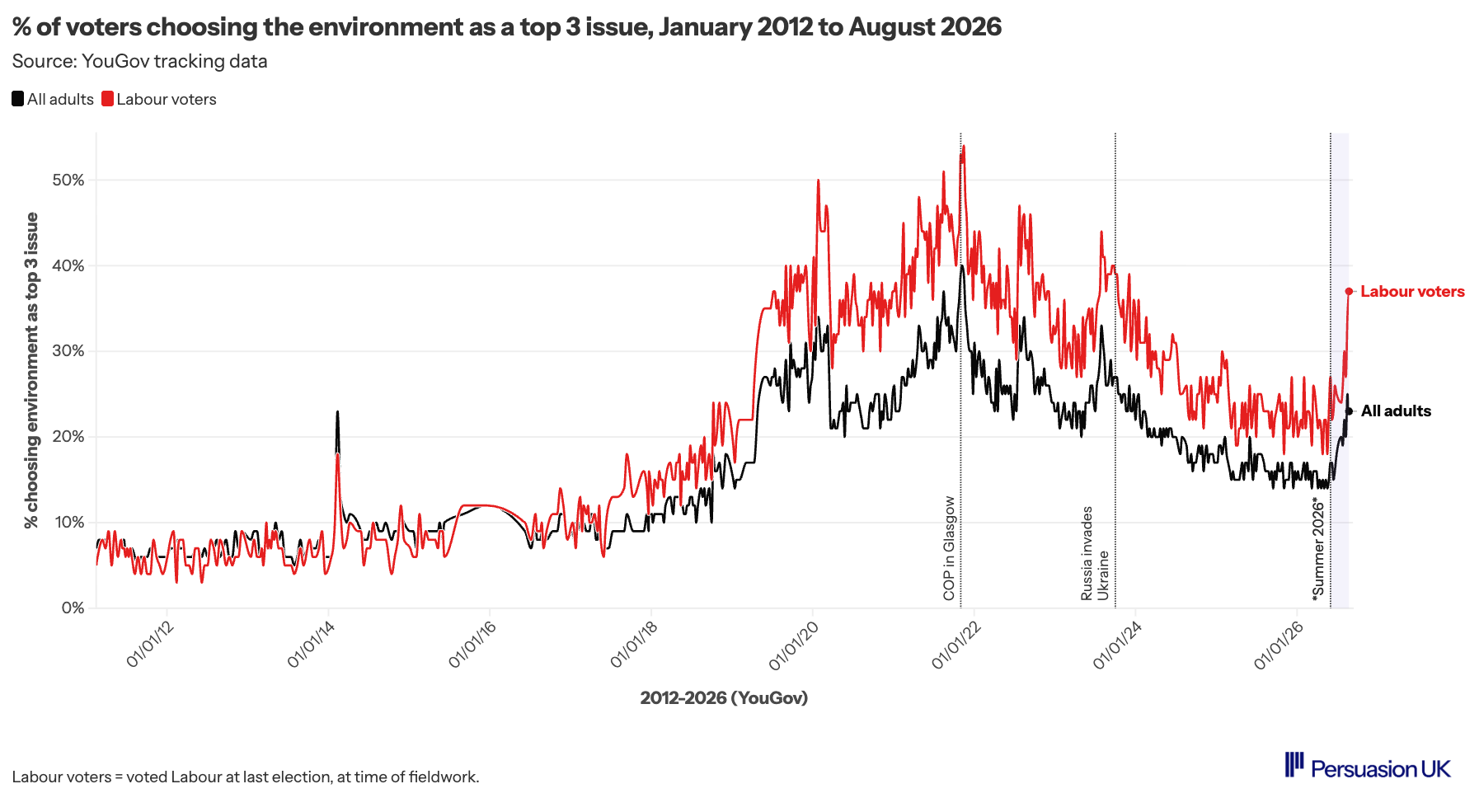
The warming of our climate is a steady line: in ever accumulating statistics, we can set our watches to this reality. The public’s opinion about it, however, is a different thing, prone to fits and starts, to falling back on itself and responding to multiple signals at once. This being said, there are two things that are generally considered to impact public attitudes to climate change: the first of these is an experience of a climate that feels unusual or weird compared to yesteryear.
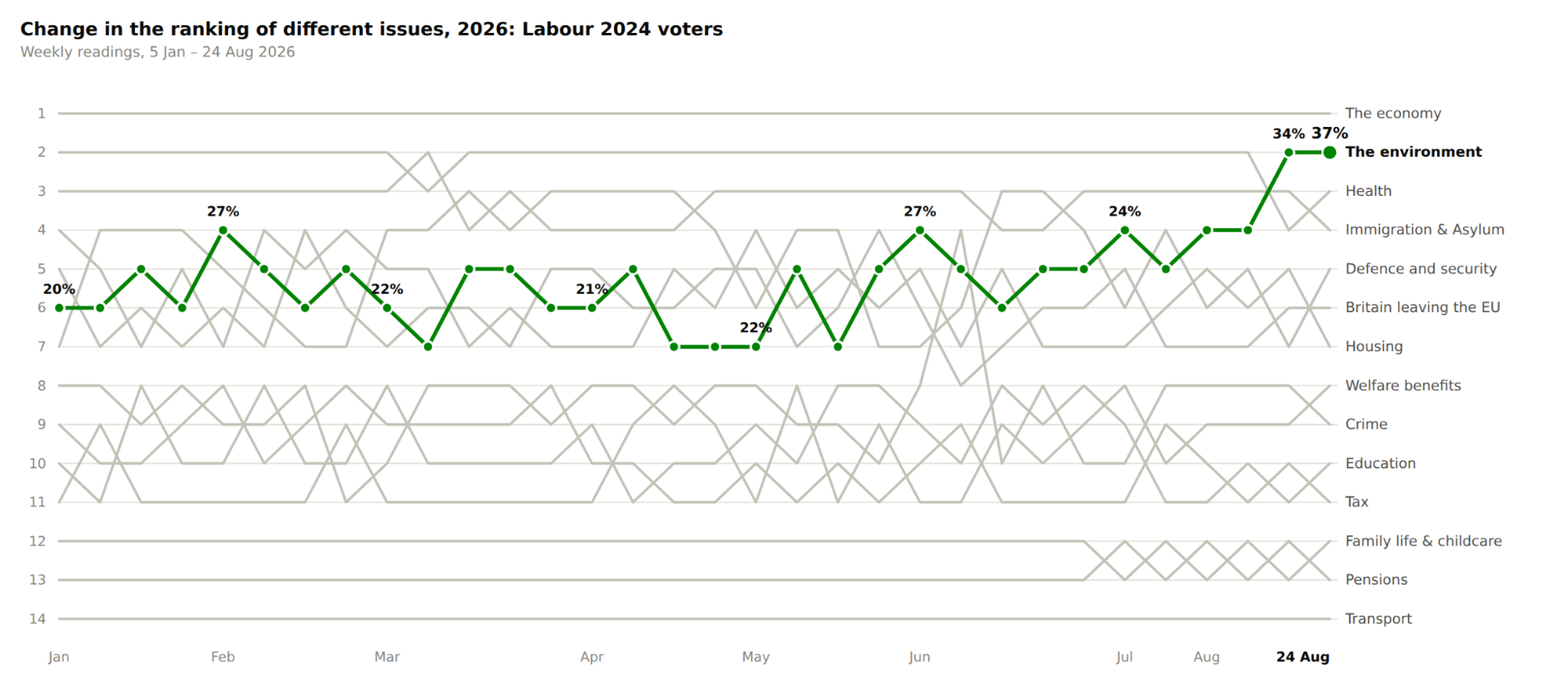
This, what we could call the experience effect, was at play this summer in our increasingly warming United Kingdom, as Persuasion’s recent work has shown. The number of people listing climate change as a political priority climbed consistently throughout the long months of repeated heat waves, going from 14 per cent in May to 25 per cent in August, the biggest leap of any single issue in 2026 aside from Defence, putting it firmly back into the top 5 (or, for Labour 2024 voters, into the top 3). We can confidently say that the summer has dragged climate change to the fore for a good number of Britons.
 Adrienne Buller
But there is no straight lines between experience and opinion. All experience is mediated via pre-existing political beliefs. A 2020 paper on Californian wildfires by Chad Hazlett and Matto Mildenberger found that proximity to the disasters led to a measurable uptick in support for climate-focused ballot measures in Democratic leaning areas; in Republican areas, the impact was near zero. Likewise, YouGov polling found that when asked 51 per cent of Reform voters would either be fairly or very happy if this summer’s weather became the season’s standard, versus 38 per cent of total voters and just 12 per cent of Green voters.
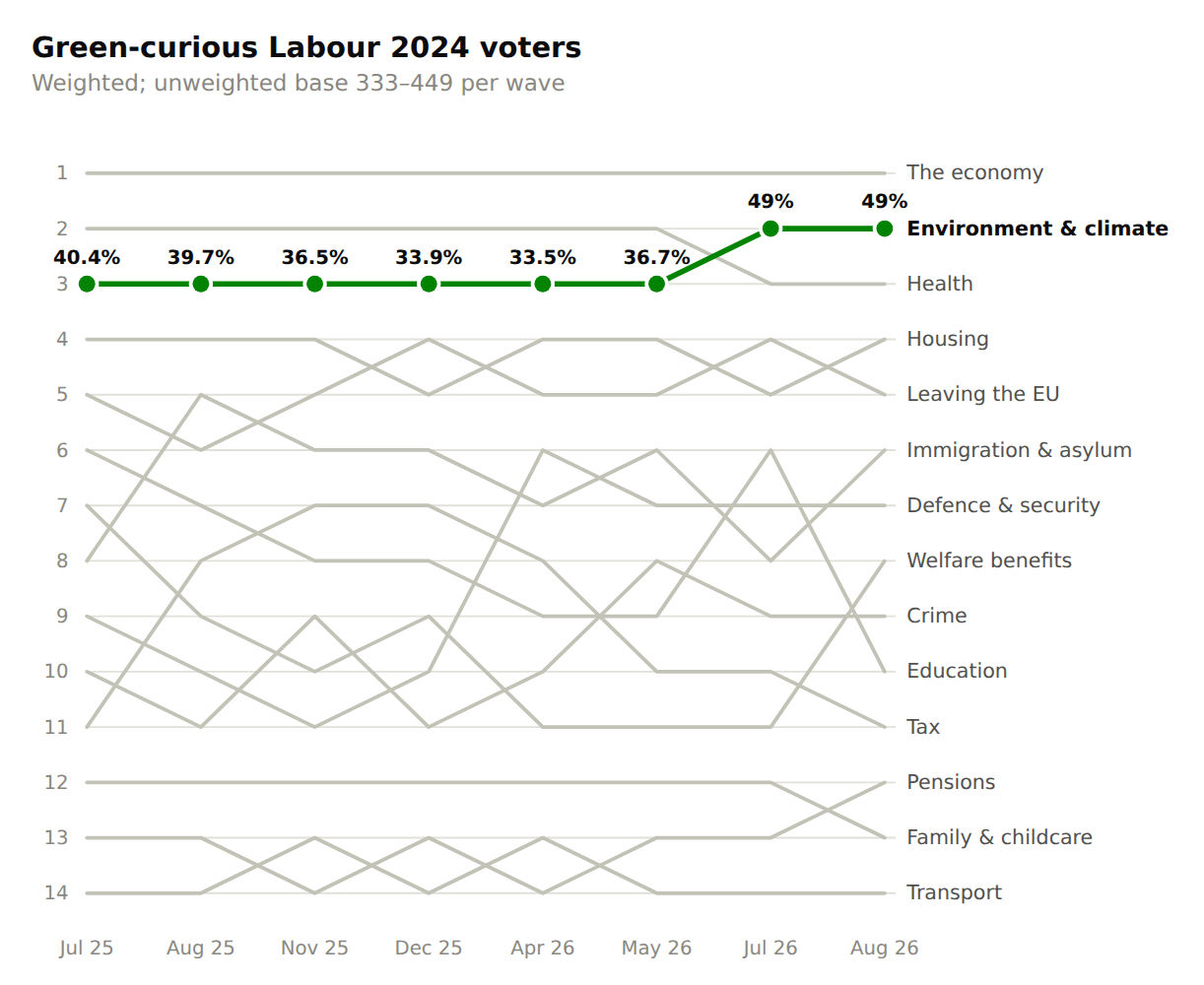
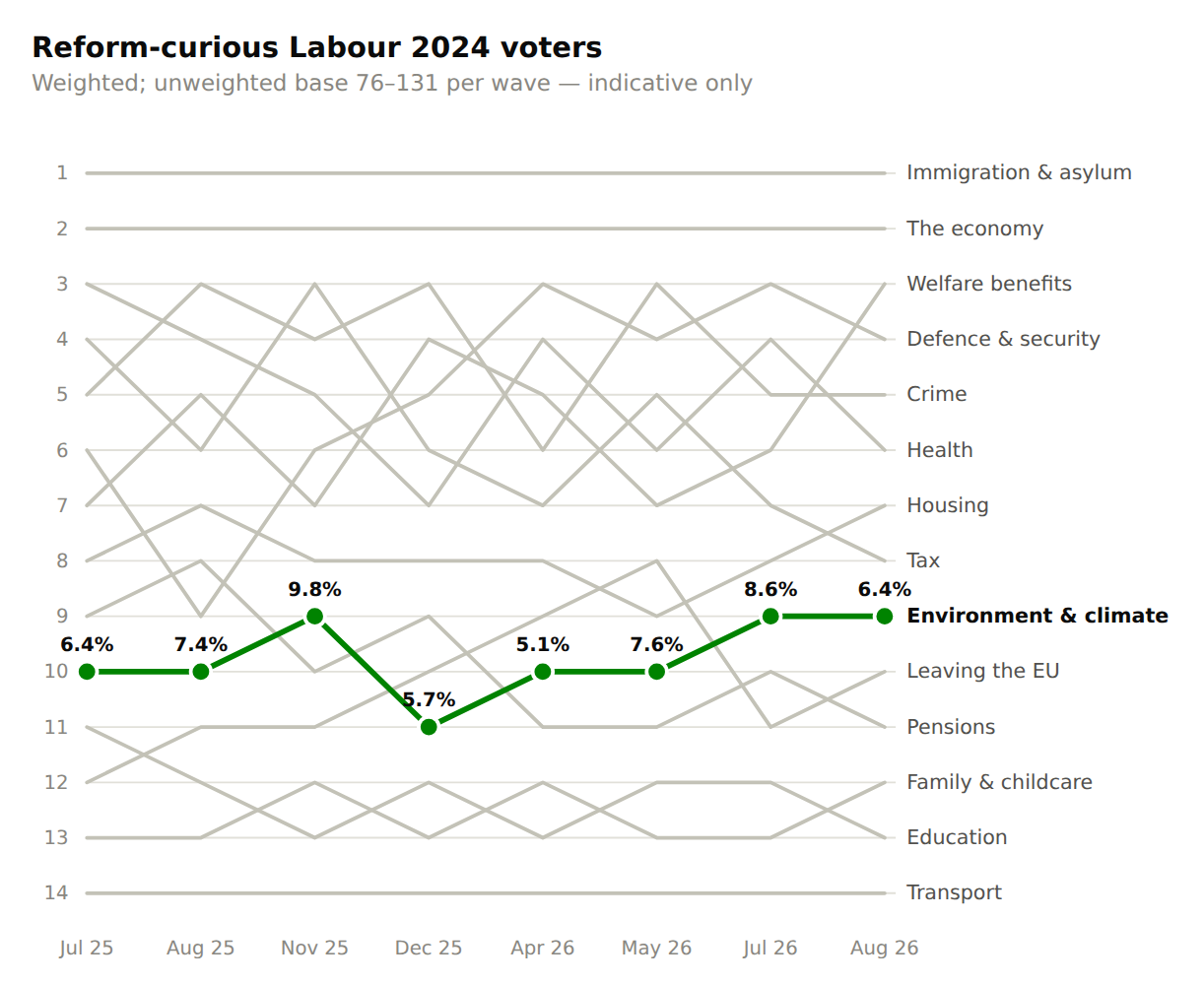
The work Persuasion UK has done with the Labour Climate and Environment Forum to track the impacts of our latest, hottest summer suggests that a similar dynamic is at play here. Our figures show that despite there being an 11-point climb in public concern among all voters this summer, the extent of this depends on political commitments. Among 2024 Labour voters, that jump was from 22 per cent in May to 37 per cent in August. Among Labour/Green swing voters, it went from 37 per cent to 49. However, among those making up their mind between Labour and Reform (a smaller demographic; our post-locals polling found that, in England, only 5 per cent of those who had voted Labour in 2024 had opted for Reform in May, compared to 22 per cent who had taken their vote to the Greens) the numbers are essentially static, ticking up only a single percentage point between May and August and then back down again.
Equally key is media coverage, something which exists in a slippery co-dependent duality with the support and statements of politicians. People understand their worlds contextually: a hot day is just a hot day, but if it is relayed to you as a hot day because of the changing climate your understanding of its significance will change. This, incidentally, fits with Persuasion’s findings in other areas: testing whether stories about crypto currency are damaging to Reform, we found inert statements about sums of money taken or given had very limited impact, while statements linking sums to favourable policies on crypto created the context through which they could be understood negatively.
One theory as to why the UK experienced such a spike of climate awareness earlier in the decade attributes it to the presence of the COP conference in the UK in 2021, which in turn generated a significant amount of mainstream political and media attention to climate change. But to really unpack this influence would involve reckoning with movements in elite, rather than public, opinion: for all that deference is declining and non-traditional media growing, what ends up in the mainstream media is still very much a top-down consideration.
Earlier this year Persuasion produced a report with the IPPR on the changing positioning on Net Zero amongst the UK’s political elites. As that report argued, “in contrast to the views of the general public—which tend to change quite slowly and do not conform neatly to left and right ideologies—elite opinion tends to be both more engaged and more partisan, making it susceptible to sudden ideological ‘sorting’ based on peer dynamics”. Perhaps the most striking conclusion from the report was the finding that Conservative MPs became drastically less supportive of Net Zero across a short period of time. In August 2024, 81 per cent of the party’s MPs backed the policy; by October 2025 it was just 11 per cent.
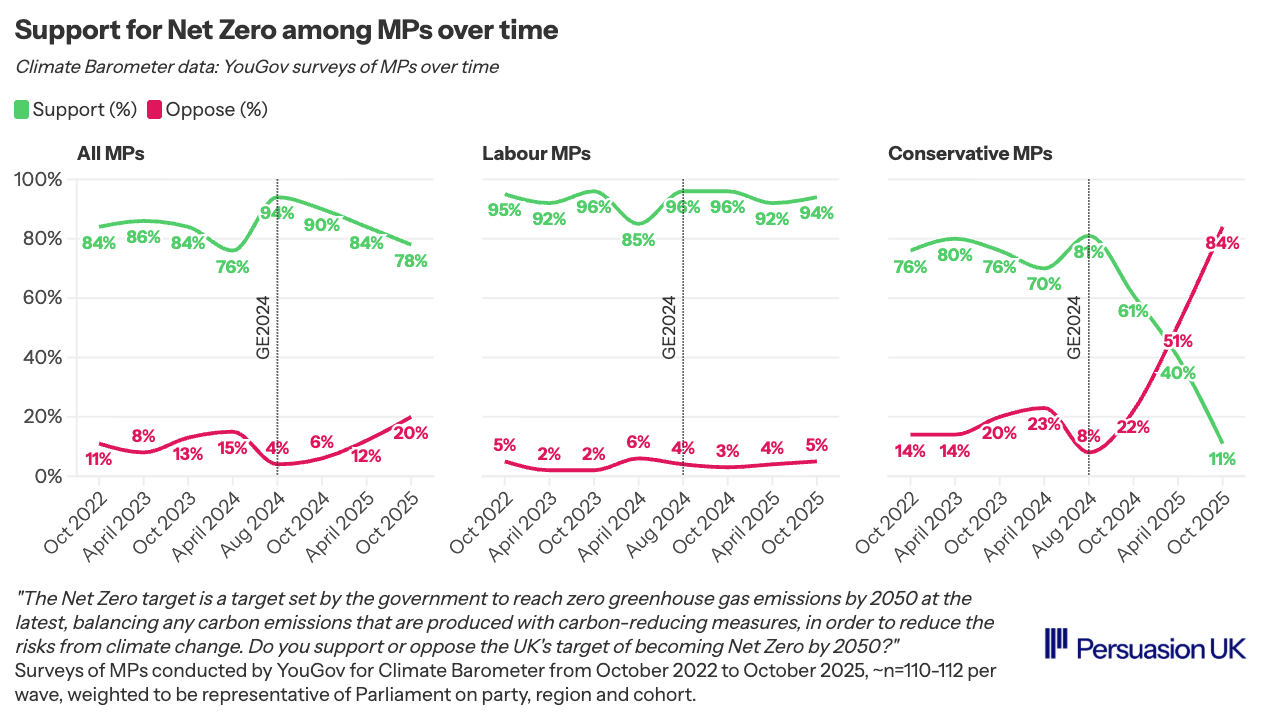
If shifts in public opinion can be sluggish, the political and media class moves like starlings, murmurating at pace. This means that they can be dramatically out of sync with the public, as we currently understand them to be on Net Zero. According to our research from earlier this year, negative opinions about Net Zero were triply overrepresented in the news media versus their actual prevalence among the British public.
But it is not only politicians who can drive news. As one 2021 study that analysed internet searches showed, news coverage of climate protests drives people to seek out more information about climate change (although the effect is short lived, not lasting much after the coverage has stopped). The surge of coverage of climate protests at the turn of the decade, coming into COP, tracked with significant bumps in climate prioritisation. This was then subsumed by a series of other issues, from the long tail of the pandemic to the cost-of-living crisis to the war in Gaza, pushing climate lower down, or off entirely, the front pages.
There is also reason to believe that the centrality of the cost-of-living crisis specifically makes it difficult for climate politics to gain ground. In the past, there was some academic consensus that economic downturns made the public less concerned with the environment, but recent work on the aftermath of the 2008 crash—where, chronologically at least, the downturn came before a fall in climate prioritisation—calls this into question. A 2017 study on the post-crash dip in climate prioritisation puts the blame at the feet of an increasingly politicised environment. Even so, the thesis that hard times cause people to prioritise economic issues over environmental does seem to be borne out, not least by another 2017 study, which found that voters in Denmark and Germany were more likely to rate green credentials as an asset for parties in better economic times and as a problem in more difficult economic periods.
Tackling the climate crisis is a huge political task, one that requires more than the tacit permission of a public who don’t actively disbelieve in the reality of a warming planet. What Persuasion’s joint work with the IPPR seems to suggest is that when climate change falls out of mainstream media discussion, people’s views about its reality do not change, but their likelihood of prioritising it does. If you see something less, you think about it less. This lower prioritisation leaves climate measures like net zero open to fragmentation and attack, with individual policy prescriptions coming under intense scrutiny and criticism from a motivated lobby.
In turn, those who don’t want action on climate change benefit from this balkanisation: those in politics, business and the media who seek to scupper action to curb emissions know that asserting that climate change isn’t happening is no longer a viable political strategy. Questioning it very much is. Focus on climate, they say, for example, is too expensive at a time when the cost of living is a priority. The last few years have seen the favourability of oil and gas showing a small but notable uptick, as has the number of people who say they do not believe the climate is changing at all (from 2 or 3 per cent a few years ago to 4 or 5 per cent now); these data points correspond with falling prioritisation.
One thing, however, is clear: climate salience is vital for climate action. We cannot expect a worsening situation on its own to prompt the public or political recognition that is necessary for meaningful action to be taken. Salience, then, is a form of persuasion.
Our climate in the near term will get hotter; whether the attentional bar moves with each hot summer or whether we become inured to new conditions remains to be seen. The only moveable lever is coverage and discussion: a public realm that is saturated with the reality of climate change, with the prospect of hotter days, of droughts and hosepipe bans, floods and food shortages. To want this is not alarmist: it is both accurate and helpful. It is also, in its own way, encouraging: there are limits to the assertion that people make the world and can make it differently, but none of them apply to public opinion.
With additional research by Tom Pruchnow.
 Adrienne Buller