

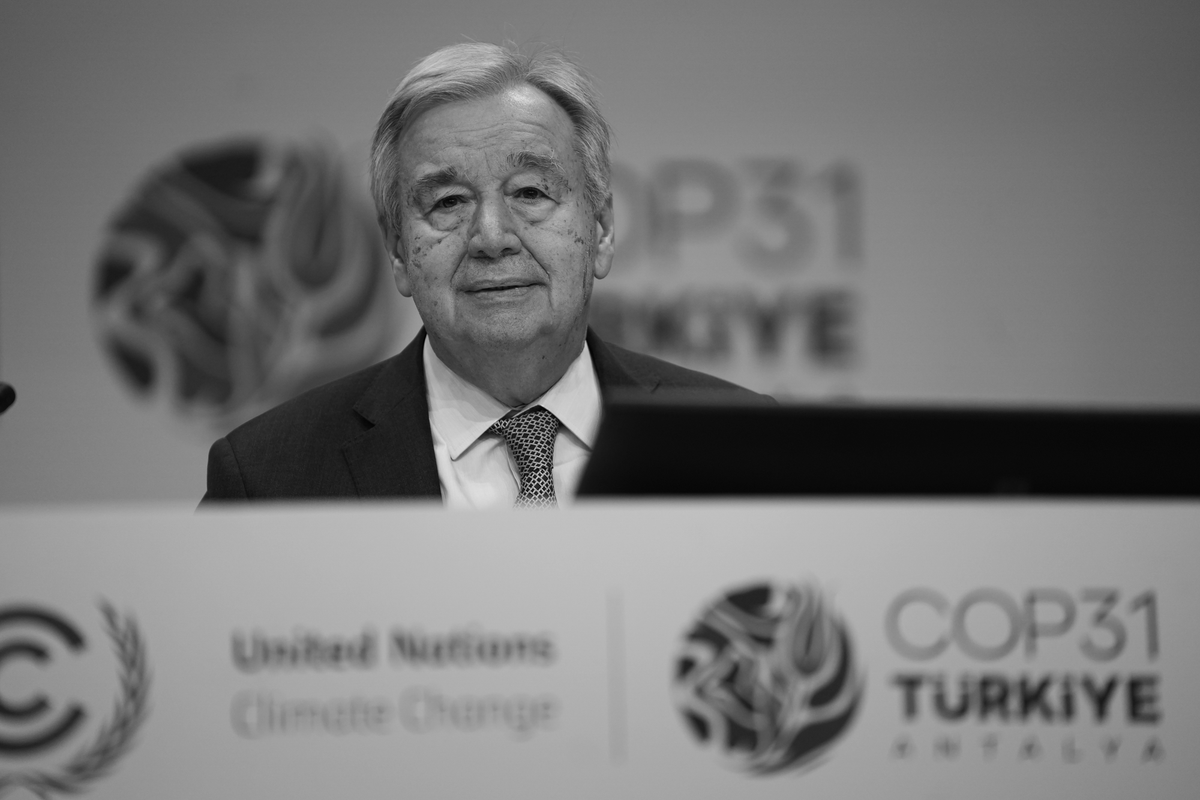
COP31, the annual United Nations climate conference taking place this year in Antalya, Turkey, draws to a close this week. So far, the prospects for a reaching a deal—particularly one with meaningful actions on key issues such as international climate finance or phasing out fossil fuels—appear dim. Frustrations with the COP process have become a mainstay of climate politics, from countless years in which the phrase 'fossil fuels' was struck from official documents to growing repression of public protest surrounding the exclusive conference halls. As the system enters its fourth decade and the world hurtles toward an era of climate "overshoot", the questions reverberate: is COP fit for purpose? Has it ever been? Or is it time to build something different altogether? We spoke to campaigner and regular COP attendee Leon Sealey-Huggins about the conference and the possibilities for action.
Adrienne Buller: This year’s COP is unusual in that it’s hosted by two countries—Turkey, where the action is taking place, and Australia, one of the world’s largest fossil fuel exporters. As an attendee of several COPs: How much do hosts shape outcomes, for better or worse, and how is this playing out in Antalya?
Leon Sealey-Huggins: The COP Presidencies have a lot of power to shape negotiations. We only won the Loss and Damage fund at COP27 in Egypt because the Presidency was held by a Global South country. Likewise, the area I work on, Just Transition, was included in the final outcomes in Egypt in part thanks to their attention to the issue as a negotiating priority.
Here in Antalya, there has been a clear division of labour between the joint Presidency. Turkey is the host while Australia is managing the negotiations. We are already seeing the influence Australia wields through their low ambition on key issues like delivering adequate climate finance and, indeed, on establishing the new body previously agreed to at COP30 to help make a just transition a reality.
There are also a lot of shenanigans regarding a ‘cover decision’— a document typically released toward the end of the conference which summarises the main political goals, targets, and priorities as agreed by participating countries. These can be controversial, as they don’t follow a standard process. In this case, there are loads of competing ideas about what the Presidency-shaped decision should and shouldn’t contain. Civil society groups are concerned the cover decision could be used by the Presidency to disproportionately shape the outcomes of the COP.
The draft cover decision that’s just been released includes problematic language across the board, notably concerning technologies under the ‘Carbon Dioxide Removal’ (CDR) banner and overshoot. These technologies are nearly always false solutions. Many CDR technologies come hand in hand with land grabbing; increased pressure on critical resources such as water; risks to local communities and food sovereignty; and impact on forests and other critical ecosystems.
It’s not clear that it’s possible to return from an “overshoot” scenario—that is, blowing past the 1.5C target with the aim of bringing temperatures back down in future. Instead, CDR is being used in the cover decision and elsewhere to distract from a just, rapid and equitable phase out of fossil fuels.
Certainly, ecosystem restoration and preservation are needed for climate justice and to protect our environment, biodiversity, and the people who live in harmony with and depend on it. However, we reject attempts to approach ecosystems like forests, mangroves, or oceans as carbon sinks only, and argue the attempt to include ecosystem restoration as CDR to legitimize overshoot is dangerous.
Ultimately, there’s no denying the sense that this is a Presidency led by a powerful global North country, and which reflects the interests and priorities of the North: talking a big game about 1.5C without following through on pledges and commitments to provide the necessary funding, technology transfer, or genuine international corporation required to achieve this, while at the same time expanding their own domestic fossil fuel sectors and placing a disproportionate burden on countries in the global South to go further faster.
 Adrienne Buller

AB: This is the latest in a run of COPs where civil society is constrained to some degree. What does this tell us about the state of, and hopes for, an effective climate movement? How are activists adapting?
LSH: I don’t know enough about the context in Turkey to be able to provide a total overview, but I had the privilege of being invited to speak at the People's Climate Summit taking place alongside the COP. From this experience, I know that local groups and movements in Turkey are facing ongoing repression and considerable barriers to their organising. Despite that, they've managed to organise a significant march of 10,000 people in Antalya. One organiser told me that the last time they marched, they were brutally repressed, and so this march meant so much to them in terms of being able to openly express dissent. The march was, in any case, historic, made possible thanks to the tireless work of Turkish unions and movements, and very likely helped by the international scrutiny and solidarity present.
I also think it's important to see this mobilisation as part of something much bigger. The People's Climate Summit in Antalya builds on the extraordinary expression of movement power we saw in Belém last year. That People's Summit was two years in the making, bringing together Indigenous Peoples, trade unions, peasants, feminist and climate justice movements from across the world. It was a powerful process of political convergence, consensus-building and collective action.
That momentum continued in Santa Marta, Colombia, earlier this year, where movements came together to advance a shared vision for a rapid, just and equitable transition away from fossil fuels, grounded in international solidarity, energy democracy and the rights of frontline communities.
So while shrinking civic space presents enormous challenges, I also see movements adapting, building international alliances and finding new ways to organise across borders and struggles. From Belém to Santa Marta to Antalya, we're seeing the emergence of a stronger, more connected international movement.
AB: What are the outcomes you’re advocating for at this COP, and why are they so important?
LSH: Our number one priority is Just Transition. It's a contested term, but for us, a just transition means addressing the connected crisis of climate breakdown and rampant inequality via a rapid, just and equitable phaseout of fossil fuels alongside the transition away from the economic and political systems that undermine efforts at care and repair.
To be more precise: by rapid, we mean meeting the urgent task of keeping global average temperatures below 1.5C. The burden of responsibility for this lies with those who are both more responsible and more able to act. By just, we mean not only for those impacted directly by this transition, but also for all those who could benefit from the creation of societies and economics based on care. And finally, by equitable, we mean addressing the global inequality that traps billions in the poverty of undignified lives, building people’s power to shape the decisions made about them and closing the door to false solutions.
Last year in Belém a broad coalition of movements and organisations supported pressure from the global South to force wealthy countries to commit to developing a new body to secure Just Transitions globally. We called this the Belém-Antalya mechanism for Just Transition—The BAM.
Already, we’re deeply disappointed to see that wealthier countries in the global North are trying to restrict the BAM and renege on their commitments. This is nothing new, echoing the failures we’ve seen in meeting climate finance commitments, for instance. But we truly believe that a strong Just Transition Mechanism could act as the framework to unlock so many other areas of climate action that remain stuck.
AB: What are you hearing in the corridors that is not making the press?
LSH: There’s a lot of buzz around the ‘electrification agenda’, but I haven’t seen much scrutiny of that or the way it’s being framed. There’s no specific language regarding fossil fuel phase-out, nothing on the Just Transition. There’s nothing on energy access, and nothing on finance. Lots of key questions are unanswered, like: where is the energy going to be coming from? Who is it going to?
Right now it seems that virtually every electron will continue to be gobbled up by data centres, or expanding private luxury in the Global North—power for air conditioning, LED TVs, electric vehicles. By comparison, there’s strikingly little on the resources required to provide the necessary energy for the 700 million people across the world, predominantly in Africa, who lack secure energy access for even their most basic needs.
Besides, electrification doesn't necessarily entail decarbonisation, especially without the finance needed to support lower-income countries to pay for clean energy installation. It’s as if the COP leadership have used AI to generate ideas about what a flashy outcome might be—“COP-GPT, or Claude31, give me some ideas about headline grabbing COP outcomes.”
Much of this is a distraction from the pre-existing commitments that high-income countries have made under both the UNFCCC and the Paris Agreement to provide the necessary money and resources to achieve climate action. Instead, they are obsessed with imposing new targets on countries without giving them the means to meet them.
Last year at COP30 in Belém, governments agreed to begin a Climate Finance Work Programme to hold rich countries accountable to their obligations. However, at this COP the UK has aligned with the other developed countries in rejecting developing countries' call for public finance. At the same time, Andy Burnham's government in the UK has been acting against the spirit of the Paris Agreement by turning the UK's £400 million international climate finance commitments from grants into loans. All this while increasing its military budget, subsidising fossil fuels and flirting with carbon-bomb projects like Rosebank.
We are also concerned about the securitisation of climate breakdown in general, especially in the context of austerity budgets being used to fund militarisation across the UK and globally. The announcement of the New Special Representative for Climate Security must prioritise the inequalities driving climate breakdown—acknowledging that we are most secure when we are more equal, not when we build more weapons.
Another issue receiving far too little attention is Türkiye's role in supplying crude oil to Israel, despite its publicly stated trade embargo. The Baku–Tbilisi–Ceyhan pipeline, which counts BP, SOCAR, ENI and Turkey's own state oil company, among its shareholders, carries Azerbaijani oil through Türkiye, accounting for between 30–40% of Israel's crude imports over recent years. This oil is refined into fuels that sustain Israel's military operations and occupation of Palestine. Our partners at Global Energy Embargo for Palestine (GEEP), alongside Turkish movements, have been exposing and demanding an end to this complicity.
AB: Cynicism about the COP process is, to say the least, high. What hopes do you still place in the conference? And what do you make of alternatives like the Santa Marta process?
LSH: I think we have to push any and all levers available to us to arrest climate breakdown, excepting false solutions.
Though deeply compromised, with big polluters overrepresented (summit attendees this year include financiers representing more than $2.2 trillion in fossil fuel money) these spaces are too important to cede.
There are so few global governance spaces where civil society have formal representation—to intervene in talks, to scrutinise, to observe and to translate what's happening for wider publics and movements. Similarly, there are few places where marginalised countries might have the opportunity to challenge their adversaries with, at least notionally, an equal voice. So we need to defend the existing spaces we have, however imperfect.
Clearly, though, we also need stronger processes. If properly designed, the Transitioning Away From Fossil Fuels (TAFF) process, led by the momentum and vision for a Fossil Fuel Treaty, could be one of them. We at War on Want were part of that process in Santa Marta. Meaningful participation wasn't guaranteed, but it was something movements could organise and fight for—and we did.
That's what's exciting in this moment: the potential for a more radical agenda, with tangible commitments to phase out fossil fuels, redistribute resources, and ensure that wealthy countries pay their fair share through public finance, not more debt.
Leon Sealey-Huggins is a Senior Campaigner at War on Want, where he leads on the Just Equitable and Ecological Transitions work.