

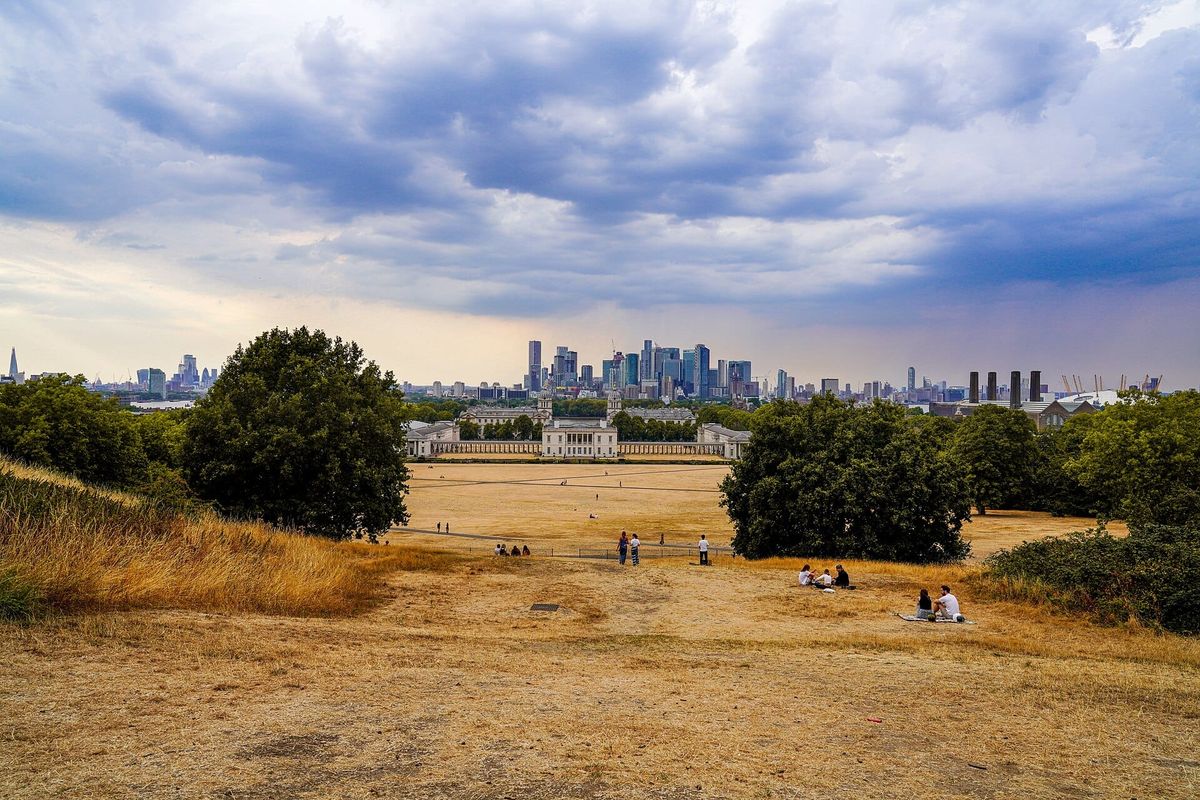

Heatwave 2.0
It feels like just yesterday we were talking about May's record-breaking heatwave in Europe. Yet, just a few short weeks later, here we are again. Earlier this week, Britain's Met Office has issued a red heat warning (for only the second time ever! We're doing great!) for a large triangle of the country, stretching from London in the southeast to Cardiff in south Wales and Birmingham in the midlands. Temperatures have already hit the high 30s which, when combined with high humidity, pose a risk of serious illness or danger to life. Incredibly, among the many things impacted by the heatwave was a panel at London Climate Action Week about the effects of extreme heat—an event which had to be cancelled due to ... the effects of extreme heat.
France, meanwhile, recorded its hottest day ever, with parts of the country experiencing power outages. Forty people drowned this week while swimming to escape the boiling temperatures. The country is often cited as a model for others to follow on decarbonization thanks to its largely publicly-owned, low-emissions energy system. Nearly 67 per cent of France's electricity comes from nuclear power, but even this sector—often touted as the solution for stable zero-carbon energy—was not immune to the temperatures. Output at multiple reactors along the Rhône and Seine rivers was reduced this week, while the Golfech 2 reactor on the Garonne had to be taken completely offline because temperatures in the adjacent river became too high to use the water to cool the reactor.
As our Editor Adrienne Buller wrote at the end of May, these extreme weather events, occurring with ever more frequency and intensity, are "inseparable from the steady march of a climate crisis that, despite its pace, has faded from the concerns of mainstream politics."
Indeed, as most of us swelter in poorly insulated homes and offices, at the well air-conditioned Olympia centre in West London, the annual "Alliance for Responsible Citizenship" conference is currently in full swing. The ARC conference gathers the stars of the British and global right, a joint project headed by the Conservative peer Philippa Stroud, frog-voiced scold Jordan Peterson and Paul Marshall, owner of right-wing TV channel GB News and the Dubai-based investment group Legatum.
Importantly, as DeSmog has reported, nibbling canapés and chit-chatting at this year's event alongside the many Tory and Reform politicians and Maga-ites are a rogue's gallery of fossil fuel lobbyists and climate deniers. On the attendees list, they report, were "executives from fossil fuel companies including Valero, Heyco Energy and Koch Inc.", the latter being firm whose co-founders David and Charles Koch have long been major sponsors of climate denial. Also in attendance were representatives of Net Zero Watch, the CO2 Coalition, the Heritage Foundation and "King Coal" himself, journalist Matt Ridley, described by DeSmog as "a powerhouse of climate science denial in Britain."
All of which would be easy to ignore (another gathering of grifters, you say?) if it weren't for the fact that such a project is both frighteningly close to power (among those getting top billing was one Nigel Farage), and the creeping effect all of this is having on British and global politics.
Indeed, a pernicious form of denialism increasingly pervades political discourse in the UK, visible in everything from the outcry over Labour's net zero "lunacy" and ban on new North Sea oil and gas licences, to the ever-decreasing salience of climate change as an issue in popular politics and in the media.
And, with current energy secretary Ed Miliband being floated as the country's next Chancellor of the Exchequer, the preemptive pushback has begun in earnest: Sharon Graham, head of the influential Unite union, said that his commitment to decarbonizing would be a “noose around the neck” of job creation, while the Guardian reported that some in the Labour Party are pushing Wes Streeting for chancellor "in a bid to reassure the business community and fossil fuel industry."
Nor is this, of course, at all confined to the UK. As a recent report from the University of Colorado found, global news coverage of climate change has fallen by 38 per cent from a peak in 2021. Mentions of climate and ESG issues on S&P 500 earnings calls, meanwhile, have dropped by roughly three-quarters during this period. All of which comes as the effects of runaway global heating are more visible than ever.
Increasingly central to these political games has been the work of closely tying fossil fuels to the idea of prosperity. As Michael Ledger-Lomas writes in a superb new essay for us on the rise of the Albertan separatist movement in Canada, "separatists believe that Albertan oil and gas pays Canada’s bills." As belts are tightened, "around a third of Albertans now feel that leaving Canada may be the only way their oil and gas industries could survive and thrive."
For now, the dream of an independent Alberta looks set to remain just that. Even so, its effects have already been significant. "The federal government has abandoned serious talk of an energy transition," Ledger-Lomas writes, "for fear of wounding the vitriolic Albertans who claim to speak for their province. The existence of the separatists, meanwhile, helps the mainstream media—not least the Globe and Mail newspaper—to dub climate change activists as equal and opposite extremists and to shove them from the moral centre where Canadians imagine themselves to be."
The piece touches on a core political problem that has faced climate action for as long as the fossil fuel lobby has been funding denial: the portrayal, and public perception, of climate advocates as alarmist, and action as premature, economically destructive, or worse. This battle of perspective is a tale as old as time, even where public support for climate action has remained high and steady. How should we make sense of it?
According to a new report by the LR Foundation, a key to understanding this conundrum holding climate action back is the gap between one's personal sense of the threat of climate change and what we perceive as our fellow citizens' level of concern. Based on national polls, they found that more than half of the British people think that climate change poses a "very serious" risk. The amount of their fellow citizens who they think share that same analysis of risk? Just 15 per cent—a striking gap of nearly 40 per cent. What that means is that the majority of people vastly underestimate how much ordinary people worry about the effects of climate change. In the US, the gap is even higher at 51 versus 10 per cent. What this signals is that voters are greener than politicians, the media—even we ourselves—seem willing to admit.
The question is how to translate that into real support for action and policy with teeth enough to take a bite out of the vast challenge we face—not only when it comes to getting off fossil fuels, but, as Adrienne argued in her recent interview with Politics Theory Other, with the urgent task of adaptation. As Adrienne (and the Committee on Climate Change) put it, the infrastructures of our societies were built for a climate that no longer exists.
The upshot is that the policies of adaptation—better working conditions, greener and shadier cities, closer-knit communities with extreme weather response plans, improved public transit and more—are the kinds of climate policies that people can see and feel improving their communities in the here and now. They're prefigurative of a better way to live, tying prosperity and wellbeing not to the false promise of fossil fuels, but to the work of climate action.