

The Price of Oil
As the Nigerian government pushes to restart oil production in Ogoniland, decades of pollution, dispossession and broken promises cast a long shadow over the future.
On Thursday 12 June 2025, the two million inhabitants of Ogoniland woke up to surprising news. The Nigerian president, Bola Ahmed Tinubu, as part of activities to commemorate “Democracy Day”, the annual celebration of Nigeria’s emergence from military dictatorship, announced a posthumous pardon for the Ogoni Nine, a group of activists including the poet Ken Saro-Wiwa who were executed in 1995 by the military junta for protesting oil pollution from Shell’s operations in the Niger Delta. Not only that, Tinubu also announced that Ogoniland would be offered several new and ambitious developmental projects, including plans for a new university, a road construction scheme and a promise to accelerate the clean-up and restoration of the environment, something which had been stymied by widespread corruption over the previous eight years.
Could this, many wondered, represent a genuine step away from the extractive practices of the Nigerian state that have blighted the land for the past half century? And did the official pardon of the Ogoni Nine after three decades amount to a real effort to account for the grave injustice done on behalf of the country’s extractive industries? Activists were skeptical. Perhaps that shouldn’t be a surprise. This part of Nigeria has been blighted by the long history of state failure and corporate greed that have turned the oil-producing Niger Delta into one of the most polluted areas on Earth.
Nigeria is the largest oil producer in Africa and Ogoniland, an area of around 1,000 sq km to the immediate west of the city of Port Harcourt, was one of its earliest sites of extraction. Commercial drilling operations began in the region in 1958, two years after oil was first found in the country. In the decades since, the oilfields of Bomu, Bodo West, Tai, Korokoro, Yorla, Lubara Creek and Afam are estimated to have produced around $30 billion in revenue for multinational oil companies like Shell and the Nigerian state.
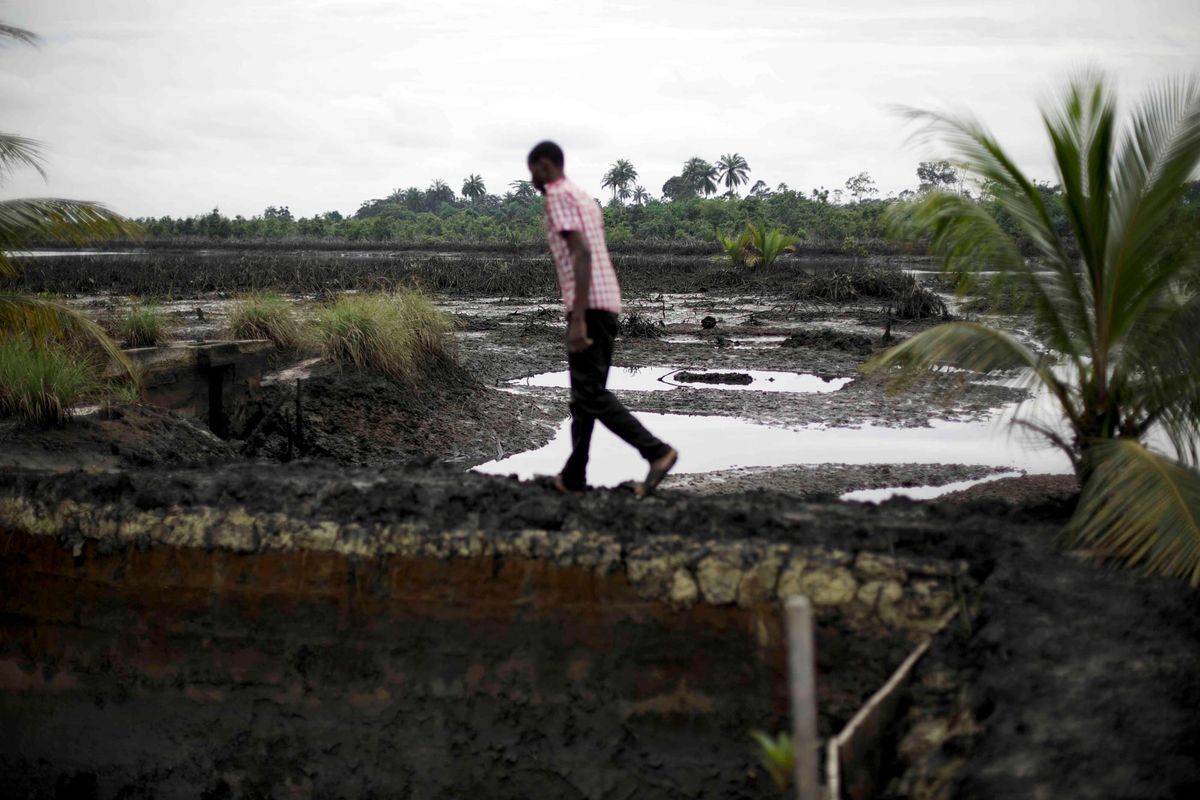
With the oilfields came destruction, too. Between 1976 and 1991, more than 2, 976 separate oil spills occurred in Ogoniland, leading to the release of more than two million barrels of oil into the community’s land, streams and creeks. The consequences have been catastrophic and long lasting, while the many promises of clean-up have not been kept.
Such was the extent of this pollution that by the early 1990s many of the region’s farmers were unable to work their land. Nor could locals fish: the area’s marine life, once a common source of protein, has become ever scarcer as the oil has contaminated the Delta’s ecosystem.
“All wildlife is dead,” the Movement for the Survival of the Ogoni People (MOSOP), the activist group founded in 1990 by Ken Saro-Wiwa and Ogoni chiefs, wrote in the Ogoni Bill of Rights that year.
The ecology is changing fast. The mangrove tree, the aerial roots of which normally provide a natural and welcome habitat for many a sea food—crabs, periwinkles, mudskippers, cockles, mussels, shrimps and all—is now being gradually replaced by unknown and otherwise useless plants. The health hazards generated by an atmosphere charged with hydrocarbon vapour, carbon monoxide and carbon dioxide are innumerable. The once beautiful Ogoni countryside is no more a source of fresh air and green vegetation. All one sees and feels around is death. Death is everywhere in Ogoni. Ogoni languages are dying; Ogoni culture is dying; Ogoni people, Ogoni animals, Ogoni fishes are dying because of 33 years of hazardous environmental pollution.
The publication of the bill of rights opened the floodgate of resistance in Ogoniland. On January 4, 1993, less than three years after MOSOP’s founding, around 300,000 Ogoni, over half of the population of the region at the time, defied a government ban on public demonstrations to turn out for a mass protest against extraction. One of the movement’s demands was an end to gas flaring, the environmentally harmful practice used by oil companies to cheaply dispose of natural gas brought to the surface while drilling for oil. Between 1958 and 1990, constant gas flaring by Shell severely damaged local biodiversity, charred mangrove forests and reduced agricultural fertility in Ogoniland, while toxic substances released into the atmosphere caused widespread respiratory problems, cancers and skin infections among the Ogoni people. Other demands made by MOSOP included the control of Ogoni affairs by Ogoni people, the use of Ogoni economic resources for local development, adequate and direct representation of Ogoni people in Nigerian national institutions and the right to protect the Ogoni environment and ecology from further degradation.
This latter demand, for political autonomy and control of economic resources, has been the cornerstone of the Ogoni resistance. Despite the centrality of the Niger Delta to the Nigerian economy, the relationship between the Ogoni people and the broader Nigerian federation, dominated by the country’s three major ethnic nationalities, the Hausa, Yoruba and Igbo, has long been fraught. Under British rule, the Ogoni were forced into the administrative division of Opobo, a situation that continued even after the Ogoni Native Authority was created in 1947 and which granted the Ogoni people some limited autonomy. This was to prove short-lived, however: in 1951, nine years before Nigeria’s independence, the British colonial power forced the Ogoni people into the country’s Eastern Region, an administrative unit dominated by the majority Igbo people, under which they suffered administrative neglect and marginalization even as the revenues from the sale of oil taken went into state coffers started to flow, paying for massive infrastructural projects everywhere except the land from which it originated. It was not until 1967, and under the exigencies of the Biafran war, that a new administrative bloc, Rivers State, was created to accommodate the Ogonis, along with the Ijaws, Itshekiris and other minority ethnic groups in the Niger Delta. Even this did little, if anything, to improve the situation of the Ogoni.
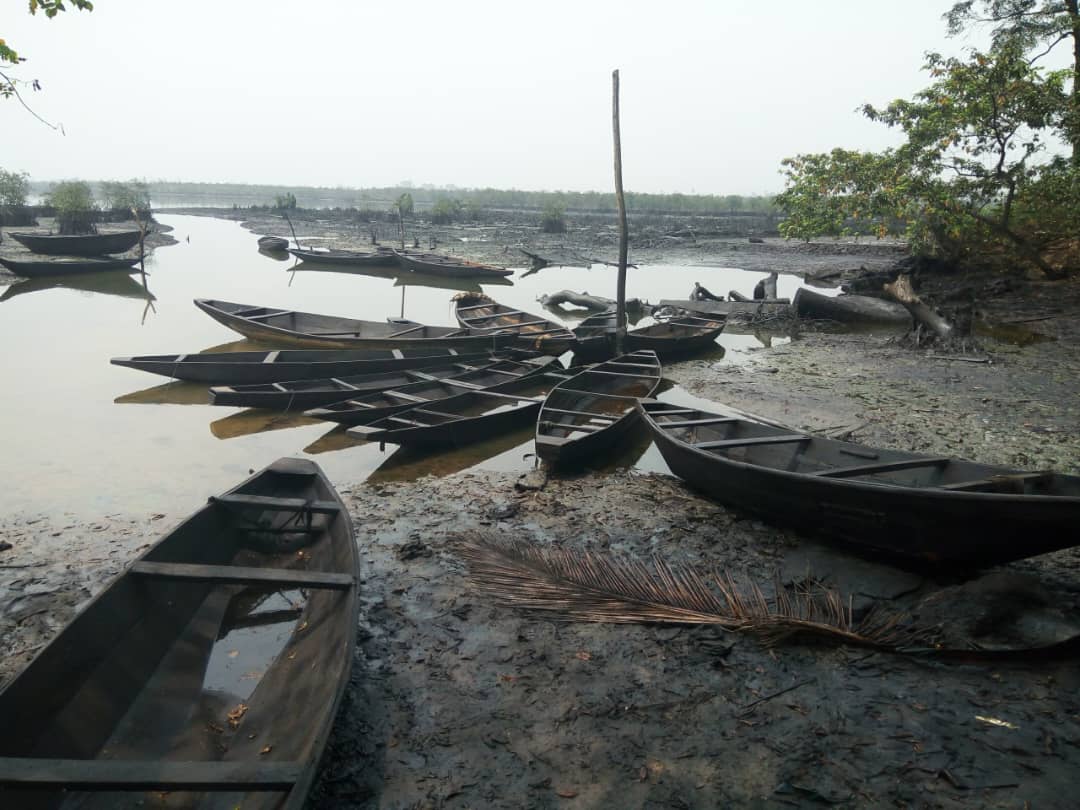
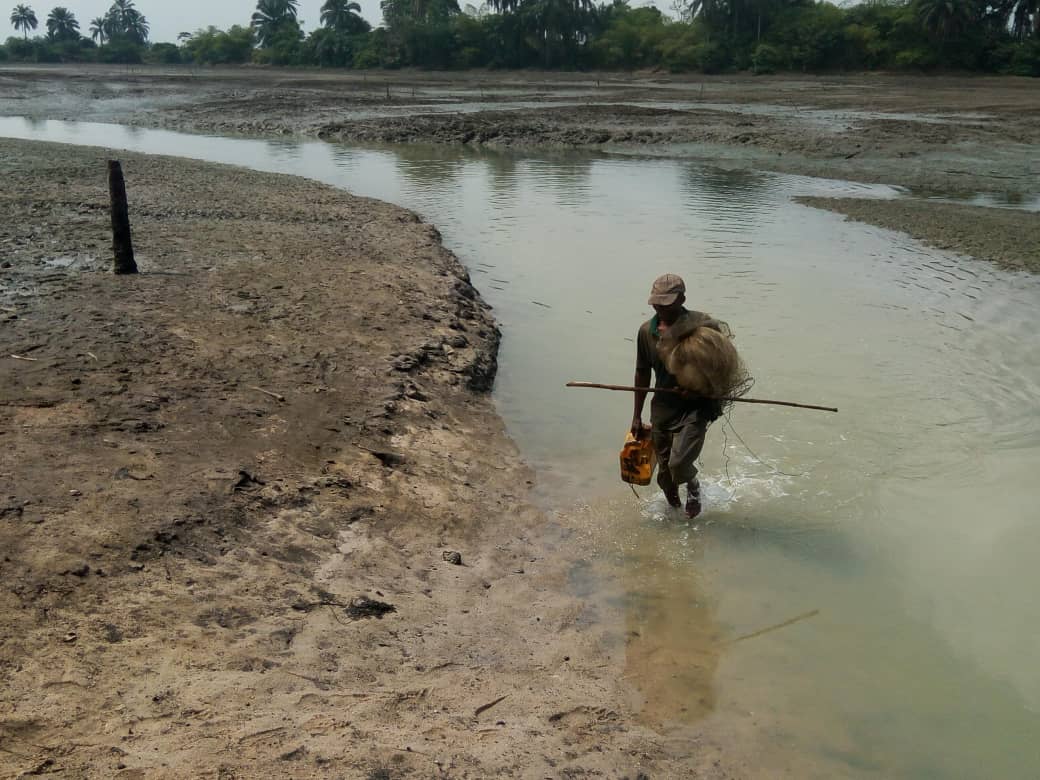
The banks of the Goi river, showing traces of oil contamination, left (Taiwo Hassan). A fisherman on the Goi river, right (Taiwo Hassan)
By this time, oil production had become increasingly central to the Nigerian economy. So long as the black gold kept flowing, the people of the Niger Delta would need to be kept quiet. With the execution of the Ogoni Nine in 1995, the military regime under President Sani Abacha managed to quell the movement, but it was not able to make Ogoniland conducive for further oil exploration. Intense and widespread protests in the region continued, and Shell withdrew their staff fearing backlash from locals.
Since then, no crude oil has been extracted from the land of the Ogoni people, and their bold example of resistance has since been taken up by other communities in the Delta. In the early 2000s, the wider Niger Delta erupted into conflict as many of the region’s youth took up arms against the oil companies. Oil production facilities were sabotaged, oil installations bombed and foreign oil workers were abducted. The ensuing crisis led to the inability of the Nigerian state to meet its OPEC quota and resulted in a substantial loss of oil revenue. It was not until 2009 that Nigeria, after a decade of large-scale military action and widespread repression that had failed to curb the violence, was able to implement an Amnesty Programme under which militants agreed to lay down their arms in exchange for government support.
Petro-developmentalism
So why has the Nigerian state decided that now is the time to restart oil production in Ogoniland? The answer lies in the catastrophic cul-de-sac into which the past six decades of capitalist development have plunged the country.
Until the 1970s, the Nigerian economy was primarily based on agricultural production. In the west, Cocoa dominated, while groundnut was the major export crop of the north and palm oil the east. It was only with the end of the Nigerian civil war, in 1970, that oil exports became a significant share of Nigerian economy. But quickly, crude oil came to displace both agriculture and manufacturing as a share of GDP: in 1960, agriculture contributed around 64 per cent of Nigeria’s GDP; by 1980, this had plummeted to just 20 per cent.
Then came the global oil price shocks of the later 1970s, which saw Nigeria flooded with foreign currency. Only a fraction of the revenue this generated was paid to the oil-producing regions of the country themselves, with the vast majority of the wealth lining the pockets of the large oil companies and the local elite. Nor was there much long-standing infrastructural and industrial development to show for the oil boom.
Many, however, in Nigeria’s capitalist elites, sought to utilize the country’s newfound wealth to build a modern industrialized economy. In the 1980s, the country’s Fourth Development Plan—an ambitious ₦82 billion ($149.09 million) initiative by the civilian government to foster industrial self-reliance, balanced development and agricultural growth—saw major investment in agriculture, social services and newly developing industries. One of these was the production of steel, under which several rolling mills were built and commissioned, meant to serve as a bedrock for the country’s industrialization. Construction of the Ajaokuta Steel Complex, the most ambitious of them, began in 1979. Over four decades later, the complex is still not complete due to funding issues, contractor disputes and policy changes. Much like other promising local industries, the steel sector is now mostly moribund, the billions invested lost to corruption and mismanagement.

According to estimates by the World Justice Project, more than $550 billion has been lost to corruption in Nigeria since 1960, most of it through contract inflation or embezzlement by politicians and civil servants. In 2021 alone, the country’s anti-corruption agency recovered at least $750 million in local and foreign currency, while Nigeria continues to lose an estimated $18 billion annually to illicit financial flows, primarily from tax avoidance by multinational corporations.
With the oil wealth either stolen or frittered away, many Nigerians have been left in endemic poverty and with a lack of access to basic amenities, while the country’s population has continued to grow. Nigeria's annual population growth rate currently hovers at around 2.1 per cent per annum, making it one of the world’s fastest-growing nations. Nigeria’s population is projected to grow from its current 230 million to between 477 million and over 500 million by 2100, a figure which would put it as either the world’s second or third most populous country.
This rapid growth is taking place at the same time as a reduction in Nigeria’s oil revenue. Over the past decade, the country’s crude oil production has declined as a consequence of aging infrastructure, lack of new investment, rampant oil theft and frequent maintenance shutdowns. In 2024, oil production averaged just 1.5 million barrels a day, a 31 per cent decline on 2015. This decrease has affected government revenue, even if rising global oil prices as a result of the US-Israel war in Iran are likely to offset some of this in the short term. This reduction in revenue is further compounding a crisis in Nigeria’s public budgets. In June last year, the country's national debt reaching $99.6 billion USD. In 2025, some 25 per cent of the country’s budget went on debt servicing, a figure that when set alongside the country’s ever-growing population will only widen the country’s infrastructural deficit.
Today, Nigeria finds itself in a classic “Debt-Climate Trap”, wherein pressure to service debt forces countries in the Global South to prioritize fossil fuel projects. The result is a cycle in which climate action becomes ever more unaffordable. Indeed, Nigeria has spent the past five years ramping-up investment in the upstream oil sector, the segment of the oil industry involving exploration and production of crude oil and natural gas, in defiance of global calls for decarbonization and a transition away from oil and gas. All of has come alongside the Petroleum Industry Act (PIA), a new legal and policy framework for the management of the oil industry introduced in 2021, and an ambitious divestment programme which has seen International Oil Companies switch their fossil fuel portfolio to more profitable Deepwater oil fields off the Gulf of Guinea. According to estimates from OPEC’s 2025 Annual Statistical Bulletin, Nigeria still holds an estimated 37.5 billion barrels of proven crude oil reserves, but at current rate of exploitation it may be exhausted in the next 40 years unless new deposits are discovered.
The Great Temptation
These are the factors that have been driving the current scramble for the resumption of oil production in Ogoniland. The region sits on Oil Mining Lease (OML) 11, Nigeria's largest onshore oil block, which contains vast, strategic oil and gas reserves making it a significant source of potential revenue and vital for meeting national production targets. While exact figures vary, many expect that Ogoniland’s 33 oil and gas fields could add a further 150,000 barrels per day to Nigeria's output, potentially boosting national production to around 2.1 million barrel per day.
In the last two years, the Federal government has initiated a series of dialogues with Ogoni stakeholders in order to build a consensus for the resumption of oil production in the region. In September last year, a Presidential Committee on the Ogoni Consultations submitted a report of its consultations to the president. Meanwhile, Nigeria's national security adviser, Nuhu Ribadu, who has been coordinating the talks, led a large presidential delegation to Rivers State to further interface with locals and prepare the ground for a resumption of drilling.
But doubt continue to trail the proposal, despite government assurances that this time production will be of benefit to the local community. At the annual Ogoni Day celebration in January this year, an annual event held to mark the anniversary of the mass protest against Shell in 1993, the current president of MOSOP, Fegalo Nsuke, called for exploration with a human face in order to avoid the mistake of the past. “While we recognize the importance of oil revenue for development,” he said, “such activities must be carried out ethically, humanely and with genuine concern for the welfare of the Ogoni people.”
Many are rightly skeptical. As the Polish journalist Ryszard Kapuściński plaintively observed in 1982, referring to another petro-state that had seen endemic corruption and dislocation trail in the wake of oil companies, Iran: “the concept of oil expresses perfectly the eternal human dream of wealth achieved through lucky accident, through a kiss of fortune and not by sweat, anguish, hard work. In this sense oil is a fairy tale, and like every fairy tale, a bit of a lie”.
This lie is woven into the very fabric of Nigeria’s historical development. Indeed, the annals of Nigerian “petro-capitalism” are an uninterrupted chronicle of naked aggression, exploitation and violence of the corporate frontier.
As far back as 1990, MOSOP claimed that “Ogoni is being killed so that Nigeria can live”. Nothing in the last three decades suggests anything has changed. Despite Shell’s withdrawal from Ogoniland in 1993, oil still contaminates the region, while the compensation owed to many of the victims goes unpaid and the promised clean-up of the spillages and environment is left unfulfilled. More concerning still is the repeat over recent decades of the cycle of extractivism and pollution across the length and breadth of the Niger Delta. Much as last time, local communities have seen little benefit. Many in the Delta accuse the oil majors of operating like criminal gangs, without care for human lives and the environment. And, as recently leaked internal documents from Shell demonstrate, profit is their only goal.
The documents, including several pages of email exchanges disclosed during legal proceedings in a British court, reveal Shell operating a major oil pipeline in Nigeria for years, despite warnings from its own staff that it was causing widespread pollution. The firm’s technical vice-president at the time, Markus Droll, warned as early as 2008 about the risks associated with continuing to pump millions of barrels of unrefined fuel through the 60-mile Nembe Creek Trunk Line, one of the company's main pipelines in Nigeria, while it was subject to infrastructure failures and theft. The revelations confirm what local campaigners have known for years: that the reckless actions of Shell’s subsidiary in Nigeria were orchestrated from the very top, out of the firm’s London headquarters. In response, the people of Ogale and Bille have brought a suit before a UK court, asking for $1billion in historic damages.
So bad is the situation that a commission set up by Bayelsa state, to the west of Ogoniland and another administrative unit in the Niger Delta, paints a catastrophic picture of pollution devastating in its scale and scope—so much so that it dubbed it an “environmental genocide”. According to the report, the Niger Delta “has suffered the equivalent of a major oil spill, on the scale of the Exxon Valdez disaster … every single year for 50 years”. The United Nations, meanwhile, estimates that since 1958, at least 13 million barrels of crude oil has been spilled in over 7,000 incidents in the Niger Delta. Between 2011 and 2022 alone, the National Oil Spill Detection and Response Agency (NOSDRA) recorded at least 10,463 spill incidents which released 507,135 barrels of crude oil into the environment.
All of which has produced a Niger Delta which is now one of the most polluted places on earth, and where life expectancy has plummeted to just 41 years—10 years behind the Nigerian average. Against this bleak background, marked by a cycle of poverty, environmental degradation and economic underdevelopment, many in the Delta struggle to see how the resumption of oil extraction could produce a positive outcome, let alone deliver tangible benefits to local communities.
As Kapuściński wrote, “oil kindles extraordinary emotions and hopes, since oil is above all a great temptation”. Perhaps. But, with the possibility that Ogoni skies may again be lit by flared gas, while its farmlands and streams, still suffering from the first 33 years of extraction, will be clogged with hydrocarbons, the people of this region could once again show the world the real meaning of hope, lighting the path of resistance to rapacious petro-capitalism.
Taiwo Hassan is a socialist and a freelance journalist from Lagos, Nigeria, where he has been at the forefront of advocacy over the last two decades. His recent work has focused on the seismic shifts currently underway in Sub-Saharan Africa under the impacts of climate change, the COVID-19 pandemic, jihadist insurgency and Russia’s invasion of Ukraine. He has bylines in several notable global media outlets, including New Internationalist, Earth Island Journal, World Politics Review, Responsible Statecraft, African Argument, Inkstick, Wired, and Prism.

