

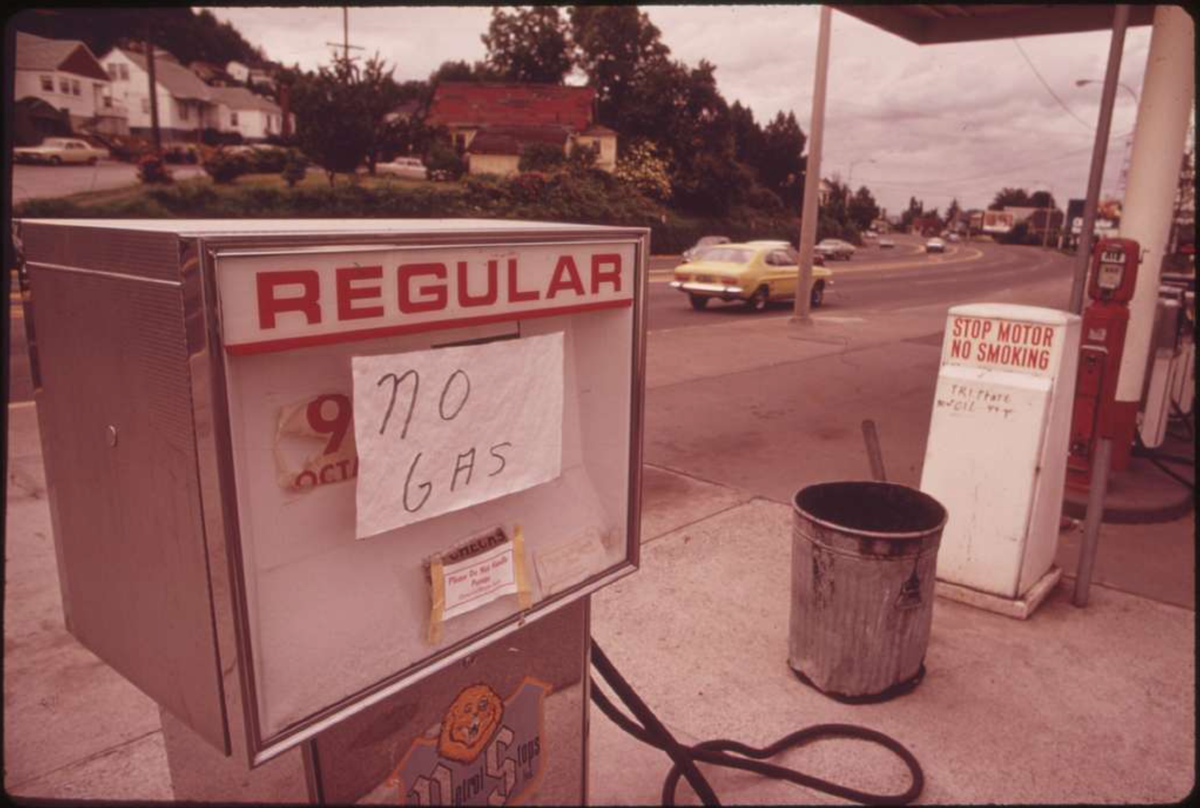
From the mid-1980s through to roughly the end of the first decade of this century, the global economy experienced a period of relative macroeconomic stability. For some, this came to be known as “the Great Moderation”: a period of relative calm following the tumultuous 1970s, years rocked by the 1973 OPEC Oil Crisis, the end of the Vietnam War and the British “Winter of Discontent”, followed immediately by the “Volcker Shocks” of the early 1980s.
In contrast to that era of instability, what followed was considered by most economists to be far more economically, politically and socially steady. Business cycles were milder, defying the Marxist critique of the cyclical “boom and bust” of capitalism, and the economy expanded into ever farther reaches of the natural world in the name of globalization. The going, for many, was good—so much so that during the peak of the Great Moderation, political philosopher Francis Fukuyama penned his famous “End of History” thesis, arguing that Western market-based liberal capitalism was the pinnacle of political economic organization.
This interpretation of the 1990s and early 2000s has, in subsequent years, faced sustained criticism, not least for being myopically “Western-centric”; after all, the period of the Great Moderation also coincided with the “Shock Therapy” of the 1990s,[1] which spurred double-digit inflation and sharp spikes in unemployment, alongside the post-Soviet conflicts in Eastern Europe; numerous civil conflicts in Africa; and the fallout of the September 11th attacks in the US, to name a few. Nevertheless, there was some truth to the thesis: everyday life did, for most people in most industrialized economies, enjoy a level of relative stability.
Today, however, one thing is clear: the Great Moderation is now definitely over, even for those Western nations which benefited from it the most. The Global Financial Crisis of 2008 marked the end of moderate business cycles, and for several years after Western economies largely floated within a haze of what the American economist Larry Summers called “secular stagnation”: negligible economic growth along with excess savings, a dearth of investment and interest rates moving into the negative territory. This would sow the seeds of what came next: political discontent combined with xenophobia and neo-Mercantilist politics[2] to fuel the rise of Trumpism, which in turn bolstered a renaissance of autocratic forms of governance, all undergirded by rising right-wing populist movements.
From stagnation to volatility
Now, a quarter century into the new millennium, what we see and what we can expect in the near future is something worse than stagnation: “the Great Volatility”. Our era today is one that is beset with macroeconomic instability, rooted in crumbling political settlements across the Global North, alongside growing inequality, wildly excessive and unbridled speculation in AI, trade wars, actual wars and—sadly all too often forgotten in economic discussions—ecological and climate breakdown. All of these present their own challenges, yet at the same time each compounds the others.
The prospect of the Great Volatility was first posited by the European Central Bank’s Isabel Schnabel during a speech in 2022. In her remarks, Schnabel argued that while the Great Volatility was not predetermined, it would pose challenging questions for central banks with respect taming inflation. Per Schnabel, the macroeconomic instability we were experiencing was not simply the result of choices made by actors like those invading their geographic neighbours (Putin’s Russia), nor of those building ever higher tariff walls (Trump’s America); rather, Schnabel argued, central banks had themselves contributed by presiding over regulatory and policy frameworks that did little to tame the speculation of finance while being unwilling to recognize their own role in global politics.
It is the supply-side shocks to the global energy system, however—first after Russia’s invasion of Ukraine and later with the US-Israeli attack on Iran and the subsequent closing of the Strait of Hormuz—that have been key source of instability over the last several years. Both have also served as an untimely reminder of the destabilizing effects that the energy system can have on the global economy, as well as just how carbon-intensive that system remains. In this sense, our new period of volatility seems to mirror the early 1970s, when the OPEC crisis caused rising costs and even, in some instances, energy rationing. However, it’s essential that we also look beyond these surface level echoes to the new forces at play.
Toward “climateflation”
Put simply: our era of volatility is intimately tied to the effects climate change. This is true with respect to more than just our reliance on fossil fuels or the failure to decarbonize our energy systems. Fossil fuel extraction, transport and combustion are both key causes of ecological and climate breakdown, and at the heart of the current era of instability.
Following Russia’s invasion of Ukraine, we entered a “new age of energy inflation”, one that would be defined by three interrelated neologisms: climateflation, fossilflation and greenflation. Climateflation, for Schnabel, refers to the effect that increasingly severe natural disasters and extreme weather events are having on economic activity and pricing. Fossilflation, meanwhile, is the susceptibility to short term shocks caused by continuing dependence on fossil fuels within global market-based energy systems. Lastly, Greenflation refers to the inflationary pressures driven by measures taken to address the causes of climate change, and indeed climateflation and fossilflation, for instance in the surging demand for so-called “critical minerals” that exceeds available supply. Others have added their own terms to what is now a growing lexicon of “-flations”, like the economist Isabella Weber’s “carbonflation”, caused by the reliance on emissions trading systems, or the now well-known phenomena of “greedflation”, “shrinkflation” and “skimpflation”.
Each of these concepts has already moved beyond Schnabel’s original theoretical provocation. So much so, in fact, that we can see a new overarching concept coming into view: “Climateflation”, or the idea that the causes of climate change, as well as its material consequences and the efforts to mitigate it, are jointly and increasingly resulting in ever worse price volatility. Climateflation is thus, in equal measure, a cause of geopolitical instability, a consequence of it and amplified by it.
An important caveat here is that inflation does not mean that every price is rising. Rather, it means that the overall direction of prices is increasing. In some instances, we might see a reduction in prices linked to, say, fossil fuel dependence, if for instance there is a significant drop in demand for oil, or even if a warmer and more CO2-rich atmosphere yields a bumper crop in a given year. A notable example of this disinflationary pressure emerges from China, where the unprecedented scale of green technologies produced at ever lower prices has exported green deflation across much of the global economy.
The most likely future, however, is one not of overall deflation. Instead, we are staring down a future in which a convergence of the above inflationary forces drives surging prices overall, with profound socio-political ramifications. This is a future defined by ever-greater levels of political volatility, as both public and private actors and institutions, alongside individuals, try to come to grips with the reality of an ever-hotter world, energy systems that remain decades behind where they ought to be, and ecological systems strained to breaking point.
The forces of inflation and climate breakdown are just two nodes in an increasingly complex and chaotic system of triggers and stressors. These forces are linked into poverty, inequality and economic instability, which in turn are linked to rising populism and nationalism, and in turn political and even military conflict. It will not be easy for us to get off this doom loop once set in motion. A polycentric problem requires a multi-layered strategic response.
In the case of Climateflation-induced volatility, this means ambitious adaptation measures, concurrent with a much more ambitious approach to energy transition, concurrent with careful macroeconomic governance to rein in inflation, concurrent with progressive social policy to mitigate rising inequality and xenophobic populism.
The Great Volatility will, above all else, be defined by inflation, itself driven increasingly as time goes on by the carbon intensity of the previous economic order and the unevenness of the transition to a new one.
- Shock Therapy refers to the rapid implementation of radical market-oriented reforms, intended to transform a state-controlled or planned economy into a free-market system.
- Referring to a policy regime in which governments actively intervene in markets and engage in trade protectionism. See, for instance, The Revival of Neomercantilism by Eric Helleiner on Phenomenal World.
Ryan Katz-Rosene is an Associate Professor at the University of Ottawa.
James Jackson is a Hallsworth Research Fellow and Lecturer at the University of Manchester.