

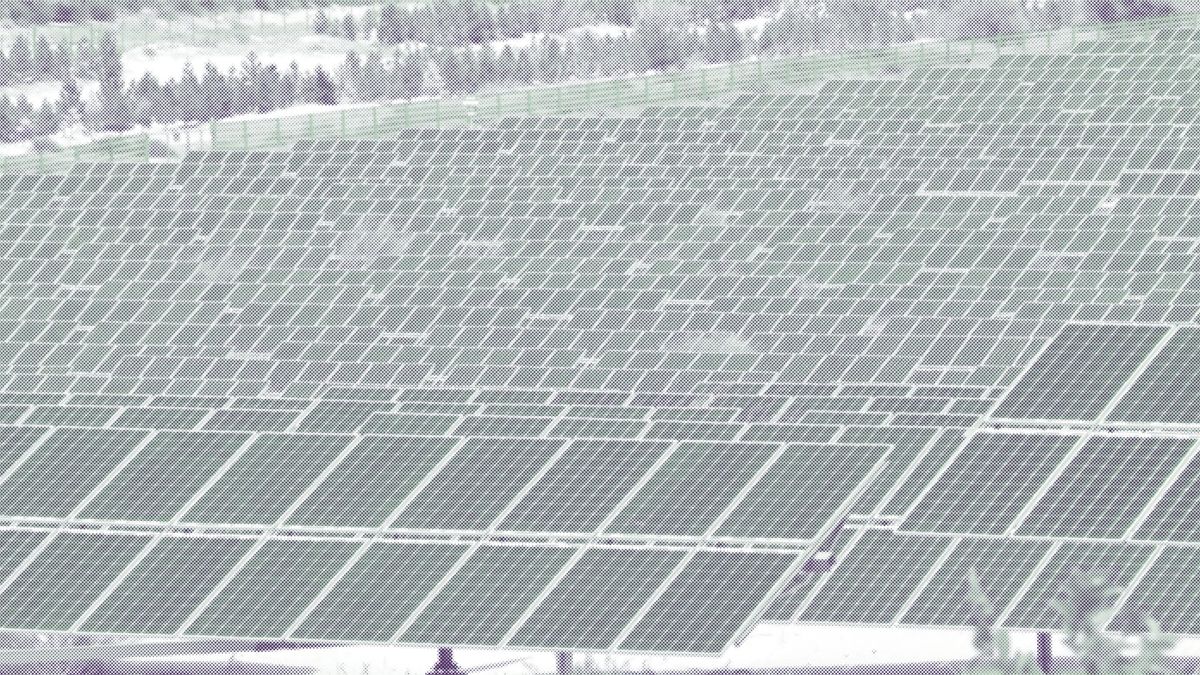
Last summer, I stood surrounded by solar panels stretching in all directions, exultant at being engulfed by the material underpinnings of a better future. Wanting a wider view, I sprinted up a small dune. Sand extended for miles, much of it covered in solar panels punctuated with substations, power lines and maintenance roads. In this arid and windy environment scrub grass struggled to grow, though the plants seemed to appreciate the shade the panels provided. Absorbing the fierce sunlight of Ordos, a city in the resource-rich Chinese autonomous region of Inner Mongolia, the panels converted it into electricity to power not just this community or province, but also distant cities like Beijing.
Nearly two decades ago, Ordos became famous for its ghost city, Kangbashi, a massive new district to the south of the city’s centre. Built as a would-be “Dubai on the Steppe”, it failed to find a human population to fill its vast expanse and the thousands of apartments that had been constructed there. Drone shots of empty streets and ghostly apartment blocks soon proliferated, and Western newspapers were filled with photos of an eerily denuded urban landscape that served as an embodiment of the folly of China’s rapid urbanization. Of the apartments that were bought, many were purchased as investments rather than residences, in a frenzy of speculation without inhabitation. Eventually, property prices collapsed, and over time Kangbashi has become less ghostly. The district now has residents, even if it is not exactly as full as its original developers had hoped. Still, the vastness of Kangbashi has imposed systemic costs on those who live there, trapping them in an unwalkable sprawl locked in place with cement.
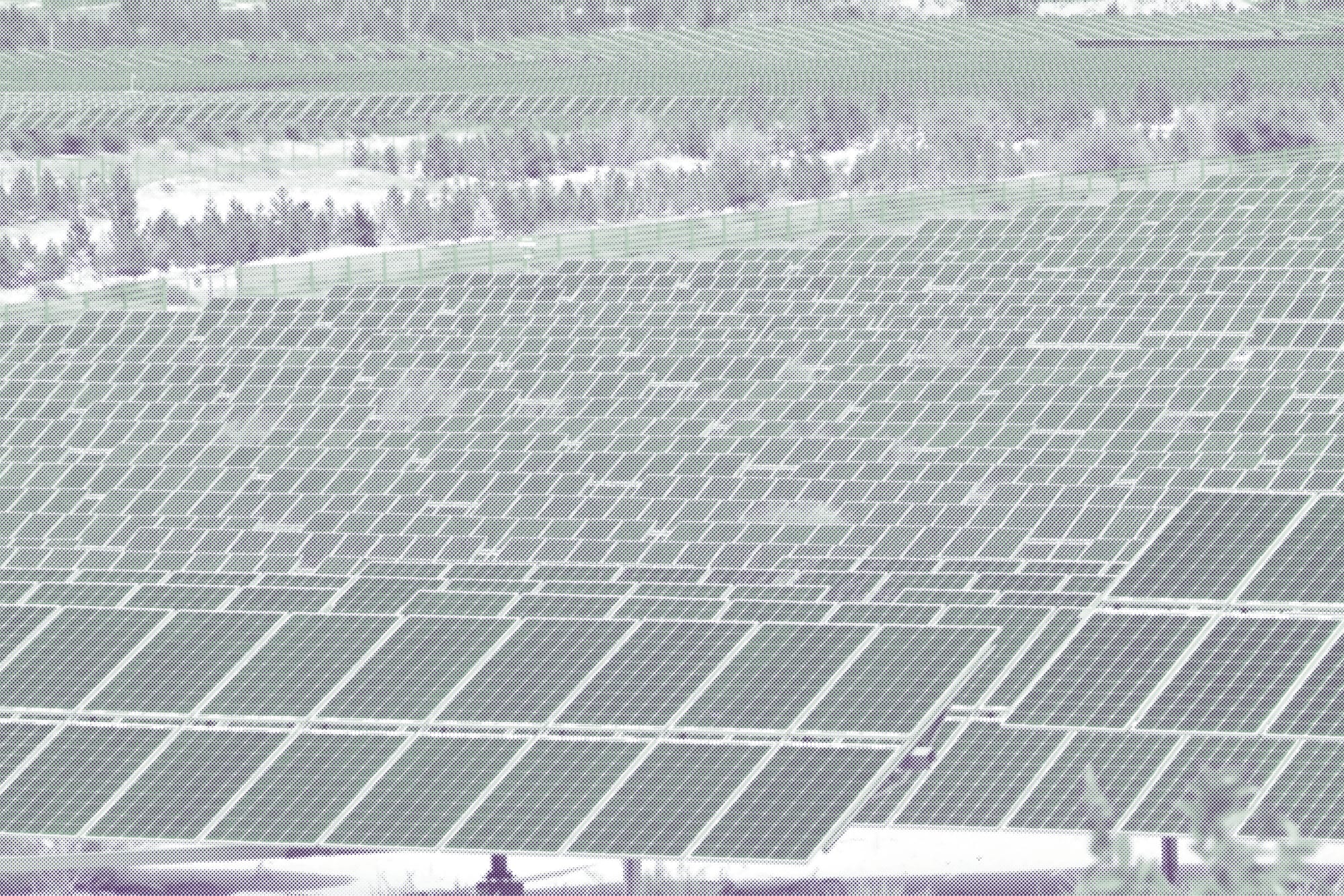
Building is rarely China’s problem. Indeed, with the proliferation of cheap solar, wind and batteries over the past two decades, China’s green tech revolution has arisen largely because of enormous bets placed on building and innovation. But by looking in places like Ordos and the wider province of Inner Mongolia, something far messier starts to emerge. Here, piled on top of one another, are energy systems old and new: solar and wind production facilities and megabases[1] stand alongside new coal plants and vast industrial works that convert coal to chemicals like methanol and plastics—a dirty industrial process meant to replace oil, and which makes already emissions-intensive work even more destructive to our atmosphere.
Ordosmaxxing
In recent years a new meme has emerged in the West: Chinamaxxing, the trend for non-Chinese people to adopt Chinese habits and enthusiastically appreciate the country’s grand strengths. Think of the screen-based ogling of the Chongqing skyline, the country’s giant light-up drone shows or BYD’s sleek new electric vehicles. Zoomed out like this, China becomes “number go up”[2] in country form. It is scale über alles.
The temptation to envy China is an obvious one, particularly for Americans suffering from shortages of housing, clean energy and public infrastructure—components in which China now excels. China is abundance itself, and as such it is looked at longingly by those famed liberal Abundance bros Ezra Klein and Derek Thompson, themselves frustrated by the legal hamstrings that they allege have slowed construction in the United States in recent decades. Nor is Chinamaxxing limited to a commentariat enamoured with building big once more. The recent output of prolific historian Adam Tooze, in numerous posts on his widely read Chartbook Substack, expertly captures much of the action and repercussions of Chinese clean tech building. Likewise Dan Wang, who in his recent bestseller Breakneck: China’s Quest to Engineer the Future, contrasts America’s lawyerly society, stodgy and slow to build, with China’s engineering state, which moves with abandon, breaking things and people along the way. Perhaps nowhere is this kind of breathless enthusiasm more apparent than in the world of climate politics: China, it seems to many, is set firm on a course away from dirty power and into a new one of abundant, clean energy. It is the energy transition made real.
In Ordos, however, we see little evidence of the breaking of King Coal. In fact, Ordos looks less like a transition than an accumulation: the megabases rise, the coal-to-chemicals plants rise faster, and nothing comes down. In this way, the city seems to map onto the analysis of the French energy historian Jean-Baptiste Fressoz: where many see the history of energy as one of transitions, with the world shifting from wood to coal to oil, Fressoz sees each reputed “transition” as dependent on its predecessor energy source for its development.[3] Coal extraction required significant amounts of timber to keep mines from collapsing; train tracks consumed large amounts of wood, as ties required replacement; coal was coked for steel to turn into the drums, tankers and pipelines necessary to move oil across the world. This, he says, is “material symbiosis”, and the result is that cumulatively, our consumption only goes in one direction: up. Subtraction, the removal of the old, simply never occurs. More is, for Fressoz, the law of energy history.
This failure to break away from the old is not an inevitable outcome of physics. Rather, it is written into a place’s institutions, prices and politics. Where those align, the old does indeed come down: Britain shuttered its last coal power plant in 2024 and now burns far less coal than it did three decades ago; California’s natural gas generation this year is down 46 per cent versus two years ago, displaced by solar, wind and storage. Subtraction is not impossible; it is just, often, left undone. And there is no better place to see both the building and the breaking than in Ordos.
King Coal
North of the formerly ghostly Kangbashi—and north of Dongsheng, Ordos’s old centre—is Dalad Banner, the heart of the contradiction. In the Dalad Banner Economic Development Zone (DEDZ) companies take coal from local mines and burn it to generate the electricity needed to smelt alumina and aluminium, while also using low-quality waste coal to produce precursors for calcium carbide and other chemical materials. Other companies, meanwhile, use the fly ash and furnace slag that coal burning produces to feed local cement facilities.
More damaging than any of these processes is the one used by Rongxin Chemical, whose major coal-to-methanol line in Ordos produces 900,000 metric tonnes of methanol every year. The company is currently completing a major US$1.4 billion expansion that will enable it to annually turn 2.1 million tonnes of methanol into 800,000 tonnes of olefins, a chemical used to make plastics.[4] In April this year, the new plant—which is expected to come online by the end of 2026—had 4,000 construction workers on site, and major components passed safety tests in July. Rongxin’s facility, however, is dwarfed by Baofeng’s, in the south-west corner of Ordos, which began operations last year. With a production rate of three million tonnes per year of olefins, Baofeng claims it to be the largest coal-to-olefins plant in the world.
But why here, in Ordos? At first glance it would appear economics has spurred this rush to build. This is an illusion. As Rongxin’s deputy director recently explained, coal costs between 500 and 600 Chinese yuan (RMB) per tonne (US$75–90), while methanol sells at roughly RMB 2,000 per tonne and olefins at RMB 7,000–8,000. These, he said, are “multi-level value leaps” that take coal and transform it into much higher-value products—seemingly an obvious economic win. But one tonne of coal does not become one tonne of olefins: each tonne of coal is converted into less than half a tonne of methanol and only about one-sixth of a tonne of olefins. As the director admitted, methanol accounts for roughly two-thirds of the cost of olefins, which leaves the facility with a fine two per cent margin. Filings show that Rongxin doesn’t expect the plant to fully pay for itself for another ten years.
The economics only work if olefin prices are high. But like many other sectors in China, the refining and chemical industry is saturated with capacity, much of it on the east coast using the more traditional gas and oil as feedstock rather than the coal used in Ordos. These plants are not only cheaper to operate but also far less polluting, with coal gasification generating three to five times as much CO2 per tonne of olefins as traditional plants. Coal-to-chemicals processing of the sort used in Ordos is therefore both an economic and an environmental disaster.
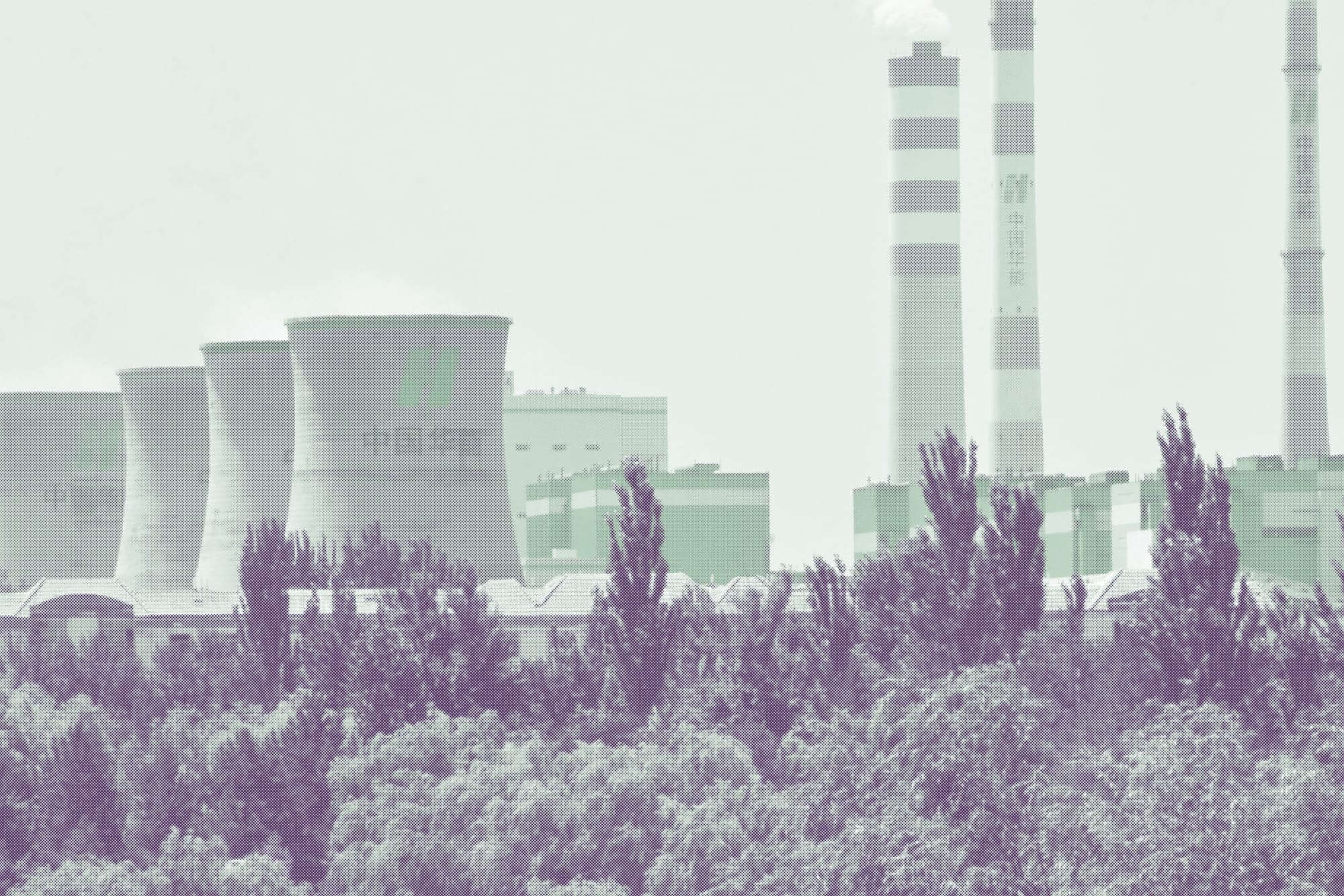
So why build these facilities? One answer is energy security: Ordos’s plants use domestic coal rather than largely imported oil and gas. These facilities also generate significant economic activity, if not profits. Companies like Rongxin directly employ thousands of people in Inner Mongolia. Indirectly, they employ far more still; the province’s mining industry provides jobs for hundreds of thousands of workers and pays taxes that Ordos and the rest of the province rely on.
Ultimately, though, the push for olefin in Ordos comes from a very different need: the need to find a demand sink for coal. If Fressoz’s wood propped up the coal mines physically, the coal-to-chemicals plants are helping to prop up the coal economy financially, as the electricity sector’s appetite for the black rock has plateaued. This plateau in the electricity market is being maintained because of other state policy decisions: coal power collects capacity payments from the grid while enjoying long-term contracts that allow coal plants to run even when there’s ample solar and wind available. As I’ve argued before, in all of this we need to consider returns to capacity[5] and not only returns to capital—significant investments and productive bubbles can reshape economies even if they fail to repay their investors. Coal-to-chemicals exemplifies that logic, pushing for continued coal dependence.
Building and breaking
Just 20 kilometres to the west of the DEDZ industrial landscape is the land on which I stood surrounded by panels, home to some of the largest solar farms in the world. These are only set to expand further into the desert in the next few years. The province’s newly released five-year plan has a target of 325 gigawatts of solar and wind installation by 2030, up from the region’s current 170 gigawatts. Adding those 31 gigawatts every year might seem incredibly rapid from an outside perspective, but the province added over 40 gigawatts of renewable capacity in 2024 and 35 gigawatts last year. In fact, Inner Mongolia’s land space is so vast that the Kubuqi Desert alone could easily absorb a further 200 gigawatts of solar. Even so, there’s been little sign of building work or expansion taking place on these sites over the past 12 months. Rather, solar and wind power are being curtailed, especially at the sunniest and windiest moments, pushed aside by generators and grid operators that favour coal and its long-term contracts.
For many, batteries, which can store capacity when the wind and sun are at their strongest for later when demand is high, are the obvious solution to excess capacity from renewables. But, in Ordos, the batteries are already there, unused, baking in the sun. Inner Mongolia’s fleet of batteries is the largest in China, with a collective storage capacity of 25 gigawatts. While in places like California, these batteries would charge from cheap electricity in the middle of the day, as solar floods the grid, and then discharge power throughout the evening when prices are higher, Inner Mongolia’s market lacks this kind of price differential. So the batteries simply sit, utilized less than three per cent of the time. In China, there is simply no business case for batteries.
If China’s building boom has admirers salivating across the world, what we can see in the deserts of Inner Mongolia is something else, something far more specific and grounded. This is not to Chinamaxx, to build big and build fast, but to Ordosmaxx, to answer all problems by building more capacity even if this new material capacity is misshapen and distorted by a failure to construct institutions that point towards the breaking of the old. It is this that the country has so far struggled with. Create the market and a price gap will emerge which batteries will absorb. But doing so will break things, too—namely, the economics of the coal fleet. Officially, coal is referred to in China as the “ballast stone”: the stabilizing force for energy supply security. The market is missing because in building it, the coal sector would be threatened. It is this that both Ordos and Beijing are reluctant to break.
There are reasons for them to worry. Beijing has done this before, and it knows the consequences. In August 2020, the central government announced a policy that would restrict new loans to housing developers with weak credit, measured as three “red lines”: a liabilities-to-assets ratio of 70 per cent, a 1:1 net-debt-to-equity ratio and cash greater than short-term borrowing. This was a way to manage what was then a US$50 trillion real estate bubble. At the time, the real estate sector made up a quarter of the country’s economy; it was the fiscal base of every city and a store of household wealth. It was, simply, too big to fail, and so everyone kept on buying and building.
If the three red lines were intended to cool down an overheated market, they instead initiated a wholesale market collapse. Real estate prices have since dropped by around 25 per cent, destroying nearly US$20 trillion of paper wealth. And they continue to slide more than half a decade later. Investment in new real estate is still trending downwards—a trend that does come with the added climate benefit that emissions-heavy building materials like steel and cement are falling as well.
Subtraction is always going to be costly, but Beijing fears that any action will result in a cliff edge rather than a gradual process of removal. It is clear already that in electricity markets, where it has had to compete against clean electricity, coal has lost. Coal is dirty and slow to ramp, and it costs money to extract out of the ground, wash and transport. Burning it leaves excesses of ash to dispose of. Solar, wind and storage are clean and quick, easily outperforming coal at the metrics markets care about.

Hence, in July 2021, China’s long-time leader Xi Jinping coined a new slogan to describe how the energy transition should be pursued: “First build the new, then break the old.” Even before the implications of detonating the property sector became clear, a frustrated Xi complained that officials were trying to meet an earlier set of decarbonization targets too aggressively (in campaign style): coal firms were haemorrhaging funds and banks were pulling loans. This was confirmed that fall, when blackouts hit large parts of the country. The question of energy security was back, and Russia’s invasion of Ukraine—followed by the Iran conflict—only further solidified the value of keeping reserves.
Letting go of the old
This spring has ushered in China’s fifteenth assemblage of five-year plans. With the current plan running until 2030, these are not the allocative strategies of China’s Mao era, when the state planning apparatus controlled the economy from Beijing. Instead, China’s contemporary plans provide guidance and direction to the economy and to favoured sectors, such as the “new quality productive forces” like renewable energy, electric vehicles and advanced computing. Energy and climate observers have been disappointed by the plan’s lack of ambition, though their expectations were low; last fall China filed a very tame nationally determined contribution (NDC) as part of its Paris Agreement obligations.
Yet hope glimmers both in the short run and the distant future. In April, Beijing pushed through binding measures to evaluate local officials on climate metrics, three of which are quantities, not ratios like carbon intensity. A cadre in Ordos can no longer Ordosmaxx his way to a promotion by pouring concrete for an unviable chemical plant. The construction might be rewarded, but somewhere in the same file is a line that counts the coal.
There are reasons to doubt the significance of these new evaluation measures. The commission that will grade officials on coal still calls it the ballast stone of energy security. The results are internal rather than public. The measures only call for officials to “reasonably control” coal-fired power rather than set specific retirement schedules. And Inner Mongolia’s own five-year plan promises to raise the share of coal burned as chemical feedstock rather than lower it. The clock, however, is non-negotiable. Xi’s dual carbon targets call for emissions to peak before 2030 and for carbon neutrality by 2060. And while peaking doesn’t require the breaking of the fuel systems that powered China’s past, getting to zero does.
Eight months after introducing the new slogan, Xi spoke to a delegation from Inner Mongolia. “The Green transition is a process, not something achieved overnight. We must build first and break later, and not break before we build,” he told them. “You can’t just throw away the tools you rely on for your current meals before you have the new ones firmly in your hands. That won’t do.”
The physical tools for the transition are in our hands. Twenty-five gigawatts of batteries sit in Inner Mongolia already built, already connected, waiting. By Xi’s own rule, the condition is met: the new tools are firmly in hand. What remains is building the institutions to let them work, which also entails letting go of the old tools. This has yet to happen, but that is what decarbonization requires.
- Massive, centralized industrial clusters designed for large-scale en-ergy production.
- A mantra of the crypto world implying the unending growth of asset prices.
- His full history is laid out in More and More and More: An All-Consuming History of Energy, London 2024.
- Rongxin’s existing methanol line will cover less than half the feedstock, with the rest bought from neighbouring coal-to-methanol plants.
- Describing the returns from additional supply that accrue to broader parts of the population beyond investors.
Jeremy Wallace is the A. Doak Barnett Professor of China Studies at Johns Hopkins School of Advanced International Studies (SAIS). He is the author of Seeking Truth and Hiding Facts: Information, Ideology, and Authoritarianism in China.