


Ana Mendieta's Ecological Politics
The Cuban artist Ana Mendieta’s Silueta Series, including over 200 artworks made between 1973 and 1980, was a trailblazing experiment in postcolonial ecology and feminist performance art. Conducted in sites ranging from Iowa’s muddy fields to the ancient tombs of Oaxaca, her method was both additive and subtractive. Some pieces take the sculptural form of a low relief, moulding nature into a figure that resembles the human. Others were made by removing clods of earth to create shallow depressions, the contours of which were scaled to the artist’s body. The type of material varied, too: the siluetas could be pressed into tidelands or fashioned out of flowers, filled in with gunpowder or traced out of burning candles. By inscribing her outline onto a variety of locations—and in doing so, almost subtracting herself from the works—Mendieta imagined the human as an empty frame through which nature can be known.
Mendieta described her art as “a way of reclaiming my roots and becoming one with nature”,[1] but the images she left seem to be more about absence and disappearance than spiritual reunion. Against any notion of permanence, the lifespan of her works was ultimately decided by changes in the environment, like the fizzling out of the fireworks from which they were constructed, or the turning of the tides that swept them away. As a result of their transience, Mendieta’s siluetas survive only in secondary documents, like the 5mm slides, photographs and Super 8 films that she and others took of them, distancing us from the object of our contemplation and speaking directly to the deathly quality of her work. Some of the pieces in the series look like memorials to the artist in the absence of her remains, others like flaming effigies celebrating her passing. In one, entitled Imágen de Yágul, it is as if she has been reanimated by the earth, returning from the underworld as a flowering phantom. In another, she might have vanished before our eyes in a puff of smoke, leaving behind just the red sediment of her sorcery.
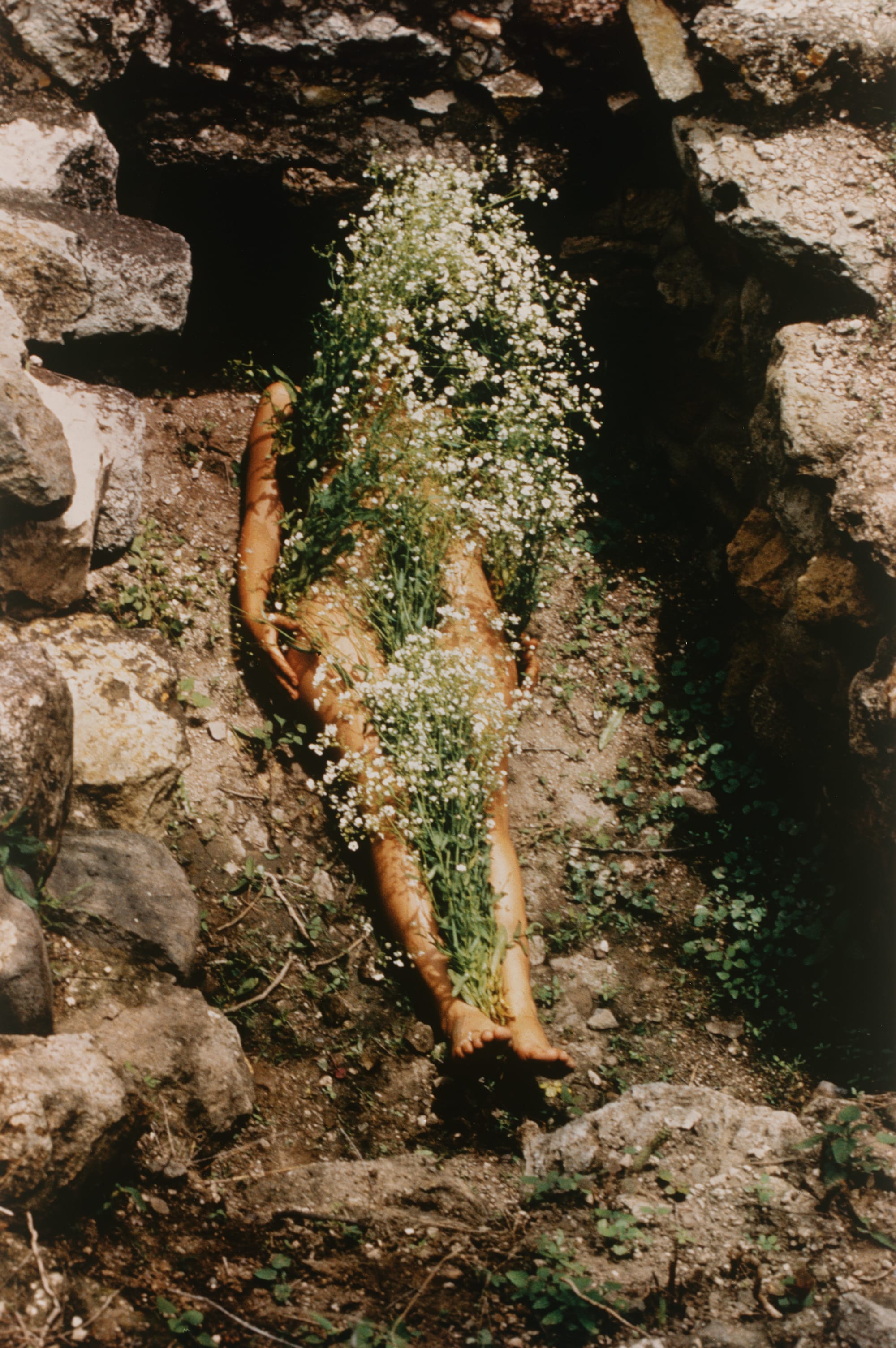
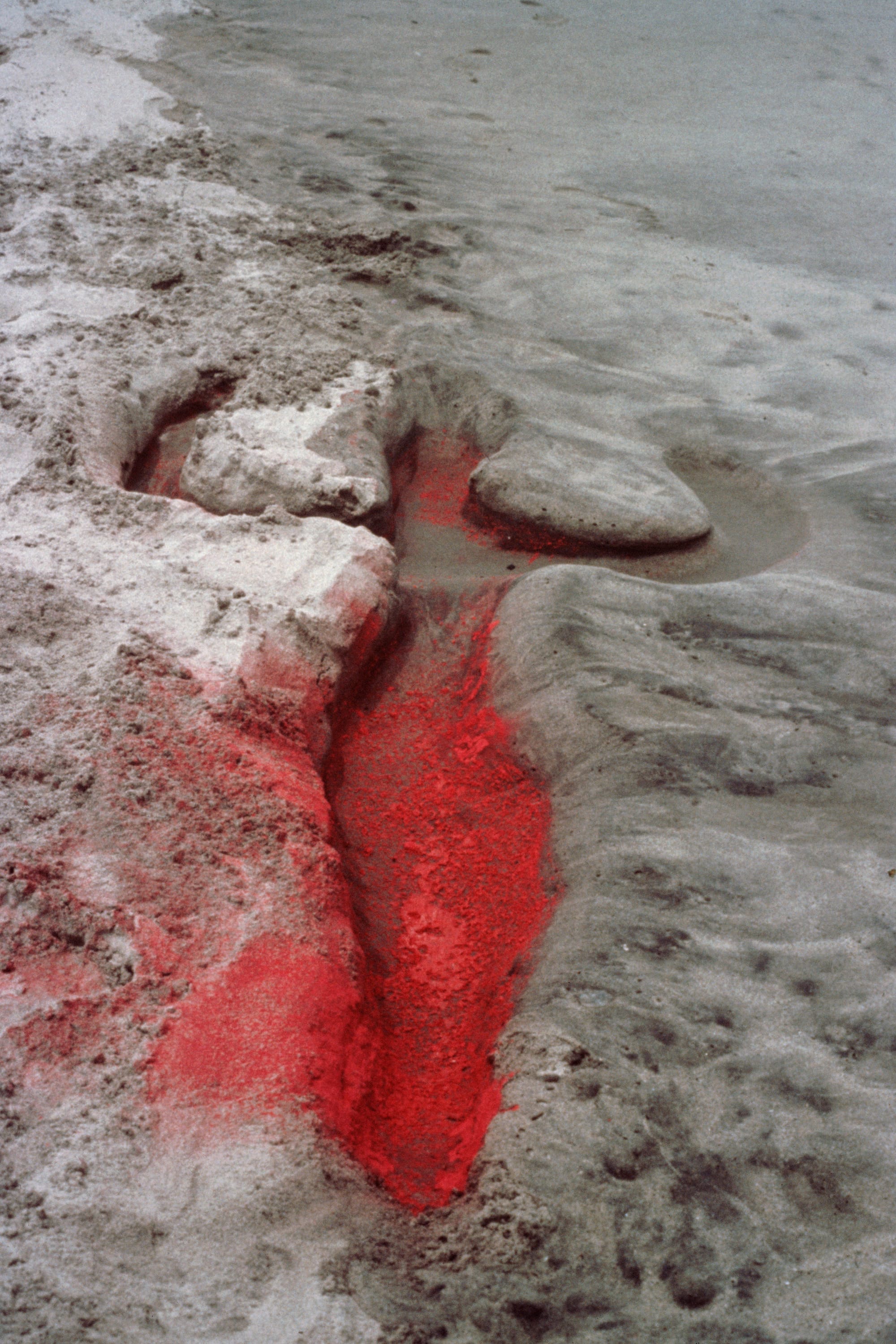
Left: Ana Mendieta, Imágen de Yágul 1973. © The Estate of Ana Mendieta Collection, LLC. Licensed by Artist Rights Society (ARS), New York / DACS, 2026 / Courtesy Marian Goodman Gallery and Alison Jacques, London. Right: Ana Mendieta, Untitled: Silueta Series 1976. © The Estate of Ana Mendieta Collection, LLC. Licensed by Artist Rights Society (ARS),New York / DACS, 2026 / Courtesy Marian Goodman Gallery and Alison Jacques, London
The current retrospective at the Tate Modern in London (the first solo exhibition of Mendieta’s work in the UK for over a decade)[2] does away with the chronological format typical of major retrospectives. Instead, it is organised into thematic clusters that foreground the lines of continuity between the different phases of her career. Gallery goers must shuttle between metaphorical islands bearing names like “the cave”, “the grove” and “the river”. The effect is to highlight Mendieta’s enduring preoccupation with the porous borderlines between art and ecology.