

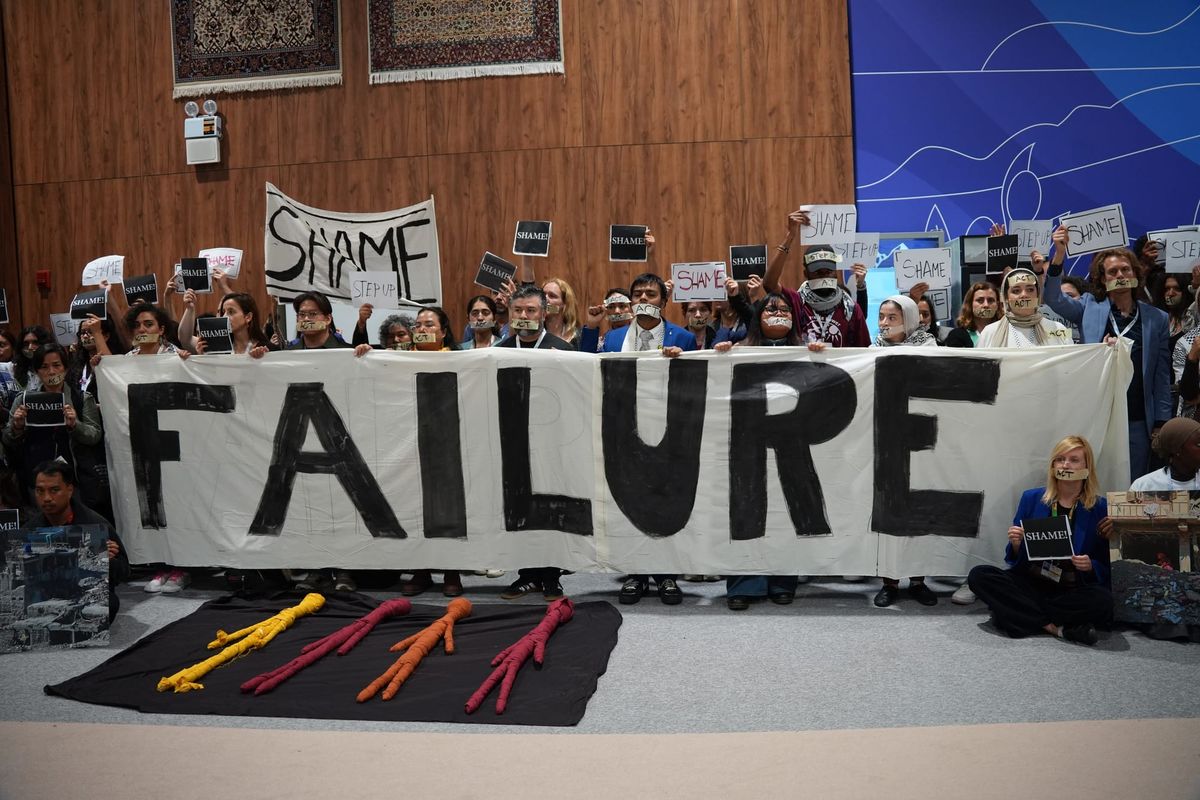

So COP31, the latest United Nations Climate Change Conference, has ended in failure. A group including the EU, the UK, Norway and Canada, along with small island nations including the Marshall Islands and Palau, refused to back a final agreement that contained no mention of fossil fuels. Watching as the news came from Antalya, Turkey, and as fossil fuel behemoths like Saudi Arabia and Russia stymied any hope of reaching a deal, it felt hard to disagree with Panama’s environment minister, Juan Carlos Navarro. The world, he said, is “being held hostage by the petroleum mafia.” And yet, he continued, “we are in love with our kidnappers…We can’t live without them, and they are so smart they have convinced us that they are doing this for our own good.”
By this point, the argument over whether or not a failure on this scale is unprecedented, or whether it’s merely one in a series of temporary mishaps on the long road of climate multilateralism that reaches back to Copenhagen in 2009 and earlier to COP6 in the Hague, feels almost irrelevant.
In the fourth decade of the COP process, while the world hurtles towards a period of climate “overshoot” in which we surpass the 1.5C target set by the Paris Agreement, the question that feels most burning is whether the COP process is (or indeed ever was) fit for purpose.
Many in the climate movement have been asking this same question for years. The fact that nations in the Global South—particularly the small island nations of the Pacific that face no less than existential risk from the climate crisis—are formally on the same footing at the conferences as the big polluters and petrostates undoubtedly gives those states leverage they otherwise would not have. Equally, as War on Want’s Leon Sealey-Huggins told us last week, the fact that there are “so few global governance spaces where civil society has formal representation” means that the annual meeting carries real value.
Then again, both of these can be read in a much harsher light. What’s the point of gathering the whole world together (this year’s COP was the largest ever, with 92,000 attendees) when it can be so easily derailed by fossil fuel interests, from the explicit manoeuvring of petro-states to the invitation of thousands of fossil fuel executives and lobbyists? What’s the point of a conference on climate change that cannot agree to include the obvious culprit, fossil fuels, in a final text that is, after all, effectively unenforceable? There was a grim irony in the fact that the one COP cover decision that did include language about transitioning away from fossil fuels, Dubai’s in 2023, also saw the host nation making oil and gas deals in private side-room meetings.
 Adrienne Buller

The process has also been stalked from its very beginnings by the “Draft Rule 42” problem: its reliance on “consensus”, rather than a majority vote, for decision-making. The system has, in effect, enabled individual nations or small groups of countries to railroad overwhelming majorities on critical points. The consensus arrangement has been in place since the first COP in 1995, where countries failed to agree on this critical rule of procedure regarding voting on substantive decisions. It has never, though, been adequately defined, and has even been interpreted at the discretion of host nations. At COP16 in Cancun, for instance, COP president Patricia Espinosa overruled Bolivia’s objection to the Agreements, declaring that “consensus does not mean unanimity… one delegation does not have the right to veto”.
The arrangement is relatively exceptional in international agreements, demanding that 198 countries manage to agree every word of a final text and effectively creating the conditions for failure. Indeed, we might well be amazed that any COP has ever produced a result.
Yet however cynically we might read the COP process, there is real significance to the actions of many nations in Turkey. Rather than accept whatever watered-down agreement is hashed out in lieu of any real action on phasing out fossil fuels, countries chose to walk away from the table. There is a reminder here that whatever future energy transition occurs will be driven by the political commitment of people across the world. Would this have happened without decades of pressure from the small island nations or many countries in Africa and Asia on the wealthier nations so wedded to their carbon-intensive societies and lucrative exports? And would it have been possible without the tenacious activism of many thousands of ordinary people? It’s unlikely.
Of course, political consensus is fragile. The world will look different if the many far-right parties now challenging governments across the world, all of which are stacked with climate deniers, come to power. Yet, as Adam Tooze perhaps optimistically noted last week, the world does seem to have hit some kind of turning point, with emissions likely to fall by 0.4 per cent in 2026, much of which is being driven by China, as well, of course, as the effects of the energy disruption from the closing of the Strait of Hormuz, the “largest energy supply shock that the world has faced” according to the IEA’s latest World Energy Outlook.
 Kaiser Kuo

The first part of the “double bet” that will be required for any proper transition is electrification of the energy system as a whole. This is the one goal that did find some sort of consensus at COP31, even if in the end it was downgraded to just one of a suite of voluntary options for nations. (Around 90 countries did sign up to the “35 by 35” pledge to have 35 per cent of final energy coming from electricity by 2035.) It is also one of the areas in which China is racing ahead. With China’s gamble on cheap green tech, the future of electrification now seems almost impossible to stop. Even so, on current trends, that will not happen fast enough to meet the urgency of the moment.
The second part of the bet is decarbonization. Governments, left to themselves, and whatever their politics, have shown that on this they will not act with the urgency required. Decades of climate inaction demonstrate this amply, as does the emphasis placed on the evasive miracle of carbon capture and storage in the COP31 draft text.
Take the example of the current British government, among the more left-leaning on the global stage: despite their public rhetoric on the climate, and Andy Burnham’s otherwise decent speech at COP, the government recently approved drilling in the Jackdaw gas field and may well succumb to pressure on the Rosebank oil field too. They also look set to roll back their EV sales target, a policy change that, despite its wonkish air, could have profound impacts on long-term emissions lock-in. These and cases like them will be the real testbed for climate commitments, not airy rhetoric in the global arena.
To make the two parts of this ambitious double bet match up will require political action—that you and I and many millions of others act. Or, as Wim Carton and Joel Wainwright wrote after the Santa Marta conference, convened explicitly to map the pathway off of fossil fuels, earlier this year: “Phasing out fossil fuels means organizing against those who are in control of them, profit from them and continue to peddle them as reasonable long-term investments. In short, it means making enemies and taking sides.”
As Carton and Wainwright note, how the process inaugurated by Santa Marta plays out is still to be decided. The path ahead “might yet take us in bold new directions, or it might lead to familiar false solutions”. Both tendencies were present in the conference itself. Even so, the Santa Marta example does demonstrate that some space remains in the arena of international politics. However contradictory and tentative the conference was, it was an obvious improvement on the expensive and failed COP process. Next July’s 2nd International Conference on the Just Transition Away from Fossil Fuels, held between Tuvalu and Ireland, will prove whether this upstart process will have real teeth, or becomes simply another COP-like disappointment.
Wealthy nations will also have to act. The EU may be basking in the rosy glow of climate leadership now, having walked out on the final day of COP, but their position at the conference was also heavily criticized for their unwillingness to sign off on the tripling of adaptation finance, a measure already agreed at COP30 in Belém last year. As Brandon Wu from Action Aid noted, the “EU came with explicitly no intention of negotiating in good faith on finance, just transition, and adaptation”. By trying to have their cake and eat it too, he said, the EU has been “breathtakingly cynical and hypocritical”.
 Adrienne Buller

What, then, do we do? How do we make enemies and take sides? Whatever form climate politics takes in the years ahead, it must foreground a real and enforceable demand to draw down fossil fuels across the world. This should start, in the UK, with the forthcoming Rosebank decision. Activists can and should put whatever pressure they can on the Labour government to ensure that the dwindling oil in the North Sea remains where it is.
Breaking the grip of fossil fuels on our economies will be challenging, even for the most climate conscious nation; it will not happen without movements that can maintain the pressure needed to see it through to completion. What is needed, as Adam Tooze has said, is a hammer. Until then, no multilateral conference, however good-willed its participants, will be enough. There is, ultimately, no substitute for politics.