
Return to Treasure Island?
Reform UK’s fossil-fuelled nationalism may be a fantasy, but it is exploiting the very real contradictions of Britain’s green energy transition.
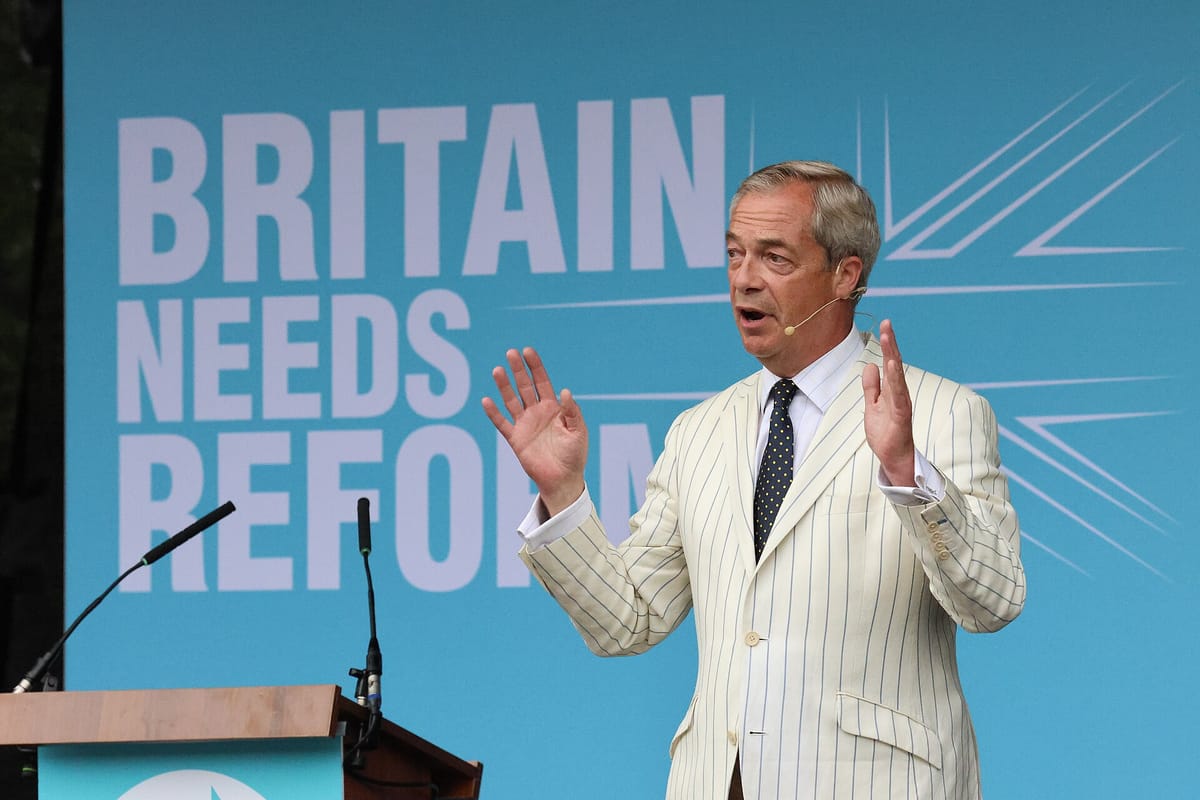
In late February, at a steel processing factory in the West Midlands, Reform UK launched its vision for industry, trade, energy and housing. Richard Tice, its self-styled “Shadow Business, Energy and Trade Secretary”, vowed to “re-industrialize Britain with bold British companies… to remotivate Britain with… the brightest British entrepreneurs, to re-energize Britain with beautiful British oil and gas.” Customarily light on detail, Reform’s industrial strategy included plans for deregulation, the building of affordable homes for “British workers and for our veterans” and a £500 billion sovereign wealth fund to support British companies. Reeling at what he called the “insanity” of climate policy, Tice vowed to scrap what Reform awkwardly dubs “net stupid zero”, declaring it “our patriotic duty to use our energy treasure.”
Of course, this prospect, of a resurgent Britain reinvigorated by onshored manufacturing, untethered by red tape and fuelled by abundant offshore oil and gas and untapped shale, is little more than a fever dream. Nonetheless, Reform’s fossil nationalism appeals to a sense of decline felt by people experiencing cost-of-living crises, job precarity, crumbling public services and social isolation, while harnessing the cultural associations of fossil fuels with the land, hard work and national vigour. For those mourning the relative security of an industrial past, it also hits upon the real contradictions of the UK’s energy transition, one that has failed to deliver the long-awaited green jobs boom and attendant prosperity.
Fossil Nationalism
Reform is just the latest mutation in a series of reactionary projects led by Nigel Farage, all of which have been characterized by a melding of anti-climate and anti-migrant politics. In 2022, for instance, Farage’s “Vote Power, Not Poverty” campaign called for a referendum on the UK’s climate commitments, directly evoking Brexit in its exhortation to “take back control of our energy policies and prices.” Invariably, the prescription was to maximize North Sea oil and gas, reverse the fracking ban and rid the countryside of solar and wind installations, with renewable energy companies and their political representatives inheriting the role once played by EU bureaucrats and cosmopolitan elites in the Brexit campaign: remote, multinational figures trampling Britain’s sovereignty and siphoning off its riches.
Such populism, of course, belies Reform’s entanglement with business interests, particularly in the fossil fuel sector. The party, which until recently was a private company owned by Farage, drew 92 per cent of its donations between 2019 and 2024 from oil and gas companies, other polluting industries and associated lobby groups and think tanks, including organizations like the notorious Global Warming Policy Foundation. Reform is also embedded in networks of climate denial that extend far beyond national borders, increasingly sponsored by MAGA-linked groups intent on fostering far-right insurgents across Europe. Farage himself regularly flaunts his friendship with Trump and has enthusiastically transposed the libidinal politics of disaster nationalism into party policy. Matt Goodwin, the party’s ill-fated candidate in the recent Gorton and Denton by-election, also has links to the Heritage Foundation, architects of Trump’s dystopian Project 2025.
The case against Reform’s fossil-fuelled future is by now well-rehearsed. The North Sea basin is already depleted, with remaining reserves increasingly small and difficult to extract, rendering operations expensive and uncompetitive. Indeed, while advocates regularly claim that oil and gas development will lower energy bills, drilling is only attractive to investors if prices remain high; the industry has in fact long relied on state subsidies and tax breaks for financial viability. Moreover, oil—the bulk of the North Sea’s vestigial reserves—is sold on the volatile international market, any increased extraction having no bearing on domestic bills, while reliance on fossil fuels prolongs exposure to price shocks. During the 2022 energy crisis, induced by Russia’s invasion of Ukraine, the reverberating effects cost households, firms and governments across the EU and UK $1.8 trillion while oil and gas majors made record profits.
Onshore, the prospect of fracking has fired the imaginations of successive fossil nationalists, from the promise of David Cameron’s elusive “shale revolution” to the recent prostrations of Reform’s Lincolnshire mayor Andrea Jenkyns before a US fracking company. Tice’s promise to release £1 trillion of “treasure” from “under our feet” is just as fanciful as Cameron’s was. Previous attempts to extract gas through hydraulic fracturing faltered in the face of concerted local opposition and safety concerns after earthquake tremors were recorded in Lancashire. Even Reform councillors in Lancashire and Scarborough have dissented, and future projects would likely encounter long planning delays and formidable public protest.
Despite the economic and geological reality of the UK’s energy base, Reform—along with much of the Conservative establishment and the right-wing press—has helped bolstered an emerging common sense around energy security in an increasingly uncertain world. As the US-Israeli war of aggression in Iran drove up oil and gas prices, a cavalcade of talking heads and columnists helped to legitimize this position, filling our screens and pages to promote home-grown fossil fuels as the only right-minded solution. Add to this the GMB union, a longstanding proponent of an “all of the above” energy policy to maintain industrial jobs, who have said that the most recent conflict proves domestic oil and gas remain “vital”.
Reform’s promise of reindustrialization is equally hollow. As David Edgerton has argued, narratives of industrial renewal project an image of the UK that is fundamentally at odds with its contemporary position in the world economy. Deindustrialization has been in train for decades, shaped by international competition, massive global labour restructuring and technological change. Compounded by the longstanding aversion of the state to productive investment, the UK is simply not placed to reclaim the industrial might of yesteryear. The recent job losses in steel and chemicals at Port Talbot and Grangemouth, respectively, have their origins in saturated and fiercely competitive global markets, not an overweening decarbonization drive. Even where there remains a manufacturing base, as in arms and aerospace—rare industries that have benefited from consistent state support—the long-term trend is job diminution, while profits accrue to multinational companies and asset managers.
The appeal of fossil fuels defies either straightforwardly conspiratorial or instrumental analyses. We cannot trace their enduring salience to the smoking gun of a well-funded lobby or to a clear-eyed assessment of their existing integration into the economy—although both are factors. We might also emphasise the cultural resources of nationalism that Reform deploys. This applies to the industries and ways of life that formed around the production of coal, oil and gas as well as the substance of the fuels themselves.
The Illusions of Green Industry
In recent years, Reform has shifted from outright climate denialism to an affirmation of fossil industry and the labour involved. In doing so, they have drawn on a long tradition that memorializes the men that powered Britain as “the workshop of the world”—think of Orwell’s ode to coal miners as “iron statues” in The Road to Wigan Pier. Contemporary British political culture has been equally steeped in representations of work, now often entangled with the social ruptures of deindustrialization. The BBC series The Way, from 2024, for instance, portrayed a post-industrial Port Talbot engulfed in civil unrest, while Sherwood, from 2022, considers the long and fraught legacy of the miners’ strike in Nottinghamshire and Beth Steel’s 2024 play Till the Stars Come Down depicts a community in which a coal mine has been replaced by a Sports Direct warehouse. The restorative tonic of “Made in Britain” served up by Farage and Tice understandably resonates with this, not least in regions where relatively well-paid and secure manufacturing jobs have given way to low-paid and precarious services and logistics.
Fossil fuels have proven to be more amenable to nationalist imaginaries than renewable energy sources, easily legible as “our” coal, oil or gas. They also correspond temporally: formed over millennia, this energy can be psychically felt as an ultra-deep material inheritance, binding past and future generations through sovereign claims to the land and all that lies beneath. Historically, fossil fuels have undergirded economic transformations—the energetic foundation of industrial revolutions, imperial adventures and post-war prosperity—a track record that proffers national renewal.
In this, there is a resonance with idealized visions of labour and work, too. Restless, efficient and always on demand, fossil fuels are the energetic analogue to the entrepreneurial spirit. Used as either energy, fuel or feedstock, coal, oil and gas are intertwined with a dizzying range of commodities, and their value and ubiquity mean that hydrocarbons are naturalized and nationalized: treated as the self-evident endowment of territory and collective property, rather than the product of particular social arrangements that generate their power and unevenly distribute their gains. The stock of fossil fuels can be readily figured as the energy wealth of the nation.
In contrast, the flow of renewable energy evades both territorial boundaries and property rights, while the panels and turbines used to harness clean power are seen to disfigure our green and pleasant land, displacing the farmers that provide a national service. In far-right manifestos, wind and solar are seen as invaders: Tice himself has denounced the “renewable robbers” for “taking our jobs” and “taking our money”, as if oil and gas majors, conversely, have UK national interest at heart. Renewable sources are further hindered by their intermittency, an intolerably fickle state of affairs for economies aspiring to be secure, robust or “unleashed”.
There are, of course, exceptions to this pattern. Swept along in the green zeitgeist of the early pandemic, Boris Johnson blustered that offshore wind “puffed the sails of Drake and Raleigh and Nelson, and propelled this country to commercial greatness.” Labour’s support for renewable projects under its “Great British Energy” policies draws on comparable nationalist repertoires. The far right, however, is always willing to go further on this terrain, more persuasively rallying the nation’s symbols—not least race and identity—to fossil capital’s cause and redirecting energy policy towards a fast-approaching horizon of climate cataclysm.
Like far-right parties across Europe and beyond, Reform portrays decarbonization and immigration as twin acts of national self-sabotage. On the day that Tice launched Reform’s industrial strategy, its “Shadow Home Secretary”, Zia Yusuf, breathlessly unveiled plans for an ICE-style deportation agency. Meanwhile, as Reform sheds its most lurid propositions in preparation for government, it is already outflanked to its right by Restore Britain, the brainchild of former Reform MP Rupert Lowe. Cheered on by Elon Musk and the very online far right, Lowe asked on X if any of its policies made the party “nazi monsters”, above a list that includes “the largest deportation programmes ever seen” and an immigration system that boasts “we will discriminate”. Alongside his plans to bring back the death penalty, ban the burqa and the transphobic promise to respect “biological reality”, Lowe aims to “end the war on motorists” and scrap net zero with a “Britain first energy strategy”.
It is Reform, though, who look set to win power at the next general election. To get there, one tactic they have used has been to successfully exploit what are very real contradictions in climate policy. The implicit maxim of net zero is to change everything so that everything can remain the same. This is a dangerous fantasy. While the UK has reduced its emissions significantly in the power sector, it is much more complicated to decarbonize sectors like transport, agriculture and housing, which all imply greater disruption to the circuits of everyday life. Confronting deep-seated notions of freedom, prosperity and normalcy, state interventions here—especially in the form of restrictions or bans—risk further undermining its threadbare legitimacy. This creates fertile ground for the far right to frame decarbonization as an elite conspiracy against the people.
But visions of net zero have often been coupled with the promise of more: more jobs, more industry, more consumption, more growth. As with reindustrialization more broadly, the possibility of a “green industrial revolution” is betrayed by the world market: the UK is simply not a “world leader” in turbines, panels, EVs or batteries, which are all produced elsewhere at unrivalled levels of productivity. Correspondingly, the prospect of a green jobs boom looks dismal. Certainly, there is plenty of work to be done, notably in retrofitting buildings, expanding public transport and nature restoration, but these are not the surplus-producing manufacturing jobs imagined by successive green industrial strategies. Once solar parks or windfarms are established the need for ongoing labour is limited—quite unlike car factories or coal mines that animate memories of industrial pasts. Fossil fuels are also more amenable to monopoly rent, swelling shareholder returns, while low barriers to entry have driven down renewable energy prices and, crucially, profitability. These perverse market incentives undermine investment in renewable energy infrastructure and the economic activity that might accompany it.
If green jobs are oversold, if the distributional impacts fall upon the humble majority, or if the national economy is no less productive but far more burdened by debt, Farage and co. will ruthlessly exploit these shortcomings, channelling grievances toward a state portrayed not only as out of touch and corrupt, but invasive, punitive and authoritarian. If the state continues down the path of market-led decarbonization, the far right will continue to link its limitations to deteriorating conditions on the ground: job losses, mobility disruptions, rising bills, empty high streets. These experiences are undoubtedly distorted through the swirl of online conspiracies and falsehoods, but they reflect the real problem of generalized austerity, to which “net zero” is no answer. As the backlash to low-traffic neighbourhoods have demonstrated, even minimally coercive attempts to secure a “green” agenda will likely generate more of the social antagonisms that fuel reactionary mobilizations.
Reform’s rise is part of a global resurgence of nationalism that espouses nativist border policies and economic protectionism. This is not the preserve of far-right demagogues: while centrist governments may be more enthusiastic about renewable energy, they too have embraced “the return of industrial strategy” while implementing sadistic immigration regimes. In the debris of neoliberalism, states scramble over valuable markets, supply chains and strategic networks amid escalating international competition and full-blown warfare. This trajectory appears singularly at odds with the global cooperation required to avert climate cataclysm.
Furthermore, while there remains some talk of “the race” for green energy—one that China undeniably leads—growth strategies increasingly rely on the ecologically destructive pursuits of AI dominance and militarization. As we have seen, the UK is ill-equipped to compete on this ground. It remains an arms exporter, succoured by the promise to increase spending, but the “defence dividend” of such largesse is overstated. Moreover, British “defence” is itself deeply entwined with and dependent on the US—not least through its nuclear programme—the risks of which have been baldly exposed by the violence and unpredictability of Trump’s second term.
The Terrain of Power
While largely detached from material and geo-economic realities, Reform has staked its claim to the nation in the realm of culture. An alternative political project must intervene convincingly on this terrain. It must also speak to the economic realities of our conjuncture in which growth—and the material benefits it distributes—is increasingly hard to come by. There is no ready-made Green New Deal just waiting for the right political vessel to carry it through. This need not translate into what some have disdained as “a politics of less”, but it would mean reckoning with the UK’s modest place in an altered world.
Such a project might redefine security in terms of social welfare, economic sufficiency and ecological repair, rather than the possession of a fossil energy “treasure”, a handful of post-colonial military bases and an extortionate nuclear deterrent. It might also heed the call to remould the cultural contours of scarcity and abundance. The Green Party shows incipient promise in this regard. Like Reform, it benefits from the affordances of opposition: redrawing the terms of contestation without the constraints of governing. But any regenerative project must also build a credible horizon of what is politically possible and ecologically necessary—a cultural politics that can plausibly be translated into power.
Rebekah Diski researches and writes about climate breakdown, labour and nationalism and is finishing a PhD at the University of Warwick. She is a fellow at the Transition Security Project.
George Edwards is a PhD candidate at the University of Warwick, writing on nationalism and decarbonisation. With the Zetkin Collective, he is the co-author of The Great Driving Right Show (forthcoming 2026) and White Skin, Black Fuel (2021).
