

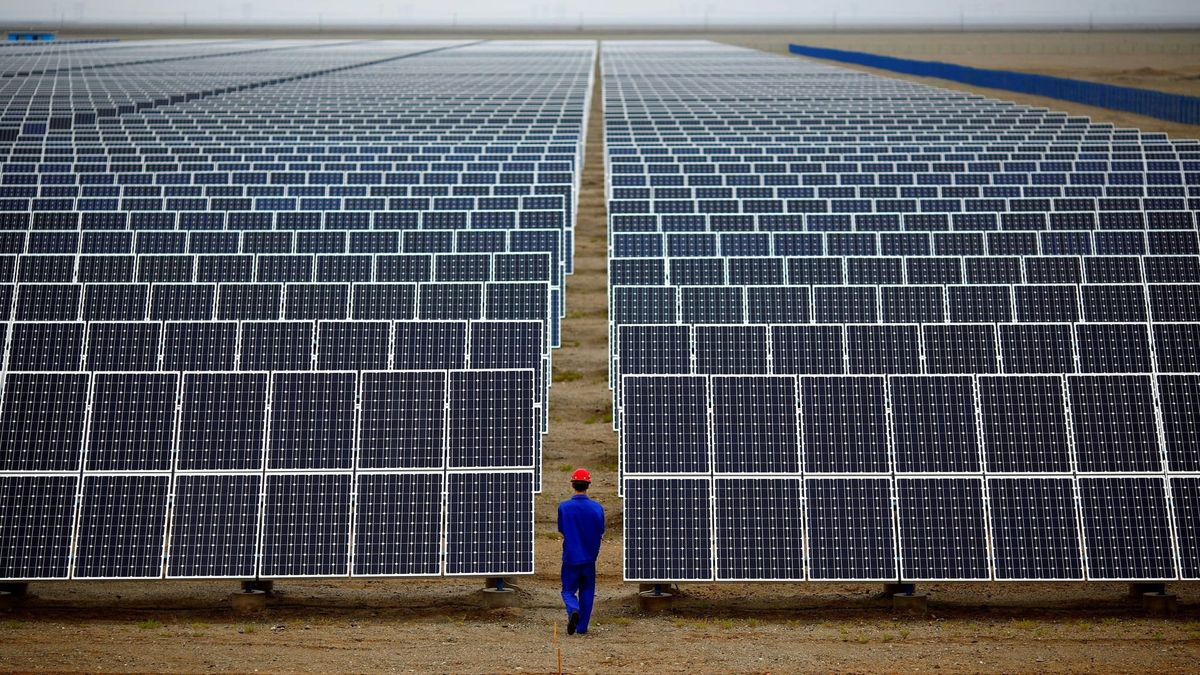
In the transition from fossil capital to electricity capital, the future that emerges will be determined by the fierce struggles of the present.
“The best business in the world is a well-run oil company. The second-best business in the world is a badly run oil company.” - JD Rockefeller
We are in a transition, a revolution and a crisis of energy all at once. It may have taken a pandemic and the energy price shocks of 2021-22 for states to really begin putting their weight behind decarbonization and electrification, but we are now at the start of something that might plausibly be called an “energy transition”. Last year, investment in low-carbon energy was double that of fossil fuels, at around 67 per cent of total energy investment globally. At this rate of development, renewables are—albeit slowly—beginning to displace fossil fuels in electrical power systems, with their capacity doubling every five years.
If this is an energy transition, it is not of the kind the techno-optimists envision—some neat, progressive shift from one fuel source to another. The economic basis of this transition is not simply between technologies of primary energy production. Rather, it is between two different fractions of capital, fractions that have been both allies and competitors for a century or more: fossil capital and electricity capital.
The transition to the dominance of electricity capital has started, but is still transitory, without any guarantee of arrival. There will be no clean break: oil and gas will not be easy to shake off. We are, however, beginning to see a challenge to fossil capital's dominance, and a path toward a world dominated by electricity, itself increasingly derived from low carbon sources. In this confusing time, the best business in the world may be, contra Rockefeller, a well-run oil company and one well-placed to profit from the energy system of the future.
Capital Contestations
Much has been written about “fossil capital”, both as a distinct sector engaged in the production, distribution and combustion of fossil fuels, and as a particular circuit of capital accumulation, of which carbon emissions are a necessary byproduct. Recent scholarship has sought to identify another distinct fraction, “electricity capital”, which describes the companies, circuits and accumulation regimes involved in low carbon energy and electrification.
How we manage, discipline and organise fossil and electricity capital in the next decade will define the rest of the century. Energy transitions of the past were characterised by upheaval—most dramatically, the shift from human and animal power to coal in the first industrial revolution, or the neoliberal turn of the 1980s through which global markets for oil were created and made profitable through waves of privatization. We should expect the transition from fossil fuels to electricity to be no different, producing significant or perhaps even greater change, not least when we consider the additional challenge of adapting to the impacts of climate breakdown at the same time as the energy system is transformed.
What is unlikely to come out of any state and intra-capital contestation over the energy system is a genuinely “green” capitalism (if such a thing is even possible). Far more likely is what I am calling an “electro-capitalism” capable of challenging a system based on fossil fuels. How it does so, when it does, who wins and who loses—these are much more contingent political questions. The energy “transition” is best understood as the fraught period in which these outcomes are realized.
In the early stages of this contestation between fractions of capital, two confusing spectacles are taking place side by side: fossil capital is continuing to accumulate, while at the same time being out-competed by electricity, both as the world’s primary energy source overall, and within the electrical power system itself, where it is being replaced by renewables (plus storage) and nuclear. Since 2020, global fossil fuel investment has remained relatively consistent at just under £1.2 trillion annually; investment in the somewhat broad category of “clean energy” was double that in 2025. Renewables alone attracted $245 billion more investment than oil last year.
Unfortunately, while fossil capitalists may be losing, they are losing too slowly—and, crucially, slowly enough to continue making the returns they and their backers expect while cooking the planet in the process. It is this strange collision of forces that makes it possible (and indeed, likely) that we will in the next five-odd years see the peak of global fossil fuel combustion at the same time that the world remains on a trajectory towards a disastrous 2.5 degrees Celsius of warming, or higher. The key question in the short term, therefore, is how quickly electricity capital comes to dominate.
In the conflict between electricity and fossil capital, three factors define the how transition will play out: the intra-capital electricity versus fossil conflict; the geopolitical tensions between electro- and petro-states (defined below); and the relationship between electricity capital and the leading “Big Tech” firms. The outcome of these conflicts will determine the structure of an emergent electro-capitalism, and most importantly, the extent to which global temperatures continue to rise.